Lathicharged in Lutyens' Delhi: what a student protest says about Modi's education compact
On 20 July 2026 Indian police baton-charged and tear-gassed thousands of students marching on central Delhi for education reform. The clampdown says less about classroom politics than about who gets to define the country's social contract.
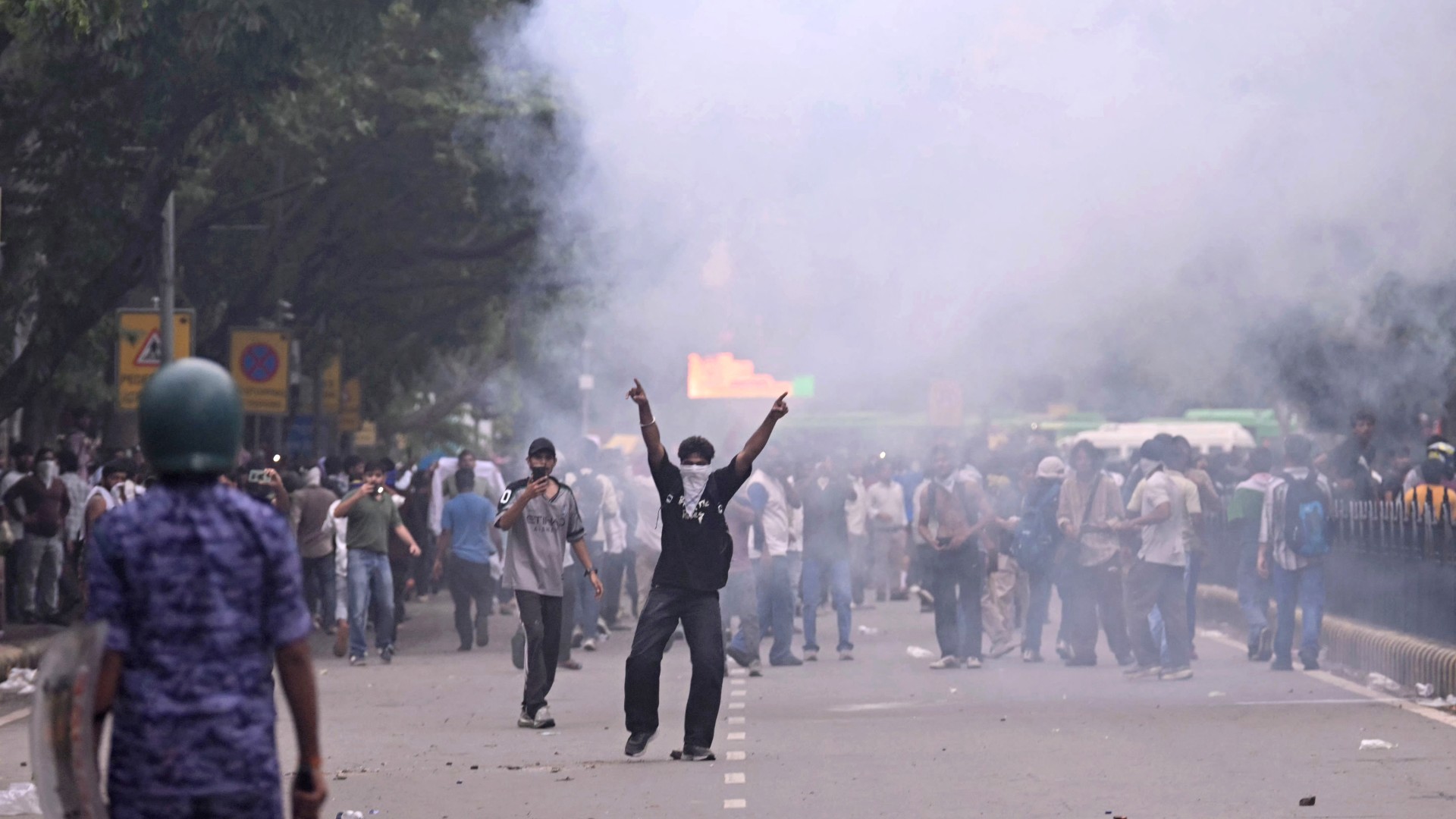
Batons swung, tear gas canisters arced across a baking July afternoon, and several thousand young Indians demanding the resignation of the country's education minister were driven back from central Delhi on 20 July 2026. Reuters footage carried on X shows riot police charging demonstrators near the seat of government; the agency reported baton strikes and tear-gas volleys as crowds pressed toward the ministry's perimeter.
The scene is not, on its face, unusual. India has seen larger street mobilisations in the past decade, from the 2019 Citizenship Amendment Act protests to the farmer blockades of 2020-21. What is telling is the choreography: students marching under the midday sun for an institutional demand, met by a security apparatus calibrated for crowd control rather than dialogue. The choice of weapons tells the political story.
What was actually asked for
The students' grievances, as framed by the Reuters report, centre on the resignation of the education minister and a wider reform package. Indian student politics has cycled through such demands before, most visibly during the 2014-15 standoff over the death of Rohith Vemula at the University of Hyderabad and the JNU sedition controversy of 2016. Those episodes widened the aperture on caste discrimination, academic freedom and the politicisation of university appointments. The current protest sits in that lineage, even if the immediate trigger is more prosaic: funding shortfalls, examination irregularities, and a perception that federal education policy has drifted from student concerns.
What makes the 2026 protest distinctive is its scale. The Reuters account describes "thousands" of young demonstrators on the streets of Lutyens' Delhi in mid-July, an unusual concentration given the academic calendar and the monsoon recess. A protest of this size, on this stretch of road, in this season, suggests a level of organisation beyond a single campus outburst.
The state's repertoire of response
India's law-enforcement apparatus has, over the past decade, refined a particular toolkit for handling large urban demonstrations: barricades on approach roads, pre-emptive detention of named organisers, mobile internet throttling, and a graduated escalation from lathi to tear gas to, in more serious cases, pellet guns and live fire. The 20 July action appears to fall at the lower end of that ladder. Baton strikes and tear gas are the stage at which a state signals displeasure without yet producing the body-bag imagery that tends to break cabinet consensus.
That choice is itself a tell. When governments face protests they judge manageable, they arrest organisers and let cameras roll. When they face protests they believe could metastasise, they clear the streets before the cameras arrive. The visible, televised lathicharge places this demonstration firmly in the first category: a warning shot across the bow of student federations that the patience of the federal executive is finite.
The compact underneath the protest
Strip the politics of the moment away, and what is being contested is a social compact that has held since the 1990s. India's higher-education expansion, the proliferation of private universities, the rise of coaching-industry towns like Kota and Hyderabad, and the federal push for a National Education Policy have together rewritten the bargain between the Indian state and its young. Public investment per student has lagged the explosion in enrolment. Employability at graduation has declined in absolute terms even as graduate numbers have risen. The student protest, read this way, is less a complaint about a minister than a renegotiation of terms.
The structural argument runs as follows: when an economy grows at six to seven per cent for two decades, the demographic dividend becomes a fiscal liability unless education keeps pace with the labour market. India's school-to-work transition is now one of the weakest among major Asian economies on most comparable measures. A protest demanding the resignation of an education minister is, in this reading, a polite formulation of a much larger frustration about whether the country is equipping its youth for the economy it has actually built.
Counterpoint: who is in the streets, and why it matters
The dominant framing in the Western wire coverage, including the Reuters account Monexus reviewed, treats the demonstration as a security event: crowd size, police response, the texture of the clash. That framing is not wrong, but it leaves out the harder question of which students showed up and on whose behalf.
Indian student mobilisations are rarely undifferentiated. Federation politics, caste composition, regional origin and language all matter. A march through central Delhi that draws participants from across states is, by construction, a nationalising event; it forces a federal minister to respond as a representative of the union rather than as a state-level administrator. That is a different political animal from a campus agitation that ends at the vice-chancellor's gate.
The credible alternative reading of the 20 July scenes is that the federal executive sees the protest through exactly that lens and is responding accordingly. Baton and tear gas are the language chosen to prevent the demonstration from acquiring that national valence. Whether the calculus holds depends on footage the cameras have not yet captured, on statements from the named federations, and on whether any student leader emerges as a recognisable national voice.
Stakes and what to watch
The near-term stakes are narrowly institutional: will the education minister survive the week, will a commission be announced, will examination timelines be reset. The wider stakes are demographic. India adds roughly twelve million young people to its working-age population each year; the political system has not yet built an institutional channel for absorbing that cohort's frustrations short of street protest. When the channel is the street, the state's only available response is the one seen on 20 July.
Three dates are worth circling. The Indian parliament's monsoon session runs into early August; any ministerial statement on education reform will land there. The Supreme Court's summer recess ends in mid-August, and several pending matters touching university autonomy and examination regulation are listed for that window. And the academic calendar resumes across most Indian universities in the first week of August, which will determine whether the energy visible on 20 July migrates from central Delhi back onto individual campuses, where it is harder to police and harder to dismiss.
What the sources do not yet settle
The available reporting, drawn from a single Reuters wire item, does not specify which student organisations led the march, which caste or regional constituencies dominated the crowd, or what concrete reform demands accompanied the call for the minister's resignation. Independent confirmation of casualty figures, detention counts and the official police version of the baton and tear-gas deployment was not in the thread Monexus reviewed. A fuller picture will require statements from the All India Students' Association, the student wing of major parties, the National Students' Union of India and parallel bodies, as well as the Delhi Police's own readout. Until those land, the 20 July action is best read as a signal of pressure rather than as a resolved political event.
Desk note: Monexus has framed this as a story about a generational compact under strain, not as a generic "protests erupt" lede. The Reuters wire supplies the date, scale and method of state response; the structural argument draws on India's demographic arithmetic and the documented evolution of student politics since 2014.