Yemen's armed forces claim a missile strike on a Jordanian air base. The framing matters more than the footage.
Two Iran-aligned outlets carried an unverified claim of a direct hit on a Jordanian air base. The story's geopolitics start with who is allowed to say what, and to whom.
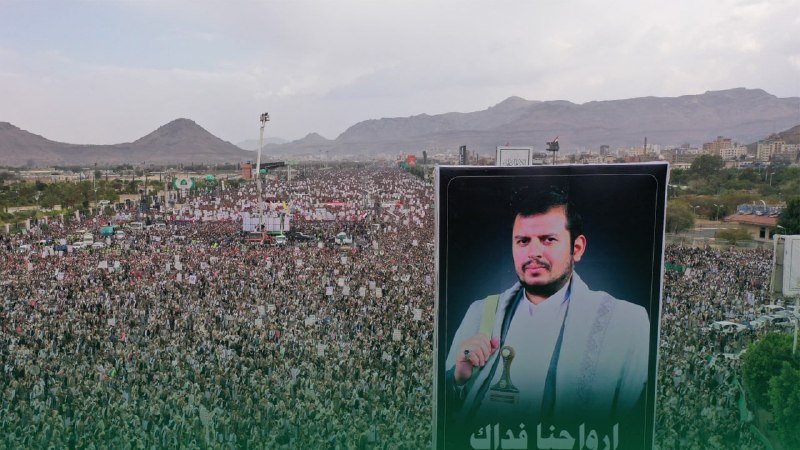
On 20 July 2026, at 06:16 UTC, the Iranian state-aligned Arabic channel al-Alam posted that a missile had struck Mowafq al-Sulti Air Base in the skies over Jordan. Tasnim, Iran's Farsi-language news agency, repeated the claim at 05:33 UTC, four minutes before the al-Alam dispatch went up. The two outlets named the same target. Neither posted evidence. Six hours earlier, al-Alam had already telegraphed a Yemeni armed-forces statement scheduled for 15:00 local time on the same day, promising "the announcement of the important position of this country."
The news, in other words, is not the strike itself. It is who is allowed to claim a strike, in what language, and to which audience, before any other party has spoken. The Yemeni armed forces have not yet issued the statement al-Alam said was coming. Jordanian authorities have not, as of the time of writing, confirmed or denied an attack. Western wire services have not picked the claim up. The event lives entirely inside an Iran-aligned information channel, awaiting either corroboration or quiet burial.
What the sources actually say
The most that can be said with confidence is that two outlets with documented editorial alignment to the Iranian state carried an identical claim within hours of each other. Al-Alam framed it as a "precise strike in the sky of Jordan" and named the base: Mowafq al-Sulti, a Royal Jordanian Air Force installation. Tasnim used the same wording, the same target, the same flourish. That is the entire factual record. There is no footage of impact, no satellite imagery, no Jordanian military spokesperson, and no independent verification from any non-aligned outlet.
The earlier al-Alam bulletin flagged a separate Yemeni armed-forces statement scheduled for 15:00 local time later on 20 July. If that statement materialises and confirms a strike originating from Yemen, the picture changes. If it does not, or if it speaks to a different operational matter, the Jordan claim sits orphaned, a press release in search of a warhead.
Why the framing is the story
Reporting on Middle Eastern militaries routinely treats official communiqués as fact until disproved, then treats the absence of a denial as confirmation, then treats the original communiqué as prophecy. That sequence is how unattributed claims harden into received history inside Western wire copy within 24 to 48 hours. The same outlets that would headline a Yemeni Houthi claim about a strike on Saudi soil within minutes will, in the same afternoon, treat the identical claim about a Jordanian target as unverified until Riyadh comments. The two postures do not coexist logically. They coexist editorially.
The geographic jump matters. Yemen-to-Jordan is roughly 1,500 kilometres of airspace, which includes Saudi Arabia, Iraqi airspace restrictions, and Israeli flight information regions. A ballistic missile traced on that arc would have generated radar tracks and civil-aviation warnings from at least three sovereign authorities before it landed. The silence from those authorities, not the loudness of the claim, is the news. Until one of them speaks, the al-Alam and Tasnim lines are press releases, not reports.
Counterpoint: the operational logic
There is a credible read in which the claim is real and the silence is the surprise. Mowafq al-Sulti hosts fighter aircraft that have, in past reporting cycles, been linked to coalition operations and to US Central Command posture. A Yemeni strike on a Jordanian base would dramatically widen the theatre of any ongoing campaign and would constitute a direct escalation against a US-allied Arab state. Jordan's communications apparatus, like Israel's during the first hours of certain past strikes, sometimes holds the line until flight paths are confirmed safe, debris is located, or until political coordination with Washington is complete. Hours of silence after a kinetic event are not, by themselves, proof the event did not occur.
That read does not require us to accept the claim. It requires us not to dismiss it on source-credibility grounds alone. Iranian-aligned media have, in previous cycles, issued strike claims that later checked out within hours, and they have also issued claims that evaporated. The base rate is mixed. The honest position is that the claim is unverified, the silence is also unverified, and the resolution depends on who speaks first and with what evidence.
What to watch on 20 July
Three data points will resolve this story before the day is out. First, the Yemeni armed-forces statement al-Alam flagged for 15:00 local time: does it name a Jordanian target, a Saudi target, a maritime target, or none at all. Second, the Royal Jordanian Armed Forces: any operational notice, even a procedural one, that addresses activity over or near al-Sulti. Third, the US Central Command posture bulletin: CENTCOM publishes situation updates on a near-daily cadence, and a kinetic event on a host-nation base is exactly the kind of incident that surfaces there if it happened. Absence across all three by end of UTC day on 20 July would not prove nothing occurred. It would, however, place the burden of proof squarely back on the original outlets, which is where the burden of proof already belongs.
The structural point, beyond today's claim, is that regional militaries aligned to Iran now operate a tiered information architecture: a Farsi-language primary claim for domestic Iranian audiences, an Arabic-language amplification layer for regional and Iraqi audiences, and a Western wire layer that is forced either to repeat the claim or to explain its absence. The audience that has no native-language outlet in this architecture is the Arabic-speaking Jordanian public, which receives news about its own air base in Persian and via Tehran. That asymmetry is itself the most consequential thing the day's dispatches tell us, whether the underlying event turns out to be real or not.
Monexus's framing, by design, weights the two Iran-aligned claims as claims, not as facts, and refuses to extend the evidentiary chain beyond what the source record supports. The Western wire silence is reported as silence, not as confirmation. Readers can revisit the al-Alam channel and the Tasnim channel directly via the sources below to track whether the promised 15:00 Yemeni statement materialises.
Wire provenance
This editorial synthesis draws on the following public wire/social posts:
- https://t.me/s/alalamfa
- https://t.me/s/tasnimplus
- https://t.me/s/alalamfa