A trophy, a handshake, and a photo-bomb: how the 2026 World Cup final became a globalised stage
Spain beat Argentina 1-0 in the 2026 final. Donald Trump inserted himself into the trophy photo, FIFA's Gianni Infantino tried to move him out, and the world's most-watched sporting event kept absorbing politics it was never designed to carry.
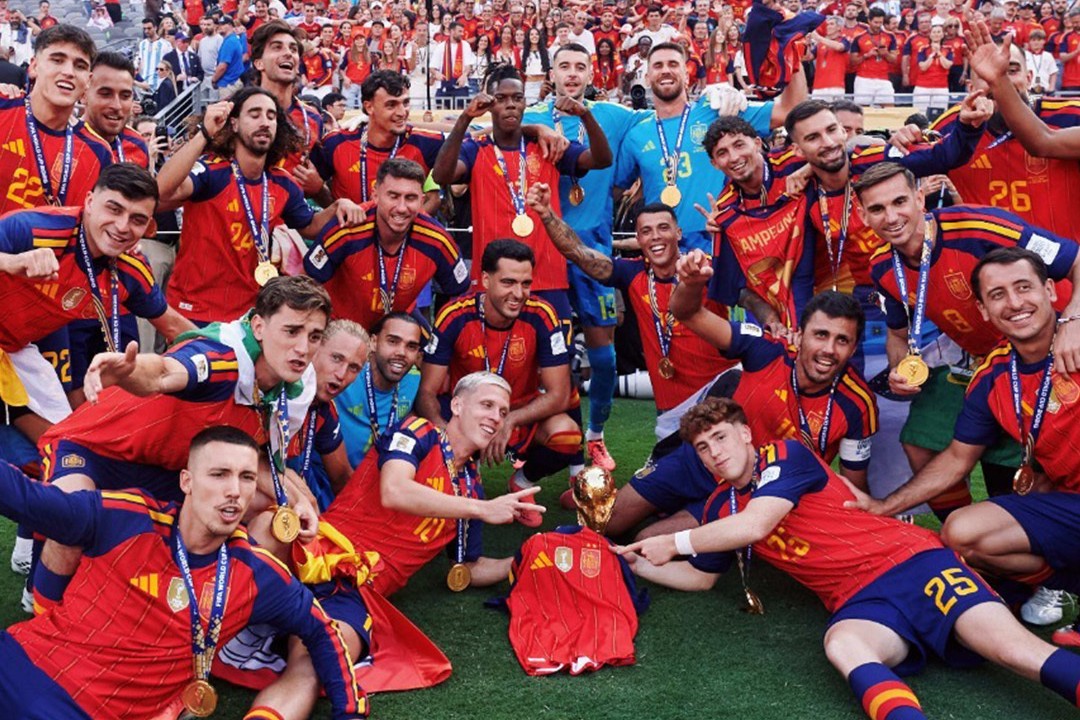
The final whistle in the 2026 World Cup came at 22:10 UTC on 19 July, and the scoreline was the smallest thing about the night. Spain beat Argentina 1-0 at MetLife Stadium in New Jersey to lift the trophy. Within minutes, the broadcast cut to a podium that already had one too many people on it: Donald Trump, the sitting US president, standing shoulder-to-shoulder with the Spanish squad while FIFA president Gianni Infantino, visibly working the flank, tried to ease him out of the frame.
That image, the trophy raised by a Spanish captain with the leader of the host nation grinning behind his shoulder, is the artefact this World Cup will be remembered by more than the goal that decided it. It tells a story the tournament's organisers spent four years trying to write around: that a sporting event this size, staged in a country whose politics are this contested, can no longer be ring-fenced from the politics of its principal spectator.
A final that produced one goal and one fight
Spain's winning goal arrived early and held. Polymarket's market for the match resolved to Spain at 22:10 UTC on 19 July, and the Unusual Whales account pushed confirmation across X shortly after. By morning UTC on 20 July the result had been re-reported across the wire as Spain 1-0 Argentina, with Spain's third World Cup title confirmed.
The Argentine response played out on the streets of Buenos Aires. Reuters reported fans clashed with police after full time, with road closures across central districts and tear gas deployed by federal forces. The losses were minor compared to the disorder that followed the 2014 and 2018 exits, but the script was the same: a generation of supporters raised on the Messi era had watched the team run out of road at the highest stage, and they took the grief public.
What was different in 2026 was the second ring of theatre around the result: the photo-bomb. A clip circulated on Sprinter Press shows Trump standing at the front of the Spain squad as the trophy was lifted, with Infantino, the FIFA chief executive, physically angling to pull him out of the central frame. The Spanish players, captain included, appear to accept the presence with the polite bewilderment that has become the default diplomatic register for visiting teams in US-hosted events. Trump's own account of the night, posted via Telegram channel Clash Report, was generous to both sides: "I wasn't sad because Argentina lost. They both played well. It looked like Spain dominated, but it was a very close match." That softer line landed hours after the podium moment had already been frozen, captioned, and memed across every platform that carries American sports content.
The game inside the game
The mechanics of how Trump ended up on the podium are worth slowing down on, because they are the actual news. Infantino had spent the tournament positioning FIFA as a neutral broker of a globally shared event, careful to keep the host-nation head of state at arm's length during the group stages and only cautiously visible during the semi-finals. The trophy ceremony is supposed to be the moment the organising body reasserts control: confetti, branded backdrop, the FIFA president in the centre, the winning captain raising the cup.
Instead, the US president occupied the centre before the Spanish squad had finished climbing the steps. Infantino's body language in the Sprinter Press clip is the body language of a man trying to retrofit a plan that did not survive first contact. He pulls at one arm, exchanges a few words, half-steps in front of the trophy at one point. None of it works.
The pattern is familiar from Trump's other appearances on international stages: a G7 family photo where he is moved forward, a NATO summit handshake that lingers a beat too long, a White House visit where the receiving leader visibly recalibrates. The novelty here is the venue. A World Cup trophy lift is a piece of inventory that the global football audience treats as sacred ground; the FIFA brand has spent two decades convincing broadcasters and federations that it is the custodian of that ground. A head of state, particularly a head of state whose domestic approval sits where Trump's does, taking the central frame is not just a gaffe. It is a small seizure of brand equity that FIFA cannot easily reverse.
A host nation that cannot stop being a host
The 2026 tournament was the first tri-nation World Cup, jointly awarded to the United States, Mexico and Canada, and the first in an expanded 48-team format. Mexico and Canada both played their full complement of group matches at home; the United States carried the bulk of the knockout rounds and both semi-finals, with MetLife booked for the final.
That geography mattered. The final fell inside the domestic political calendar of a country preparing for midterm elections, with immigration, trade, and the federal posture toward Latin America all live issues. Argentina's run to the final, and Mexico's deeper-than-expected group-stage exit, were never going to be received as pure sport. The Spanish victory, on the other hand, played into a softer diplomatic register. Spain under Pedro Sánchez has spent the last two years positioning itself as a stabilising European voice on Latin American trade and on Ukraine, and the trophy lift handed Madrid an evening of uncontested soft-power airtime.
Trump's presence in the central frame complicated that gift. For Spanish viewers the picture is graceless: their captain celebrating the country's third World Cup, with a foreign head of state glued to his shoulder. For Argentine viewers it adds injury to the loss: the team they support being upstaged in defeat, again, by the politics of the country they have to win in. For American viewers it is yet another data point in the rolling referendum on how the president performs in front of global audiences.
A tournament that absorbed the world and the world absorbed it back
There is a longer story about the 2026 World Cup that the final does not by itself contain. The tournament was, on the organising body's own marketing, the most-watched sporting event in history: more matches, more host cities, more broadcast windows, more betting turnover. Polymarket and a handful of other prediction markets ran liquidity through the roof on individual fixtures, including the final. The expectation, baked into FIFA's commercial model since 2018, was that scale would produce political de-risking: the bigger the event, the more its hosts could plausibly claim neutrality.
What 2026 actually demonstrated is the opposite. Scale did not de-risk the politics; it amplified them. A 1-0 final in New Jersey produced a podium image that was, within an hour, the lead photograph on news front pages across four continents. The Argentine street response produced rolling video for Buenos Aires correspondents in three languages. The Sprinter Press video of the photo-bomb cycled through X, Telegram and WhatsApp groups faster than FIFA's communications team could draft a holding line. Each of those pipelines has its own incentive structure, none of them aligned with the organising body's preferred narrative.
The deeper structural fact is that a tournament this size cannot be cordoned off from the country hosting it. FIFA's commercial logic assumes that it can: that the event is a portable product, separable from whatever politics its hosts are running at home. The 2026 final suggests the assumption is breaking down. The United States in 2026 is a country in which nearly every large public gathering is also a political statement, and the World Cup, for all its global brand, is a public gathering. Infantino's efforts to manage Trump, visible in real time on the podium, were the organising body's first line of defence. They were not enough.
What the next cycle inherits
The next men's World Cup is in 2030, awarded jointly to Spain, Portugal and Morocco, with three opening matches in Argentina, Paraguay and Uruguay to mark the centenary of the first World Cup. The diplomatic choreography for that tournament is already being written: Morocco as the first African host, Spain and Portugal as the European spine, the South American opening trio as a bridge to the global-south framing FIFA has spent the last decade trying to develop.
That script will now be written in the shadow of the 2026 podium photo. The lesson from New Jersey is not that hosting a World Cup inside a politically maximalist country is impossible. The 1994 final in Pasadena worked, more or less. The lesson is that the moment of the trophy lift is no longer a moment the organising body controls end to end. Once the confetti drops, the cameras belong to whoever is on the steps, and the host-nation head of state, if present, is by default the most photographed person in the frame.
Infantino will have to decide, before 2030, whether to write the host head of state into the ceremony script or accept the recurring optics of trying to move them out of it. The 2026 attempt at the latter was visible, polite, and unsuccessful. It will be replayed, in briefings and in boardrooms, until the format itself changes.
The Spanish squad will leave New Jersey with the trophy. The Argentine squad will leave with the same emptiness that follows a final loss, this time in front of a global audience that was watching for the football and got the politics instead. And Trump will leave with the photograph he came for, which is, on the balance of available evidence, the only outcome he was interested in from the night.
This publication framed the 2026 final around the politics of the trophy ceremony rather than the goal, on the view that the photo-bomb is the artefact readers will still be looking at in 2030. The match result is one sentence; the podium is the rest of the article.
Wire provenance
This editorial synthesis draws on the following public wire/social posts:
- https://x.com/reuters/status/2079123241499754496
- https://x.com/sprinterpress/status/2079132671884595200
- https://t.me/ClashReport
- https://x.com/unusual_whales/status/
- https://x.com/polymarket/status/