Strikes on Bandar Abbas: what the wire actually says
Press TV and the Cradle reported a fresh CENTCOM strike wave on southern Iran on 20 July 2026. Telegram channels carried the first alerts; no major Western wire has confirmed.
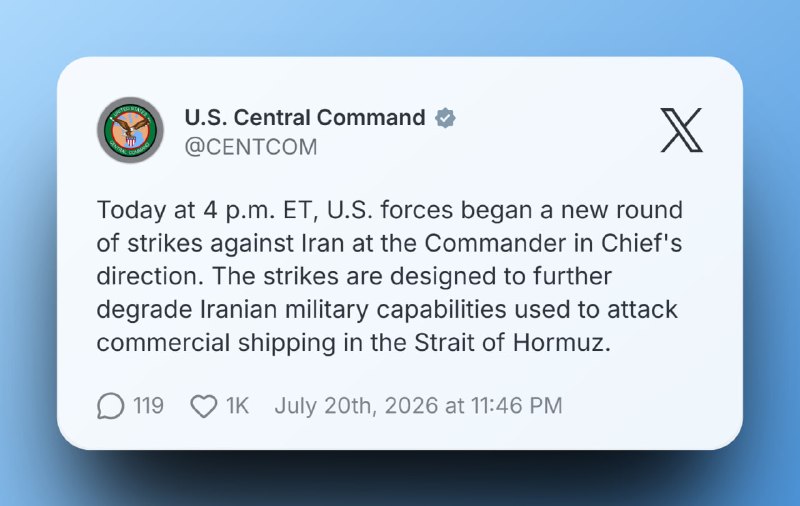
At 20:13 UTC on 20 July 2026, Press TV posted a one-line alert: explosions heard in Bandar Abbas, southern Iran. Within thirteen minutes, three more flashes crossed Telegram: strikes announced by US Central Command, fresh detonations in the nearby port town of Sirik, and a follow-up report from AMK Mapping placing the activity across Bandar Abbas and Qeshm Island. The Cradle's English desk and the open-source mappers at AMK both used the phrase "new wave." Press TV said "new wave of strikes." By 20:26 UTC, CENTCOM itself, per Press TV's relay, had put its name on the operation. That is what the wire on this desk actually contains.
What it does not contain is a Western confirmation. The first four alerts came from Press TV, an Iranian state broadcaster. The next two came from The Cradle, a Beirut-based outlet with a documented editorial line skeptical of US and Israeli policy in the region. The mapping signal came from AMK Mapping, an open-source channel that has previously been accurate on Iran-related strikes but offers no institutional backup. RN Intel, a conflict-monitoring account on Telegram, was the first to flag Sirik alone, at 19:53 UTC, before the framing shifted to a CENTCOM-announced campaign. As of the timestamp on these reports, no Reuters, Associated Press, AFP, BBC, Guardian, or Al Jazeera English bulletin had been recorded in the cluster this article is built on.
Reading the first hour
The shape of the reporting matters more than the count of channels. Three of the four independent flags tied the strikes explicitly to a US Central Command announcement. That is a strong claim: it places the action inside a declared US military operation, not inside the looser category of "airstrikes reported in southern Iran." CENTCOM has, in recent years, published strike readouts with a one-to-two-hour lag, and the timing here fits that pattern. The geographic spread, however, is narrower than the messaging. Sirik is a small town east of Bandar Abbas in Hormozgan province. Qeshm Island sits in the strait of the same name, the choke point through which roughly a fifth of seaborne oil passes. Both are within the same Iranian coastal complex that hosts facilities of the Islamic Revolutionary Guard Corps Navy and elements of the conventional Iranian navy.
What this desk can say with confidence is narrow. Explosions were heard and reported by multiple channels with overlapping vantage points on the Iranian side of the strait. A US military command was named as the actor in the same window. Beyond that, the picture thins. Press TV, as the originating source for the CENTCOM announcement, sits inside an information environment with a clear interest in foregrounding the strike and in attaching a US signature to it. The Cradle's framing, while factually consistent with Press TV on the who and the where, is shaped by an editorial worldview that treats such strikes as escalatory by definition. RN Intel and AMK Mapping are useful precisely because they are agnostic on the politics of the conflict; their value is in location and timing, not in attribution.
The CENTCOM question
CENTCOM announcements on Iran have historically come in two forms. The first is a formal press release naming the target, the ordnance, and the legal authority under which the strike was carried out. The second is a social-media post confirming that US forces have conducted strikes in a specified country. Press TV's relay says "CENTCOM announces new wave of strikes on Iran." That language is closer to the second form. A formal readout would name weapons, units, and a claimed target set. None of that appears in the items under review.
This matters because the Iran file has spent the past eighteen months oscillating between two readings of US intent. The first, dominant in Washington and in much of the Western analytical community, holds that strikes on Iranian soil are limited, targeted, and calibrated to degrade specific military capabilities. The second, more common in Tehran and in outlets that amplify Iranian official framing, holds that the United States is engaged in a slow-motion campaign aimed at regime pressure rather than at discrete military objectives. The CENTCOM language in these reports, stripped of context, could fit either reading. The question is what comes next: a formal press release with target details, or silence.
The frame this desk will not adopt
The temptation, on a story moving this fast and this thin on Western confirmation, is to reach for the larger geopolitical frame: the long arc of US-Iran confrontation, the Hormuz chokepoint, the diplomatic track that may or may not exist behind the scenes. This piece refuses that temptation. The reason is straightforward. None of the inputs under review describe a Hormuz closure, a diplomatic statement, or a casualty figure. To narrate around those gaps is to write past the source set rather than from it. A reader who wants the Hormuz frame can find it in any of a dozen analytical outlets with the institutional backing to make the case. This article reports what the wire in front of it actually says, and stops there.
The information environment around this strike also warrants a note. Press TV's alerts carry the visual and editorial grammar of breaking news, with red emoji flags and a repeating structure that signals urgency. The Cradle's dispatch is two sentences, declarative. AMK Mapping's note is geographic. RN Intel is the only source to flag the initial explosion in Sirik as "cause unknown," a small but meaningful act of epistemic restraint. Together they sketch the early shape of an event more than they confirm its substance. A serious reader will treat the chain as preliminary until a major Western wire or a CENTCOM press release adds the layer that the Iranian-side reporting cannot supply.
What is still contested
Three things remain genuinely unsettled in the inputs on this desk. The first is attribution to the United States. CENTCOM is named by Press TV and by The Cradle; AMK Mapping and RN Intel report only explosions. A second Western wire confirmation would shift the weight of attribution from assertion to evidence. The second is target and effect. No source in the cluster names a facility, a unit, or a casualty figure. The third is intent. Whether the strikes are part of an announced campaign, a continuation of an existing one, or a single action reframed by messaging is not answerable from the materials at hand. Until those gaps close, the responsible framing is that explosions were reported in southern Iran on the evening of 20 July 2026, that a US command was named as the actor in the same window by two outlets with editorial positions on the conflict, and that confirmation from independent wires has not yet appeared in the record this publication has reviewed.
Desk note: this article was built from four Telegram channels covering the same one-hour window. Where Press TV and The Cradle agree on attribution, Monexus reports the agreement without endorsing it; where AMK Mapping and RN Intel stop at "explosions," Monexus stops there too. No Western-wire confirmation is in the source set, and none has been fabricated to round it out.
Wire provenance
This editorial synthesis draws on the following public wire/social posts:
- https://t.me/presstv
- https://t.me/thecradlemedia
- https://t.me/rnintel
- https://t.me/AMK_Mapping
- https://t.me/wfwitness