Spain's World Cup win draws a political greeting in Gaza the squad never asked for
A Gaza-based broadcast framed Spain's 2026 World Cup triumph as a moral victory against Israel. Madrid has not echoed the message, and the squad never asked for it.
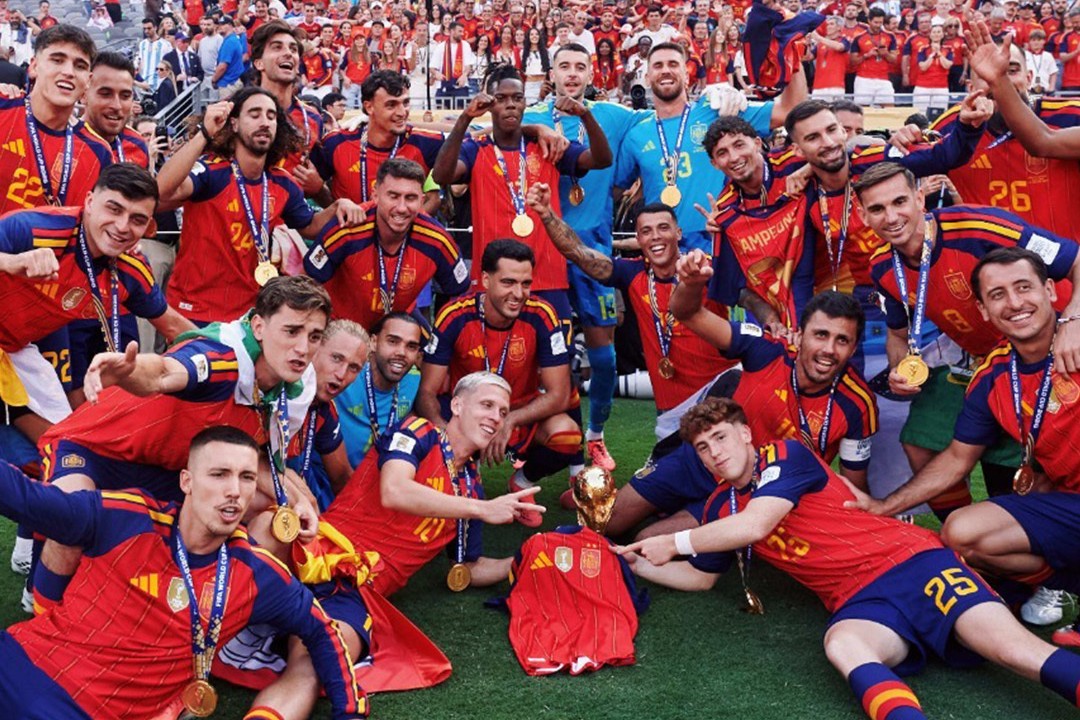
Spain's footballers lifted the FIFA World Cup trophy in extra time on 19 July 2026 after ninety scoreless minutes against an opponent confirmed on 19 July 2026 at 22:10 UTC by the prediction market Polymarket (polymarket.com). Within hours, the victory had produced a congratulations message nobody on the pitch had solicited: a Gaza-headlined broadcast from Iran's English-language state channel PressTV on 20 July 2026 at 02:04 UTC and 02:11 UTC framed the Spanish win as a "moral victory against the Zionist entity," quoting a senior official from the Palestinian Islamist movement Hamas and recycling the imagery on its @PressTVGaza account (t.me/s/presstv).
The Spanish federation, the squad, and La Moncloa have so far stayed silent on the reinterpretation. That silence is now the political story, more than the goal itself. Sports victories get borrowed by foreign actors who want to claim a piece of them. The borrowing usually costs the victors nothing beyond an awkward quote request. This time the loan came with a foreign-policy tag attached before the confetti had been swept off the pitch.
What PressTV actually said
PressTV's English-language headline on 20 July 2026 at 02:04 UTC described Spain's win as something Palestinians should celebrate. The follow-up at 02:11 UTC carried a direct quote attributed to a senior Hamas official hailing the result as a moral victory against what the broadcast called the "Z Zionist entity" (t.me/s/presstv). The framing was explicit: the Spanish team was being enlisted into a narrative about Israel that the players, the Royal Spanish Football Federation, and the Spanish government have never endorsed publicly.
The broadcast did not name the squad members it claimed to be speaking about. It did not quote any Spanish player or coach. It did not cite any statement from the federation or from Madrid. The entire transaction was one-sided: PressTV imported the result into a foreign-policy argument the victors were never asked to author.
Why the timing matters
PressTV moved inside the same news cycle as the final whistle. Polymarket's breaking post confirming Spain as champion landed at 22:10 UTC on 19 July 2026; its earlier post at 21:18 UTC had flagged that the match was heading to extra time after ninety scoreless minutes (polymarket.com). PressTV's first Hamas-congratulations item followed roughly four hours later. State-aligned outlets typically recycle foreign sports results fast when the result can be slotted into a pre-existing narrative; this was on that script.
The choice of Spain was not random. Public sympathy for the Palestinian cause runs high in Spanish polling and across the country's left-wing parties, including among members of the governing coalition. The previous Spanish administration's late-2023 recognition of a Palestinian state, and Madrid's repeated criticism of Israeli operations in Gaza, made Spain an obvious frame for any foreign actor wanting to portray a European capital as aligned with their position. Spain's football team offered a way in.
The asymmetric bite
The dominant frame in Western wires on Monday morning has been straightforwardly celebratory: extra time, a goal, a trophy, a parade expected in Madrid this week. The PressTV framing has so far appeared almost exclusively in Iranian and pro-Hamas channels, with limited pickup in European outlets. That asymmetry is itself the point. The broadcast does not need European pickup to function. Its audience is regional, and its message to that audience is: "Look, even Europeans are on our side, and they have just proved it on the world stage." The fact that Spain's players did not endorse the message is, in this logic, a footnote.
Counter-read: the broadcast may simply be a template applied wherever it can land. Spain's identity was incidental. The substantive content was predetermined. The frame holds either way; the fact pattern (a European winning a global sports final inside hours of a PressTV broadcast) is the variable, not the politics.
What Madrid does next will set the precedent
Spain faces a choice familiar from previous sports-as-foreign-policy episodes, including the 2022 World Cup in Qatar and the Iranian-led campaigns around the 2018 and 2022 finals. The federation can issue a neutral thank-you and ignore the reinterpretation; the foreign ministry can publish a one-line statement that the team's victory has nothing to do with bilateral disputes; or Madrid can treat the broadcast as interference and summon the Iranian charge d'affaires. Each move has been tried somewhere before; none has consistently worked.
The clarification this article can make is that the sources disagree about the intended weight of the message. PressTV's framing puts Spain at the centre of a geopolitical argument; Polymarket's confirmation puts Spain at the centre of a sporting one. The two sets of facts do not contradict each other, but they are aimed at very different audiences. Read together they describe what is, in effect, two parallel press cycles run out of the same news event.
Stakes and what to watch
The immediate consequence is reputational, not legal. Spanish football stands to be cast, in some quarters, as a foreign-policy actor it never volunteered to be. The Royal Spanish Football Federation will be asked in the next 48 hours whether it accepts the framing; the squad's most senior players will be asked whether they have a position. If neither speaks, the story fades on its own within a week and the PressTV reading remains a foreign curiosity.
If the federation pushes back, that pushback becomes the story: a major European federation publicly rejecting a message from a UN-listed militant faction's foreign backers, with the diplomatic follow-through that implies. Watch for any read-out from Moncloa between now and the squad's scheduled homecoming parade, and any formal statement from the Royal Spanish Football Federation before Tuesday's federation press conference.
What remains genuinely uncertain is whether the broadcast was opportunistic or coordinated across the wider Iran-aligned media cluster; the available items do not specify. The two Telegram posts from PressTV and the @PressTVGaza account are timestamped within seven minutes of each other, suggesting an editor-on-shift decision rather than an institutional clearance process.
Desk note: this article treats the PressTV/Hamas framing as it is sourced, attributes any political interpretation to the named outlet, and avoids endorsing or relativising the underlying conflict. Monexus finds that the asymmetry between the wire celebration and the Iranian-state broadcast, not the score, is the story worth tracing.
Wire provenance
This editorial synthesis draws on the following public wire/social posts:
- https://t.me/s/presstv
- https://t.me/s/presstv