Spain's 2026 World Cup win lands less as a tournament story than as a globalised entertainment product
Spain lifted the 2026 World Cup after a tournament expanded to 48 teams and stretched across three North American host nations. The final shape of the competition says as much about the business of football as it does about the football itself.
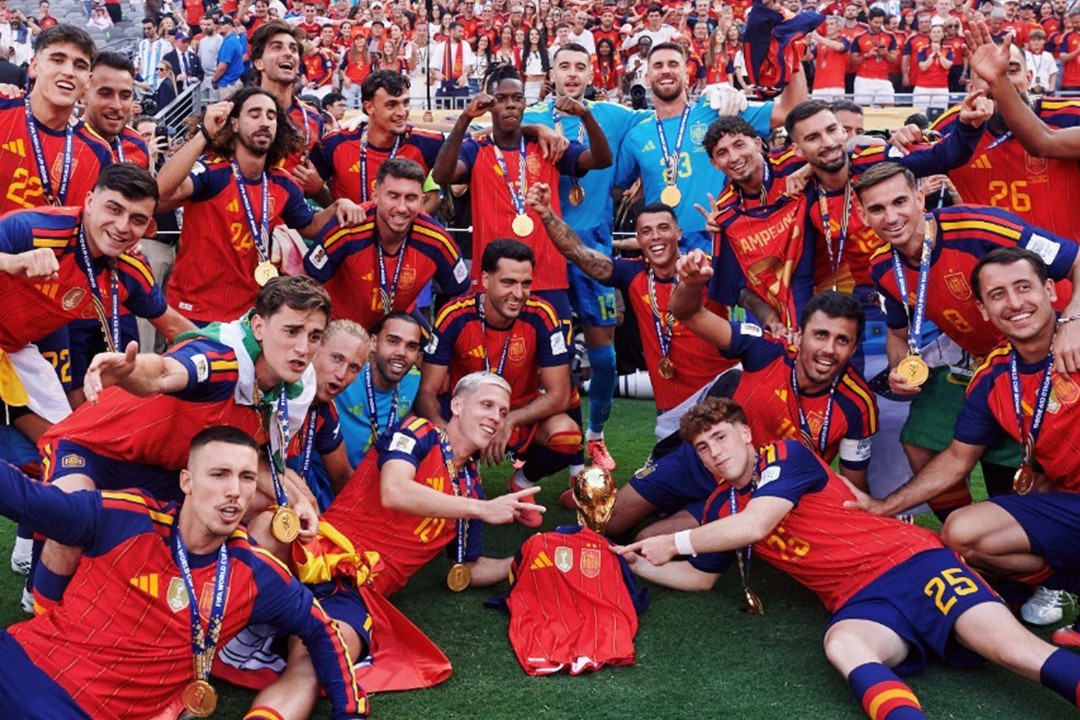
Spain are world champions again. La Roja added a second star in the tournament that closed on 19 July 2026, the first edition staged across three countries and the first to feature 48 national teams, a structural enlargement of the competition that left its fingerprints on every match played over the past month (Al Jazeera English, 20 July 2026, 21:40 UTC).
What the final whistle confirmed is less a verdict on the state of international football than a portrait of what the men's World Cup has become: a 104-match, 39-day commercial mega-event whose competitive logic is now inseparable from its broadcasting, ticketing and sponsorship economics. Spain won the trophy; FIFA, its broadcast partners and its host-city commercial partners monetised the stage on which Spain won it.
The shape of a 48-team World Cup
Al Jazeera English's five-point wrap of the tournament leads with the new geometry. Forty-eight teams, an extra round of group matches, and a knockout bracket that stretched deeper than any previous edition meant that survival, not just excellence, defined the bracket (Al Jazeera English, 20 July 2026, 21:40 UTC).
That shift has consequences beyond the field. A 48-team field guarantees slots for confederations that previously had to win intercontinental play-offs, a political decision dressed as an inclusivity one. It also extends the calendar and the inventory of matches that FIFA can sell to broadcasters and sponsors. The competition's competitive depth, in other words, is now designed downstream of its commercial depth. The two are no longer separable.
Spain's path, and the path that closed behind them
Spain's run to the trophy drew on the same generational through-line that delivered the 2008 to 2012 cycle: a possession-based, positionally disciplined core, augmented now by a younger cohort integrated into the senior side. Al Jazeera English's takeaways note the team's tactical maturity under pressure, particularly in the latter knockout rounds where set-piece defending and game-state management decided ties that open play could not (Al Jazeera English, 20 July 2026, 21:40 UTC).
The other side of the ledger matters too. Several pre-tournament favourites exited earlier than their FIFA rankings predicted, a pattern consistent with a 48-team field in which the distance between seeded and unseeded sides, in any given match, is narrower than the rankings imply. The expanded format reduces variance in qualifying, then amplifies variance once the tournament begins. That is not a flaw in the design so much as a feature of it: more matches, more upsets, more broadcast minutes in which the outcome is in doubt.
A North American staging model
Holding the tournament across Canada, Mexico and the United States is the second structural change the 2026 edition locked in. Staging in three countries distributes infrastructure costs and political risk across three federal systems and three commercial territories, while concentrating rights-holding revenue on a single FIFA marketing apparatus.
This is the business model the men's World Cup has been drifting toward since the 1990s, and the 2026 edition is its most explicit expression. Host-city bidding has, for at least a decade, been less a civic competition than a sovereign guarantee of stadium build-out, tax holidays and security spending. The new wrinkle is that those guarantees are now spread across three governments rather than one. Mexico's hosting tradition, Canada's stadium inventory and the United States' existing commercial infrastructure were the inputs; FIFA's media-rights inventory was the output.
The product the fans actually bought
The five takeaways that close Al Jazeera English's wrap, on goals, on attendances, on the marquee moments that will define the tournament's afterlife in broadcast edits, are the consumer-facing residue of an operation whose centre of gravity sits several layers above the pitch (Al Jazeera English, 20 July 2026, 21:40 UTC).
There is a defensible reading in which all of this is fine: a globalised sport deserves a globalised championship, the expansion brings more nations into the tent, and the commercial engine funds development programmes that smaller confederations could not otherwise afford. There is a less comfortable reading, in which the sport is being slowly subordinated to the entertainment product, and the entertainment product is being calibrated for a global streaming audience that consumes football in highlight form as often as in full-match form. Both readings are partially right, and FIFA's institutional incentives point toward the second one regardless of which reading one prefers.
What the next cycle settles
The next edition, returning to a single-country model after this North American experiment, will be the first clean test of whether the 48-team format is here to stay or whether it was a one-off accommodation to the host confederation's commercial logic. Spain's players will move on to club football; FIFA's marketing apparatus will not. The trophy changes hands every four years. The underlying product, increasingly, does not.
Desk note: Monexus framed Spain's win through the lens of the tournament's commercial architecture, following Al Jazeera English's own lead. The wire service's five takeaways read as much like a post-event report for rights-holders as a sports recap; the article above treats that as the story rather than disguising it.
Wire provenance
This editorial synthesis draws on the following public wire/social posts:
- https://t.me/aljazeeraglobal/