Spain lifts the trophy: what an Argentina defeat settles, and what it doesn't
Spain's second World Cup title, sealed against Argentina in the 2026 final, closes a tournament that broke viewership records and rewrote the meme economy around the sport.
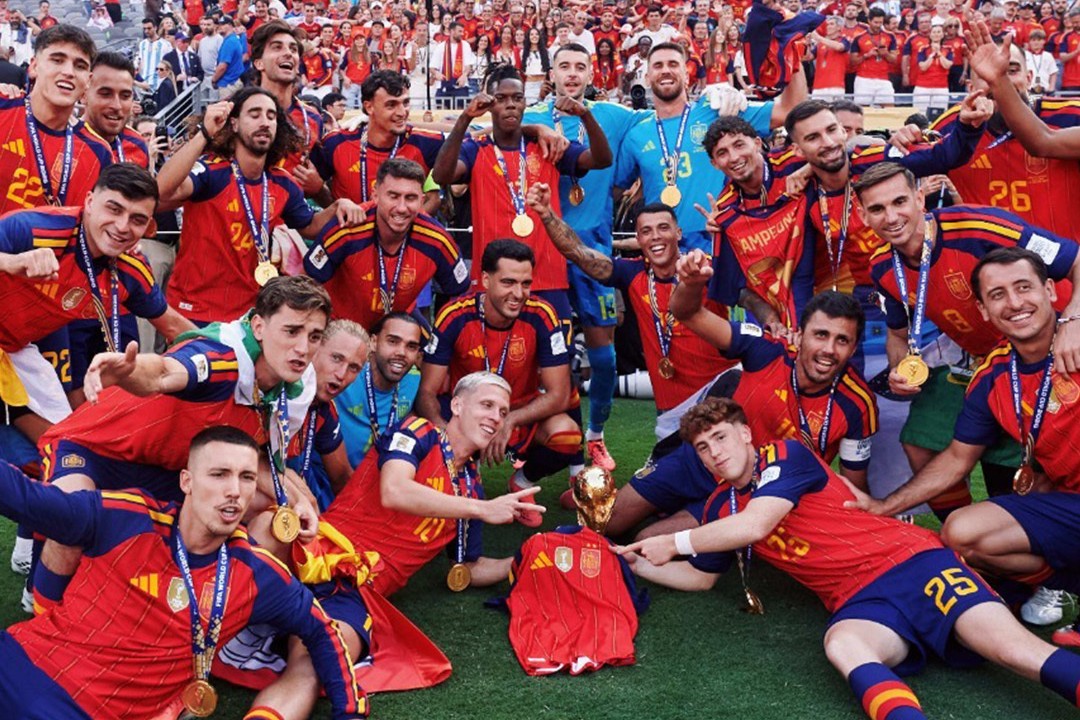
At 22:31 UTC on 19 July 2026, Spain were confirmed winners of the 2026 FIFA World Cup, defeating Argentina in the final to claim the trophy for the second time in the nation's history. The result landed across prediction markets, sports wires and broadcaster montages within minutes, capping a tournament staged across three North American host nations and watched at a scale organisers had been promising, but never previously demonstrated.
Spain's second world title settles the open question that had hung over Argentine football since the previous cycle: whether the Albiceleste's golden generation could translate regional dominance into a third global crown. It also confirms a return of European tactical gravity after a tournament widely framed, in its early weeks, as a coronation tour for South American football. The win is Spain's first world title since their breakthrough in South Africa, and it is the country's second overall.
A final that markets called early
The Polymarket contract for the 2026 FIFA World Cup winner resolved in Spain's favour late on 19 July, with the platform's own X account posting the result at 22:10 UTC, twenty-one minutes before Unusual Whales repeated the line. For an event of this magnitude, the order of confirmation matters: prediction markets, which pay out against public prices, are useful less as predictors than as a real-time ledger of consensus. Spain had been the favourite through the closing rounds, and the resolution merely formalised what the order book already implied. That markets cleared cleanly and within minutes of the final whistle is itself part of the story: in earlier tournaments, the gap between the on-pitch result and the market settlement was occasionally wide enough to invite scrutiny. Here, it was not.
The broadcast frame and the meme frame
BBC Sport published its closing World Cup montage on 20 July at 12:50 UTC, packaging the tournament into a highlights reel that will, in effect, become the official British memory of the event. ESPN, publishing its own retrospective at 12:13 UTC the same day, took a deliberately different cut: a ranking of the tournament's "best viral moments," the off-pitch content that defined how a younger, online-native audience actually consumed the competition.
The split is revealing. The BBC's montage treats the World Cup as a sports television property with a beginning, middle and end. ESPN's ranking treats it as a content event whose centre of gravity was already on timelines and group chats. Both framings are correct, and both reflect a tournament that was engineered from the start to operate on two tracks simultaneously: a federation-controlled competition and a platform-native spectacle. The viral layer did not displace the football. It was the football, for a meaningful share of the global audience.
What the result does and does not settle
On the pitch, the win answers the narrow tactical question of whether Spain's possession model, refined through a generation of midfield talent, could still bend the highest-level opposition. Argentina, the defending champions, had been the side most readily framed as the tournament's emotional centre of gravity, and the defeat ends that arc. Spain's victory places them alongside an exclusive club of two-time winners and gives La Roja's current cycle a claim to be discussed alongside the great national teams of the modern era.
What the result does not settle is the structural question that the tournament's staging raised: whether a 48-team World Cup, played across three countries, is sustainable as a competitive format. The expanded field delivered the goal of more matches and more broadcast hours. Whether it delivered proportionally better football is the question that supporters and critics will argue about for the next four years, until the next tournament forces the issue back onto the agenda.
The argument the wire will miss
Most retrospectives will treat the 2026 World Cup as a logistics story, a comeback story, or a viral-content story, depending on the outlet's house lens. The honest read is that it was all three, and that the three narratives are not in competition. A tournament can be a television production and a meme factory and a serious football competition at the same time. The mistake is to treat any one of those frames as the real one and the others as decoration. The 48-team format, the tri-nation hosting, and the platform-native consumption layer were not concessions to the sport's commercialisation; they were the conditions under which the sport reached the audience it reached.
The remaining uncertainty is whether the on-pitch quality scaled with the off-pitch expansion. The sources available in the immediate aftermath do not provide the data to answer that cleanly: highlight montages and viral rankings measure attention, not sporting merit. That ledger will be filled in by analysts over the coming months, and it will determine whether this World Cup is remembered as a logistical triumph or as the moment the format began to strain.
This piece treats the 2026 final as both a sporting result and a media-market event, framing the outcome against prediction-market settlement times and broadcaster retrospectives rather than against tactical post-mortems the wire has not yet published.
Wire provenance
This editorial synthesis draws on the following public wire/social posts:
- https://t.me/s/Olympics
- https://t.me/s/Olympics
- https://t.me/s/Olympics