Philadelphia's Slave-Revolution Backdrop Quietly Rewritten
Six months after removing an outdoor exhibition on slavery in the founding era, the administration has replaced it with panels that omit the bondage at George Washington's Philadelphia house.
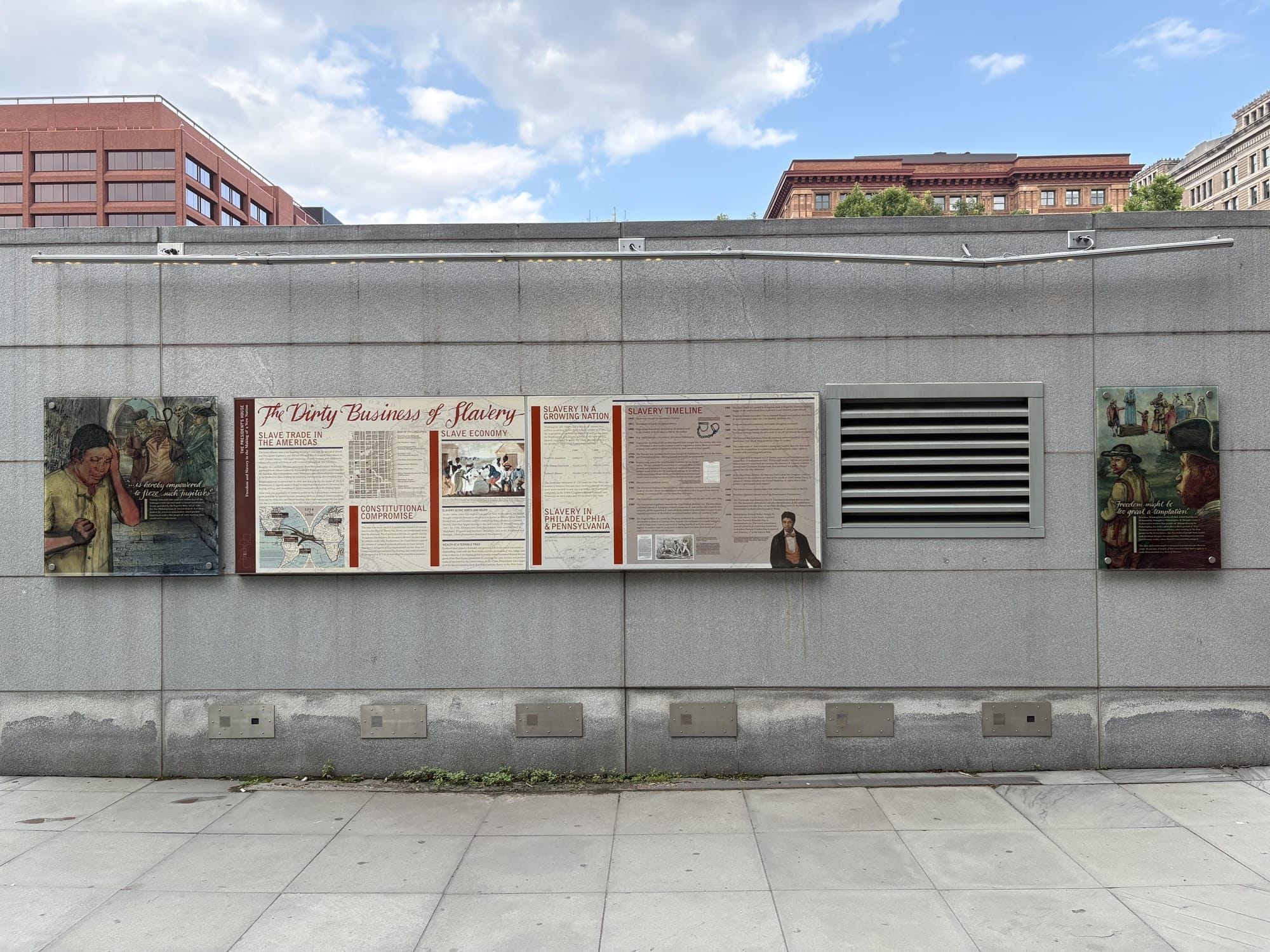
On 18 July 2026, workers finished mounting new interpretive panels at the President's House site on Independence Mall in Philadelphia, the open-air ruin where George Washington lived from 1790 to 1793 and where, by the historical record, he kept enslaved people in his household. The replacement text, installed under the Trump administration, drops the language Washington used about the captives he held and omits the names of those he owned at the Philadelphia address, according to Hyperallergic.
The edit lands six months after the same federal authorities ordered the outdoor exhibition Freedom and Slavery in the Making of a New Nation dismantled. What is being curated, in other words, is not just the panel copy but the policy of the site itself. The previous administration had treated the contradiction at the founding as the story. The current one is treating the contradiction as removable.
A site that already had a fight
The President's House memorial opened in 2010, after years of activist pressure led by the Avenging the Ancestors Coalition, and was the first federally funded installation on Independence Mall to acknowledge that enslaved people were held in the presidential residence. Its empty-windowed steel ghost structure sits a few hundred feet from the Liberty Bell pavilion, deliberately within the frame of any visitor's photograph of the founding-era landscape.
That placement was the point. The original exhibition, designed under President Barack Obama and maintained through two successors, foregrounded nine people Washington enslaved in Philadelphia, including Oney Judge, who escaped, and Hercules, the chief cook. A short video loop showed the faces of scholars and descendants. The outdoor panels quoted Washington's own letters about his desire to recover the runaways.
The site has always been contested ground. In 2025, before the most recent changes, the administration began trimming references to slavery from national park signage and visitor materials more broadly. The Philadelphia installation became the highest-profile casualty of that pattern: the one place where the architectural setting itself forces the question, every minute of every day, was the one place most likely to draw the rewrite.
What the new panels say, and don't
According to Hyperallergic's reading of the replacement text, the new panels keep the chronology of the presidency and the building's construction, but they no longer name the people Washington held at the Philadelphia address, no longer reproduce his correspondence about recovering them, and no longer describe the legal loophole he used to keep enslaved labour in Pennsylvania past the state's 1780 gradual-emancipation law. The interpretive language now treats the President's House as a seat of executive power and a chapter of constitutional formation.
Hyperallergic reported the installation on 18 July 2026. The thread's central observation is that the rewrite is not a retraction of an error but a substitution of one frame for another. The administration's framing treats the slavery record as an ancillary controversy rather than as the operating context of the executive branch the site commemorates.
The previous exhibit, by contrast, was built around the argument that the household's enslaved labour is not separable from the executive power exercised inside its walls. Removing that argument is not a neutral editing choice. It is the choice the panels were always going to make, once the decision to replace them was made.
Whose history gets the prime real estate
Independence Mall is the most deliberately curated piece of American civic geography in the country. The presence, in that half-mile, of the Liberty Bell, the President's House footprint, the National Constitution Center, and Independence Hall is itself a designed argument about which national stories deserve stone, glass, and federal maintenance. When the federal government changes the panel copy at one of those sites, it changes the argument the whole mall makes.
The structural question is whether the National Park Service, which manages the site, is being directed to read its holdings in a narrower key, or whether Philadelphia's installation is a local pressure point inside a broader instruction. The reporting available so far points only to Philadelphia: Hyperallergic documents the change there and ties it to the earlier dismantling of Freedom and Slavery in the Making of a New Nation. National Park Service guidance on slavery references elsewhere in the system is not described in the source material, which is a limit on what can be claimed from this thread.
The stakes for the next four years
The interpretive choices at Philadelphia will outlast the administration that made them, in the same way the 2010 memorial outlasted the officials who resisted it. Future panels can be rewritten again. The video loop can be re-cut, the names re-inserted, the loophole re-described. What is harder to reverse is the precedent that the founding-era slavery record is treated as a removable feature of the American story rather than a permanent condition of it.
The Avenging the Ancestors Coalition, which pressed for the original memorial in the 2000s, has not been publicly reported as responding to the new installation in the source material. The thread does not include reaction from the National Park Service, from the City of Philadelphia, or from the descendants' organisations whose pressure produced the original site. The reporting record on this story, as of 18 July 2026, is thin on the response side and thick on the description of the changed text itself.
What is clear is that Independence Mall now offers two competing arguments, layered into the same ground. The architecture still puts the empty-windowed presidential footprint inside the founding-era photograph. The panels now decline to describe what was happening inside those windows. The dissonance between the structure and the signage is the story the site will tell for as long as the new text stands.