Kyung-Me turns inward, and the sunflower does the rest
A New York painter's new series treats a single bloom as a clock: sharply defined at peak, dissolving at the edge.
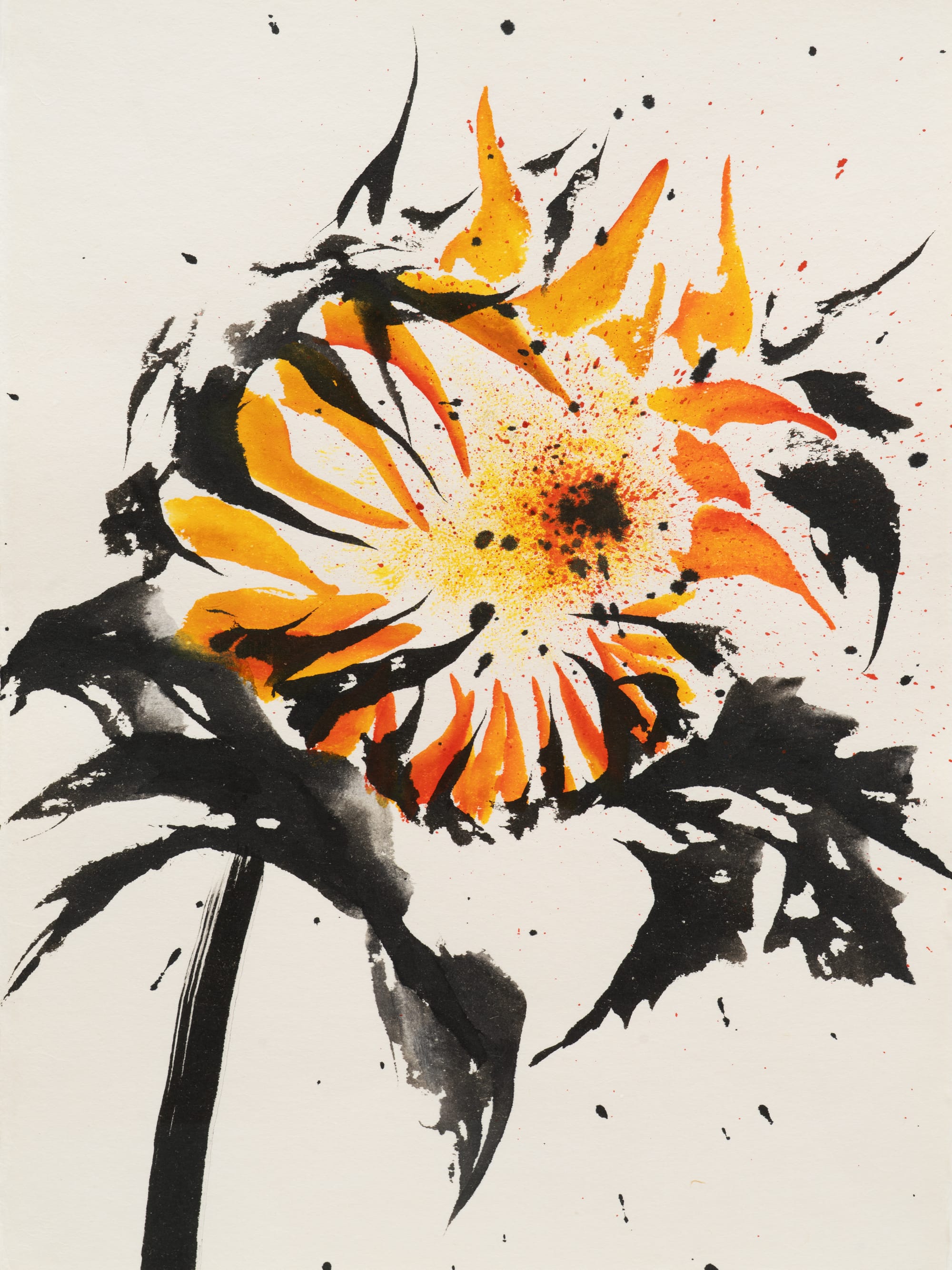
On a gallery wall in New York this summer, a sunflower holds its head up the way sunflowers do, then quietly loses the argument with gravity. That single arc, blooming to dying, is the through-line of Kyung-Me's current body of work, a shift in practice documented by Hyperallergic on 20 July 2026 and built around a deceptively simple motif.
The series is a portrait of a flower at every stage of its own lifespan, and, by extension, a portrait of the act of looking at one. Kyung-Me treats the bloom as a clock: sharply defined at peak, then surrendering to rivulets of dissolution at the edge. What changes is not the subject but the painter's grip on it.
From form to flow
The earliest canvases read as studies in control. Petals have edges; the centre of the flower has the tight, geometric authority of a mandala. By mid-series, those edges begin to bleed. Pigment runs the way watercolour runs when a brush lingers too long on a wet sheet. The sunflower does not so much wilt as translate itself into a different visual language, the same plant described first as architecture and then as weather.
It is the kind of pivot that sounds modest in a caption and lands harder in the room. A viewer who walks the wall left to right watches a single organism move from object to event. There is no trick to it. There is, however, a discipline: knowing when to stop describing a thing and let the description fail on purpose.
What the framing resists
The obvious read is also the lazy one: a flower as a memento mori, blooming as a stand-in for the brevity of life. Hyperallergic flags the temptation and declines to take it. The series is interested less in symbolism than in the mechanics of seeing; the sunflower is the unit of analysis, not the moral of the piece.
This is where the work does its real work. Painting that announces its allegory tends to die on the vine of its own intention. Kyung-Me keeps the allegory offstage. The viewer is asked to watch a process, not to be instructed by one. The looser passages are not tears; they are the painting letting go of the need to be precise at the exact moment precision stops being the point.
The structural read
Contemporary painting has spent two decades circling back to the figure after a long, justified detour through the conceptual. The result is a generation of artists who know how to make a canvas mean something and who, increasingly, want to make one feel like a canvas again. Kyung-Me sits inside that current, but the sunflower series is not a return to representation so much as a study in what representation costs. The early pictures show the cost paid up front; the late ones show the cost paid over time.
There is also a quiet argument with photography embedded in the project. A photograph of a sunflower fixes a moment; a painting of one can hold a season. Kyung-Me exploits that asymmetry rather than apologising for it. The dissolved passages are where the medium earns its keep.
What to watch
The series is current, which means the catalogue, the sales cycle, and the institutional pickup are still in motion. The most useful question a viewer can ask in the room is not what the flower means but what the painter kept and what she let go. The canvases answer it directly, in the order you encounter them.
Desk note: Hyperallergic carried the framing of the series as a study in perception rather than allegory, and this piece tracks that read while pushing harder on what the looser passages are doing technically. The wire did not specify gallery, pricing, or sales; Monexus did not invent any.