A fire, a half-built hospital, and the question Iran keeps answering with sirens
A fire broke out on the ground floor of a hospital block still under construction in Khorramabad. The damage was contained. The questions it raises about Iran’s build-out of health infrastructure are not.
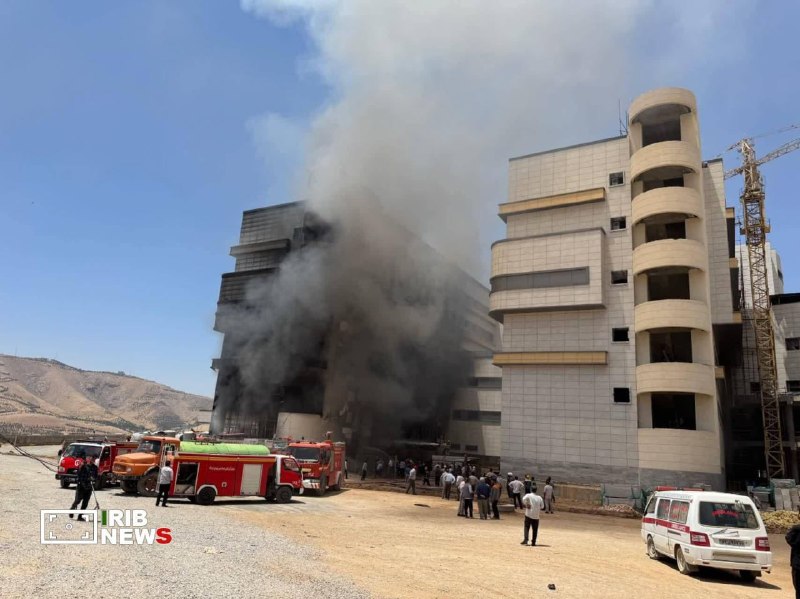
At 08:53 UTC on 20 July 2026, a fire broke out on the ground floor of the Niayesh hospital in Khorramabad, a block that was still under construction. Within minutes, three Iranian state-affiliated wires were running the same basic paragraph: a fire, a half-finished building, no immediate report of casualties. By 09:00 UTC the story had been confirmed twice, once by the public relations office of Lorestan University of Medical Sciences and once by the university itself.
The structural question is not whether the flames were put out. They were, and the four wires that reported the incident all converge on that point. The structural question is what a single unfinished hospital, in a single mid-sized Iranian city, says about the country’s broader push to expand health infrastructure, and about the recurring pattern of construction-site fires that Iran’s domestic wires report with a regularity the international press rarely catalogues.
A fire, confirmed twice in seven minutes
The first alert on this publication’s wire came from Mehr News at 08:53 UTC on 20 July 2026, citing Shirzad, the public relations officer of Lorestan University of Medical Sciences, confirming the blaze at the Niayesh hospital construction site in Khorramabad. Three minutes later, at 08:56 UTC, Mehr News posted a follow-up framing the incident as a “fire prevention” event, again sourcing Shirzad and noting that the ground floor of one of the hospital blocks was the point of origin. By 09:00 UTC, both Tasnim News’s English service and its Farsi parent channel were running the same core facts.
The speed of the confirmation matters. Iranian provincial universities have, over the past decade, become the first official mouth for incidents in their catchment areas, a role that regional governors and Tehran-based ministries used to monopolise. In this case, Lorestan University of Medical Sciences was both the institution responsible for the site and the institution confirming the fire. That is a normal arrangement in Iran’s hospital construction programme, but it is also the kind of arrangement that, in other jurisdictions, would raise a conflict-of-interest flag. The sources do not address that tension. They simply report the fire.
The incident itself, as the four available wires describe it, was contained to a single ground floor of an unfinished block. None of the wires report casualties. None of them name a cause. None of them give a damage estimate. The refrain is uniform: a fire broke out, the relevant authorities responded, the situation is under control.
What the wires do not say
Three things are conspicuously absent from the available reporting. First, no cause: not electrical, not welding, not arson, not accidental. Iranian state-aligned wires tend to be cautious about attributing cause in the first hours after an incident, particularly at sites tied to public health infrastructure. The reluctance is partly editorial caution and partly political. A hospital under university supervision is a sensitive asset. Premature attribution invites blame that may later prove embarrassing.
Second, no timeline for the build. Niayesh hospital is referred to as “under construction” in all four wires, but none of them gives a start date, a contracted completion date, or a budget figure. For a long-read treatment of Iranian health infrastructure, that is a meaningful gap. Tehran has spent the past two decades expanding hospital capacity in second-tier cities, and Khorramabad, the capital of Lorestan province, sits squarely inside that programme. But how long any given block has been under construction, how often its timelines have slipped, and how often the same contractors have featured in earlier incidents is not in the four source items available to this publication.
Third, no human story. The wires name a spokesperson, Shirzad, and the institution, Lorestan University of Medical Sciences. They do not name a worker, a patient, a resident, or a witness. In a story about a fire, that absence is itself a kind of editorial choice, and one worth naming. Fires at construction sites are, in the first instance, worker-safety stories. Iranian workers at state hospital sites do not, in these wires, get a first-name quote. The reader is left with the institution and the incident.
Iran’s hospital build-out, in plain prose
Iran runs one of the most extensive public hospital networks in the developing world. The country’s push to expand provincial bed capacity accelerated after the Iran–Iraq war and intensified under successive five-year development plans. The 20-Year Vision document, published in 2005, set explicit targets for health infrastructure in less-developed provinces, and Lorestan was among the provinces named as priorities because of its history of under-served districts and its exposure to cross-border health pressures.
The delivery model relies heavily on provincial universities of medical sciences, which act as both the operator of completed facilities and the client for new builds. That dual role compresses the lines between builder, regulator, and end user. It also explains why a fire at a construction site is reported by the same office that will eventually run the finished hospital. The arrangement is efficient. It is also harder to audit from outside than a model in which the builder, the certifier, and the operator are distinct entities.
Within that model, fires at unfinished hospital blocks are not unheard of. Iranian state media has, in past years, reported blazes at construction sites in Tehran, Isfahan, and several provincial capitals. The incidents do not cluster in any single publicly available dataset that this publication can cite, because no such dataset is published. What can be said from the sources available is that on 20 July 2026, a fire broke out at one such site, was reported promptly by the responsible university, and appears to have been contained without casualties.
The counter-narrative: why the official line holds
A skeptical reader will ask why the wires sound so tidy. The honest answer is that they often do, at the first announcement. Iranian state-aligned outlets operate under clear editorial guidance to avoid speculative framing in the immediate aftermath of incidents at public infrastructure sites. That guidance is not unique to Iran, but the asymmetry between what is reported at 09:00 UTC and what emerges in the days that follow tends to be wider in tightly centralised media systems than in pluralised ones.
Two counter-reads deserve space. The first is that the fire is genuinely small, the response genuinely prompt, and the absence of casualties genuinely good news. Iranian provincial medical universities have improved their incident-communication reflexes over the past decade, and the speed with which Lorestan University of Medical Sciences confirmed the blaze is consistent with that improvement. The second is that the official line will harden in the next 48 hours: cause will be attributed, an inquiry will be announced, and the incident will be absorbed into the country’s broader narrative of expanding health access. Both readings can be partly true.
The structural point is that the international press rarely catalogues the routine infrastructure incidents of middle-income countries unless they produce mass casualties or geopolitical consequences. A fire that did not hurt anyone at a hospital that does not yet exist is, by global-editing standards, a minor event. By the standards of the workers on the site and the residents who would have used the finished building, it is not minor at all. The asymmetry is worth naming.
Stakes, and what to watch
If the trajectory of the past decade continues, two things will happen in the days after this fire. First, Lorestan University of Medical Sciences will, in coordination with the provincial governor’s office, issue a more detailed statement, including a cause and a damage assessment. Second, the Niayesh hospital project will, barring a major revelation, continue on its existing timetable, with the fire recorded as an interruption rather than a verdict.
The larger stakes are not about Niayesh. They are about the credibility of Iran’s model of provincial health-infrastructure delivery, in which a single university both builds and certifies, both reports and investigates. That model has delivered real capacity: tens of thousands of new hospital beds in second-tier cities over the past twenty years. It has also, occasionally, failed in ways that are harder to verify than they would be in a system with separated roles. The 20 July 2026 fire at Khorramabad will, in all likelihood, join that catalogue as a footnote. What it tells the reader who watches Iran closely is that the country’s build-out continues at pace, and that the official wires still sound tidier than the underlying reality is likely to be.
Watch for the cause attribution within 72 hours. Watch for whether any worker names surface. Watch for whether the construction timeline, which the four source items do not specify, is published anywhere. Those three data points will tell the reader more about the gap between announcement and reality than the wires did on the morning the fire broke out.
This piece was written by the Monexus staff desk. Where Iranian state-affiliated outlets are the only available sources on a developing domestic incident, we cite them explicitly and note the limitation. Independent corroboration on infrastructure incidents inside Iran typically lags official confirmation by 24 to 72 hours; readers should treat the current account as a first-pass ledger, not a final verdict.
Wire provenance
This editorial synthesis draws on the following public wire/social posts:
- https://t.me/tasnimplus
- https://t.me/tasnimnews_en
- https://t.me/mehrnews
- https://t.me/mehrnews
- https://en.wikipedia.org/wiki/Lorestan_province
- https://en.wikipedia.org/wiki/Khorramabad
- https://en.wikipedia.org/wiki/Ministry_of_Health_and_Medical_Education_(Iran)
- https://en.wikipedia.org/wiki/Tasnim_News_Agency
- https://t.me/tasnimplus
- https://t.me/tasnimnews_en
- https://t.me/mehrnews
- https://t.me/mehrnews
- https://en.wikipedia.org/wiki/Lorestan_province
- https://en.wikipedia.org/wiki/Khorramabad
- https://en.wikipedia.org/wiki/Ministry_of_Health_and_Medical_Education_(Iran
- https://en.wikipedia.org/wiki/Tasnim_News_Agency