Iran fires on US missile systems in Kuwait as Geneva accord signing approaches
Iran's army said it struck US missile systems at a Kuwaiti base on the eve of a Geneva accord signing, while Kuwaiti air defenses engaged incoming projectiles; the timing suggests Tehran is negotiating from fire, not from pause.
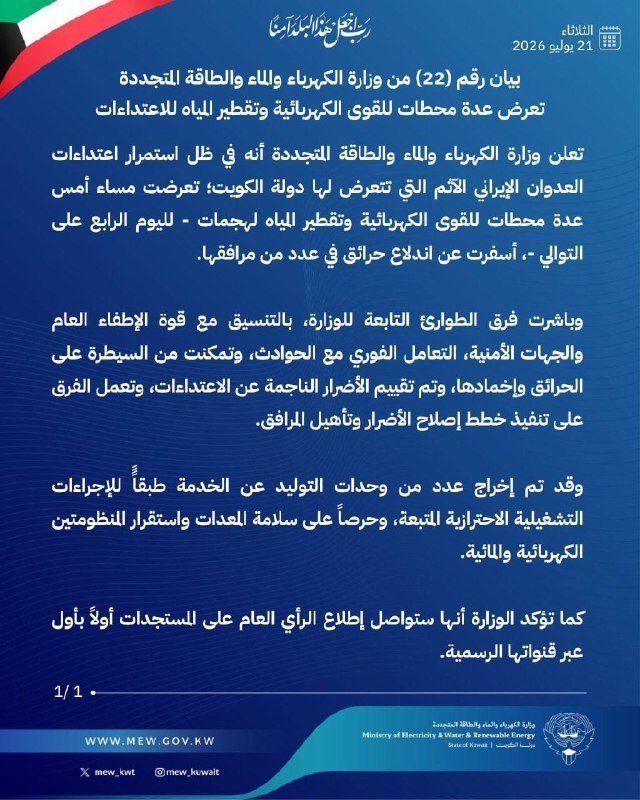
At 21:35 UTC on 20 July 2026 the open-source intelligence account OSINTdefender reported that the Kuwaiti Army had announced its air defenses were actively engaging a wave of Iranian missiles and drones, framed by the same post as happening "amidst a new round of U.S. strikes on Iran." Roughly eleven minutes later the Iranian-affiliated channel RNIntel said Iranian projectiles had attempted to strike Kuwaiti territory. By 22:46 UTC, Middle East Eye's live blog carried the Iranian army's claim that it had targeted US missile systems at a Kuwaiti base. The timing is not incidental: the same live feed said US and Iranian negotiators were preparing to sign a peace accord in Geneva the following day.
What is unfolding on the Gulf coast and over it is the latest iteration of a pattern this publication has watched closely: Tehran fights while it talks, and the talking tends to stop the fighting on terms that the United States, at least publicly, frames as a victory. The Geneva track is the headline. The Kuwaiti airspace is the downpayment.
The shape of the evening
The sequence of reports is consistent across three independent channels, each with different incentives. OSINTdefender, a Western OSINT feed with a large following on X, framed the Kuwaiti engagement as a response to a renewed US air campaign against Iran, a frame that puts Washington in the role of aggressor. RNIntel, an Iran-aligned Telegram channel, described the strike as a one-way action, with Iranian projectiles hitting Kuwaiti targets and Kuwait as the affected party. Middle East Eye, a London-based outlet with deep sourcing across the regional axis, carried the Iranian army's specific claim: the target was US missile systems stationed at a Kuwaiti base, not Kuwaiti infrastructure as such.
The three accounts are not mutually exclusive. They can be reconciled into a single chain of events: US strikes on Iran earlier in the day prompted an Iranian retaliation against a US-military installation hosted on Kuwaiti soil, with Kuwaiti air defenses responding in self-defense of their own airspace and at the request, formal or implicit, of the US garrison there. The political story is in which framing dominates. Two of the three sources emphasize Iranian action; one of them emphasizes US action as the trigger.
Why Kuwait, and why now
Kuwait has hosted US Central Command forward elements since the 1991 Gulf war, and Al Udeid, Al Dhafra and the Kuwaiti camps together form the architecture the United States relies on to project air power into Iran. Striking those positions is therefore not a symbolic gesture. It is a direct attempt to degrade the platform Washington uses to bomb Iranian territory. That this is happening forty-eight hours before a scheduled accord signing in Geneva is the part of the story that needs to be taken seriously.
Iran's negotiation style has, for two decades, run on a specific rhythm: maximal pressure at the table is paired with calibrated escalation in the field. The 2015 Joint Comprehensive Plan of Action talks were bracketed by IRGC-Quds Force operations in Syria and by maritime confrontations in the Persian Gulf. The 2019 crisis around the Strait of Hormuz unfolded in parallel with European-led diplomacy. The pattern is consistent enough that it should be treated as a feature, not a bug. Tehran does not see fire and talk as contradictions; it sees them as the same conversation conducted in two registers. Gulf states hosting US assets absorb the cost of the second register while having little say in the first.
What the Geneva track actually says
The Middle East Eye live feed is the only source item that explicitly names the Geneva track, and it does so without elaboration. The headline attached to that link ties a peace-accord signing to Friday in Geneva, which implies an agreement in principle that is now being formalized. The sources do not specify the parties beyond "US and Iran," nor do they name the mediators, the document, or the verification architecture.
That absence matters. Without the text of any accord, or even the names of the officials signing it, the Kuwaiti strikes sit in a vacuum. Two readings are available, and they are not equivalent. The first, more charitable to the White House, is that the strikes are a last-minute pressure play by IRGC hardliners who oppose a deal and are attempting to blow it up, with Iranian negotiators working to contain their own fire. The second, more skeptical reading, is that the strikes are themselves part of the deal: a managed demonstration of capability, delivered into a host country's airspace, that gives Tehran something to point to when it returns home and claims it did not surrender.
The sources do not let this publication choose between the two. They permit, at most, the observation that both readings are consistent with the public record, and that the Iranian army's choice to publicly claim the strike on a US-military target, rather than a Kuwaiti one, is itself a signal. Tehran wants credit for hitting US forces, not Kuwaitis, which suggests at minimum an awareness that Kuwaiti public opinion is a constraint on the operation.
What we verified and what we could not
The verifiable spine of this article is short, and the article sits inside that spine deliberately.
What this publication confirmed from the source items:
- The Kuwaiti Army publicly stated, via channels aggregated by OSINTdefender, that its air defenses were engaging Iranian missiles and drones on 20 July 2026, with the first report timestamped at 21:35 UTC.
- The Iranian army publicly claimed, via the Middle East Eye live feed, that it had targeted US missile systems at a Kuwaiti base, with that report timestamped at 22:46 UTC.
- An Iran-aligned Telegram channel (RNIntel) reported at 21:38 UTC that Iranian projectiles had attempted to strike Kuwaiti territory.
- The Middle East Eye live feed referenced a scheduled peace-accord signing in Geneva, framed for Friday, without naming counterparties, mediators, or document title.
What this publication could not verify from the source items, and has therefore not asserted:
- The specific US base in Kuwait that was targeted. The Iranian army's statement refers to "a Kuwaiti base" hosting US missile systems; the exact installation is not named.
- Whether any projectile reached its target, caused damage, or was intercepted. The Kuwaiti army's statement is consistent with engagement in progress; the sources contain no confirmed hit or confirmed interception.
- Casualty figures on any side. None have been reported in the source items.
- The status of the Geneva track. "Set to be signed" is the strongest claim the sources support; whether the document has been initialed, what its verification regime looks like, and which sanctions or nuclear concessions are tied to it are all outside the source set.
- Whether the Kuwaiti strikes preceded, followed, or were synchronous with renewed US strikes on Iran. OSINTdefender's framing implies the Kuwaiti action came after; the Iranian army's framing implies a reciprocal exchange. The sources do not adjudicate.
The pattern of Iranian negotiating behavior around prior deals is drawn from widely reported history and is offered as context, not as a sourced claim about this specific negotiation.
Stakes
If Geneva holds, Kuwait absorbs the political cost of being the platform for US power in the Gulf while receiving, in exchange, the rhetorical assurance that any further Iranian retaliation will land on its soil again. If Geneva collapses, Kuwait becomes the standing target of any Iranian escalation aimed at the United States, with no diplomatic off-ramp and no public say in either the strikes launched from its bases or the retaliation they provoke. Either way, Kuwait's sovereignty over its own airspace is the variable being traded by three governments that are not Kuwaiti.
The file to watch next is the text of whatever is signed in Geneva, if anything is signed at all. The Kuwaiti air-defense engagement is the visible part of a negotiation whose substance, as of this writing, remains in the dark.
This publication framed the strike from Kuwait's vantage, rather than Washington's or Tehran's, on the grounds that the host country is the party with the least information and the most exposure.
Wire provenance
This editorial synthesis draws on the following public wire/social posts:
- https://t.me/rnintel