Three meetings, one commander: Zelenskyy presses his top generals a day after a major reshuffle
Volodymyr Zelenskyy met the new Joint Forces commander and two senior staff chiefs on 19 July 2026, signalling that the rotation announced the previous day is already reshaping day-to-day command.
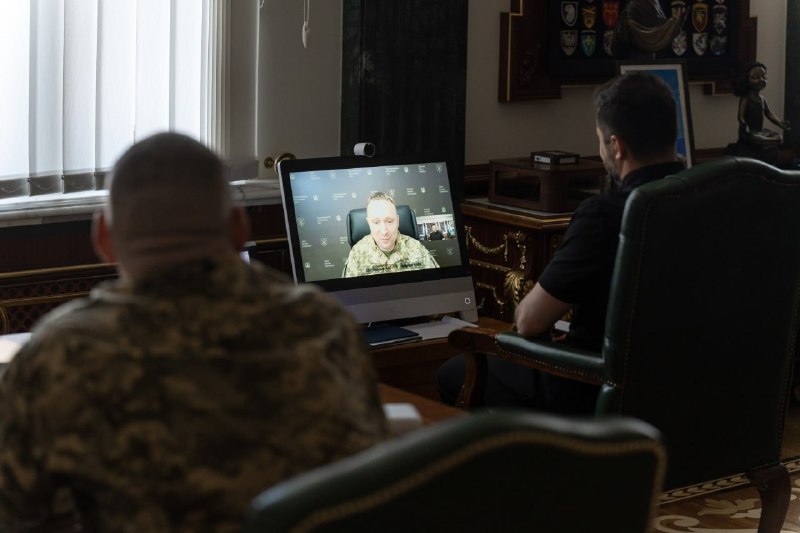
At 11:48 UTC on 19 July 2026, the official Telegram channel of President Volodymyr Zelenskyy published a short post: "Today I spoke with three more experienced Ukrainian military personnel." Within minutes, the wire-style channel operated by UNIAN and the operational channel operated by the Armed Forces of Ukraine had matched the announcement with identical wording, names and titles. Three men had sat down with the commander-in-chief a day after the most senior command reshuffle of the war.
The guests were Mykhailo Drapaty, commander of the Joint Forces of the Armed Forces of Ukraine; Volodymyr Horbatyuk, deputy chief of the General Staff; and the commander of the Desantno-Shturmovi Troops (DShV), Ukraine's air-assault branch, whose name the official post cites only by position. The choice of those three is the story. Each of them sits inside a chain of command that was rebuilt on 18 July, and each of them has a specific operational file on his desk before the next rotation of brigades.
What the meetings tell us
Public readouts of presidential conversations with serving generals are not new for Kyiv. What is unusual here is the speed. The previous day brought the dismissal of the previous Joint Forces commander and several senior staff moves; Drapaty's installation as the new commander was confirmed only hours before the meeting. Sitting down with him within that window signals to the rank-and-file that the change is operative, not cosmetic.
Horbatyuk's presence is the more telling signal. The deputy chief of the General Staff is the channel through which operational planning reaches the General Staff chief and, from there, the cabinet. Bringing him into the same conversation as the new theatre commander and the air-assault commander folds three separate vertical chains into one room. In a force that has spent four years arguing about the boundary between operational command and strategic planning, that is not a courtesy call.
The DShV commander rounds out the picture. Air-assault units have carried a disproportionate share of the positional fighting around Donetsk and the southern axis, and they are also the formation type most exposed to any new round of conscription reform, which the Rada is debating this month. A direct line from the president's office to that branch is, in effect, a line to the troops most likely to feel the next personnel decision first.
The rotation that put them in the chairs
On 18 July, Zelenskyy dismissed General Andrii Hnatov as commander of the Joint Forces, a post Hnatov had held since the spring of 2024. The dismissal was the first senior command change in more than a year and arrived against a backdrop of public frustration in Kyiv over the pace of mobilisation reform and the slow grinding of the southern front. Drapaty, who previously commanded a corps in the eastern grouping and led the 67th Mechanised Brigade before the full-scale invasion, took over within twenty-four hours.
The shape of the reshuffle, taken together, is conservative. All three officers named on 19 July are career Ukrainian commanders with field command experience since 2022. None is a foreign-trained officer, none is a civilian technocrat, and none has been publicly associated with any faction inside the president's office. The choice reads less as a reorganisation and more as a re-anchoring: the same institutional culture, with different personnel at the top.
The counter-read
The institutional reading is the dominant one, but a plausible alternative is that the meetings are themselves the product, not the substance. Ukrainian politics over the past eighteen months has run on the public choreography of command: the nightly address, the filmed visit to a brigade, the handshake. Telegram posts on the day of a command change serve a domestic-audience function as much as an operational one. They reassure soldiers that someone senior knows their new chain of command. They signal to parliament that the rotation is settled. They also pre-empt the leak cycle that has, in past reshuffles, run ahead of the official announcement by twelve to twenty-four hours.
That reading does not contradict the operational one. It sharpens it. The meetings are doing two jobs at once: building a working relationship between the new theatre commander and the political leadership, and broadcasting that relationship to an audience that includes both the troops and the political class. Whether the public-facing function or the operational one is doing the heavier lifting is something only the next month's tactical picture will reveal.
Stakes, in plain terms
If the rotation holds, the new chain of command inherits a force that is short on trained infantry, well-supplied with Western armour and strike drones, and facing a Russian offensive that has traded depth for pressure along the Pokrovsk and Kurakhove axes. The personnel file the three officers will most directly influence is mobilisation reform: how many Ukrainians are called up, on what timeline, and under what training pipeline. That file lives in the General Staff and the cabinet, and Horbatyuk is the bridge between them.
If the rotation is the prelude to a wider shake-up, the meeting is also a stress test. Dismissals at the top of a wartime force are politically cheap; what follows is not. Mobilisation reform, contract terms for serving officers, and the division of labour between the operational and strategic commands are all files the new leadership will be expected to move within weeks. Whether Drapaty, Horbatyuk and the DShV commander will be given the room to move them is the open question.
The information environment around the meetings is unusually thin, and that itself is worth flagging. The three Telegram channels that carry the news are the president's official account and two wire-style outlets that operate inside the Ukrainian information space; the names and titles match across all three, but no transcript, no readout, and no follow-up from the General Staff briefing channel has appeared in the same window. The subjects discussed, the decisions taken, and the next public milestone in the command-change sequence are not on the record. Anyone reading the official post as a window into Kyiv's operational planning is reading past the available evidence. What can be verified is narrower, and more concrete: the president met the new commander, the deputy chief of the General Staff, and the air-assault commander, within a day of the most senior command change of the year. The rest is inference.
This publication treats command-rotation stories as institutional signals first and political theatre second; the dual reading above reflects that discipline rather than fence-sitting.
Wire provenance
This editorial synthesis draws on the following public wire/social posts:
- https://t.me/V_Zelenskiy_official
- https://t.me/uniannet
- https://t.me/operativnoZSU