Young Greens co-chair race crystallises around anti-Zionist platform as UK left edges further from Labour consensus
Both candidates to lead the Green Party's youth wing have publicly identified as anti-Zionist, an unusually unanimous stance that exposes a widening gulf between Westminster's Labour leadership and the activist left feeding it.
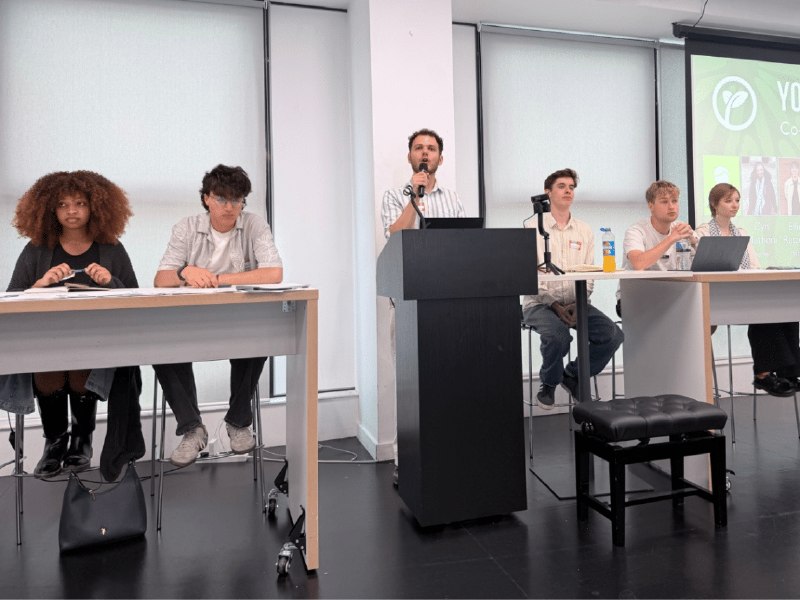
On 19 July 2026, as the Green Party of England and Wales prepares for an internal ballot that will decide the next co-chairs of its youth wing, the most striking feature of the contest is what is missing: a dissenting position. Both candidates bidding to lead Young Greens have publicly affirmed an anti-Zionist stance, according to analysis published by The Canary on the same morning. The unanimity is the story. It marks a deliberate departure from the cautious, often equivocal language the broader British left has deployed since the October 2023 Hamas attacks and the subsequent war in Gaza, and it lands at a moment when Labour's leadership has spent eighteen months hardening its own definitions of acceptable criticism of Israel.
The point is not that two young activists hold a particular view of the Middle East. Many Britons do. The point is that the institutional vehicle they are about to inherit has chosen, unanimously, to describe itself in terms that the governing party, the opposition front bench and a string of recent High Court rulings have all treated as either contested or out of bounds. That tells you something about where the activist edge of British progressive politics now sits relative to the centre of gravity in Westminster.
A coalition without a faction
Young Greens is the youth branch of a party that currently holds four seats in the House of Commons, dozens of councillors across English local authorities and a slice of the proportional representation vote that has kept it relevant in an era designed for two-and-a-half party politics. Its co-chairs matter because the position functions as a pipeline: alumni of the role have moved into Green Party national executive seats, council group leaderships and, less frequently, parliamentary candidacies.
The Canary's reporting frames this election as a test of whether the youth wing will move further from the parent party's strategic restraint. The parent party has, under successive co-leaders, attempted to balance pro-Palestinian solidarity language with the kind of institutional vocabulary British broadcasters and election agents tend to find defensible. The phrase "anti-Zionist" is not in that vocabulary. It rejects the legitimacy of a Jewish national project in any form, which is a categorically different claim from criticism of specific Israeli governments or specific military operations. Both candidates, by adopting it without qualification, have removed the wiggle room that has allowed the Green Party nationally to square that particular circle.
Where Labour draws the line
Keir Starmer's leadership has invested considerable political capital in drawing a firm line between antisemitism and anti-Zionism. The 2024 general election manifesto committed a future Labour government to adopting, in full, the International Holocaust Remembrance Alliance working definition of antisemitism, which includes several illustrative examples referencing Israel. The Party has disciplined members, suspended councillors and reshaped its complaints machinery accordingly. For Labour, anti-Zionism sits inside the perimeter of unacceptable speech; criticism of Israeli government policy does not.
That distinction is contested. The Canary's framing, like much of the British independent left, treats it as a rhetorical sleight of hand: a way of foreclosing solidarity with Palestinians while claiming the mantle of anti-racism. The Labour position, articulated repeatedly by the Party's headquarters and echoed by the Community Security Trust and the Board of Deputies of British Jews, is that the conflation is what fuels harassment of Jewish students, council candidates and synagogue-goers, and that the working definition is the most precise tool available for distinguishing political criticism from prejudice.
The Young Greens election does not formally bind Labour. It does, however, expose the gulf. Labour draws the line; the Greens' youth wing, in this contest at least, is standing on the other side of it.
A wider drift, or a niche signal?
How far this signal travels is the harder question. The Green Party's youth wing is not numerically large. Turnout in Young Greens internal elections typically runs into the low thousands. The candidates' views will not, by themselves, shift the British centre.
But the direction of travel is consistent with patterns elsewhere on the activist left. Student unions at several Russell Group universities have passed similar motions in the past two years. The National Union of Students' elected leadership has moved in the same direction, more cautiously. Momentum, the grassroots organisation that emerged from Jeremy Corbyn's leadership, has been riven by arguments along similar lines. The pattern is not a sudden lurch; it is the consolidation of a position that has been advancing for some time, now reaching an organisational threshold where it becomes visible as a default rather than a faction.
A plausible counter-reading is that this is a self-selecting sample: two candidates who knew the membership and knew what would land well, presenting positions calibrated for the median Young Greens voter. On that view, the result tells us about the membership's preferences, not about British progressive politics broadly. That reading has force. It does not, however, explain why no candidate thought it worth contesting the position, given that a moderate challenger would have an obvious strategic incentive to offer one.
What the next six months will test
The internal ballot will close in the coming weeks. Three downstream moments will indicate whether this unanimity is durable or performative. First, the Green Party of England and Wales national executive will have to decide whether to ratify the new co-chairs' mandate, which is a small but real check on youth-wing autonomy. Second, the next round of local elections in May 2027 will test whether the party's external messaging shifts to match the youth wing's vocabulary, or whether the two run on parallel tracks. Third, any General Election cycle, whenever it comes, will test whether candidates selected under the new regime can hold the line under media pressure and broadcaster challenge.
The honest summary is this: a small organisation has made a unanimous choice that puts it at odds with the vocabulary of the governing party. Whether that choice is a leading indicator or a niche artefact is the question the next year will answer. The fact that no one in the contest thought it worth dissenting is, for now, the data point.
Desk note: Monexus has reported the candidates' platform as described by The Canary and the institutional positions of the Labour Party and the Green Party of England and Wales as they have been articulated in public. The story is one of organisational positioning within the British left; the underlying conflict in the Middle East is treated here only as the backdrop against which that positioning is happening.
Wire provenance
This editorial synthesis draws on the following public wire/social posts:
- https://t.me/s/TheCanaryUK