Two deaths, one flag, the long arc of US-Iran escalation
On 19 July 2026, the US military announced two more American deaths from Iranian attacks, the same afternoon the Iranian flag was raised at MetLife Stadium in front of the US president.
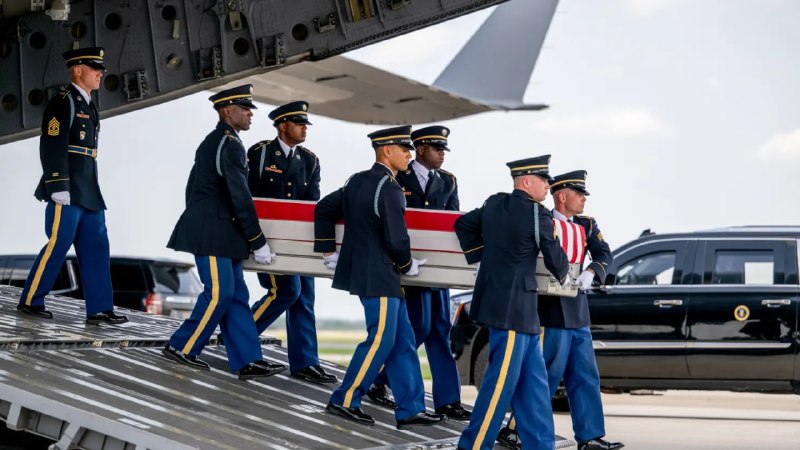
Two American service members are dead and an Iranian flag flew inside a US stadium on the afternoon of 19 July 2026. The pair of facts, arriving within hours of each other, are the cleanest available measure of where the United States and the Islamic Republic stand after months of slow escalation. The US military announced the fatalities at 19:29 UTC. By 19:16 UTC the Iranian tricolour had already been raised at MetLife Stadium alongside the flags of 47 other nations ahead of a final that the US president attended in person. The choreography was not subtle: one flag under stadium lights, two coffins incoming.
The sequence crystallises a contest the wire services have been reporting in fragments for most of 2026. Washington speaks of deterrence and roll-back; Tehran speaks of sovereignty and resistance; and a global sporting stage has, almost without intending to, become the place where the messaging converges. The military announcement and the stadium image are not, on their own, the whole war. They are, however, the whole argument.
What the military actually said
The US military's notification on 19 July 2026, relayed through the Fotros Resistance channel on Telegram at 19:29 UTC, reported two additional American deaths attributable to Iranian attacks. The wording is austere: two more lives added to a running count that has crept upward across the spring and summer. The channel did not specify the theatre of the attacks, the unit affiliation of the fallen, or the operational circumstances of the strikes. That omission matters. Without those details the public is left to read the figure either as a rounding error inside a managed campaign or as confirmation that the cost curve is bending upward.
The sourcing route is itself a fact. Fotros Resistance is an Iranian-aligned channel, and the announcement it carried came from US military communications. Reporting that originates in adversary-aligned outlets but reproduces adversary-government material is, by long convention, treated cautiously by Western newsrooms. The pattern here is familiar: Tehran's information ecosystem often surfaces Western official statements faster than the originating institutions do, packaging them inside a frame that emphasises American losses. That does not make the underlying announcement false. It does mean the reader is meeting a true statement inside a hostile wrapper.
The flag at MetLife
Thirteen minutes before the casualty announcement, Tasnim News, an Iranian state outlet, posted on Telegram at 19:16 UTC that the Iranian flag was raised at MetLife Stadium next to the flags of 47 other countries before the start of a final. Fars News, another Iranian outlet, repeated the framing at 19:08 UTC with the same emphatic note that the display occurred in front of the US president. The underlying event, a multi-national flag ceremony at a major stadium final, is unremarkable in itself; international federations stage such ceremonies routinely.
The Iranian framing turns the unremarkable into the symbolic. Both Tasnim and Fars foreground the same two elements: the Iranian flag's presence, and the proximity of the US head of state. The implicit claim is recognition without reciprocity. Iran sits inside the roster of competing nations; its athletes, or its officials, or both, have earned the platform; and the most powerful man in the Western alliance has watched it happen. The language the outlets use is pointed, describing the stadium in a colour-coded insult aimed at the US president. The translation is unflattering in ways that do not need restating here.
What is genuinely interesting is that the flag ceremony is a fact of tournament protocol. National flags fly at finals because the participating nations have qualified on the field. Iranian participation, and the consequent visibility of the flag, is a function of sporting merit, not diplomatic concession. The Iranian outlets' gleeful framing presupposes a contest over symbolism that the stadium itself, a venue, does not necessarily intend.
The information war inside the information war
The day's two items belong to a single, older pattern. When direct military contact between two powers is constrained, each side leans harder on optics. The US signals through force posture, base access, and public casualty announcements. Iran signals through controlled displays of presence, choreography of regional allies, and a media apparatus that converts routine events into narrative victories. The 21-minute gap between flag and fatality notification is, in that sense, not an accident. Both sides operate on the same clock.
Western readers tend to discount the Iranian framing as theatrics. That discount is partly correct, partly an error. Iranian state outlets do produce agitprop, and the insults they append to their reporting are not analysis. But the underlying reality is that Tehran has spent four decades building an information architecture that reaches audiences the Western wire services do not. In parts of the Middle East, Sub-Saharan Africa, and South Asia, the Iranian framing of US-Iran friction competes on roughly equal terms with the Washington framing. When Tasnim says the flag flew "in front of Trump's eyes," the line lands with intended force across that audience.
The deeper point is that neither side can fully control the optics. The US cannot prevent Iranian athletes from competing in international federations; the IOC and the international football authorities are not US instruments. Iran cannot prevent US casualty notifications from reaching global audiences. The space between the two is where the actual information contest lives.
What remains uncertain
The two announcements, taken together, settle very little. The US military has not, on the materials available here, named the service members, the unit, the date of the attack, or the location. The Iranian outlets have not explained how they obtained the military notification faster than Western wires, though the pattern is consistent with prior reporting cycles. The tournament at MetLife has not, on these materials, been independently confirmed by Western sports media within the window between 19:08 and 19:29 UTC, though the existence of a major final at MetLife in mid-July is plausible on tournament calendars. The framing the Iranian outlets impose on the flag ceremony, that it constitutes a kind of forced recognition, is a reading rather than a fact.
What can be said with more confidence is that the cost of the present trajectory is no longer abstract for either side. Two American families will receive the formal notification that goes with a casualty announcement. Iranian athletes will return home from a tournament hosted in the country whose president their state media describes in vivid terms. Each outcome feeds back into the political constituencies that, on both ends, profit from continued confrontation. The structural argument is plain. When both sides find domestic reward in escalation, the off-ramp has to be either a negotiated settlement that lets each side claim victory, or an external shock that changes the calculation. The materials available here do not point at either.
What to watch next
Three signals will matter more than rhetoric in the coming weeks. First, the formal US military identification of the two service members, which will convert the announcement from a number into a name and a unit. Second, the official White House read-out of the MetLife appearance, which will indicate whether the administration treats the Iranian flag's display as a non-event or as a provocation. Third, the next round of Iranian state-media framing around any US military move in the Gulf or in Iraq, which will reveal whether Tehran is preparing for another escalation cycle or holding at the current temperature.
The day's image, two flags and two deaths within twenty minutes, is not a turning point. It is a snapshot of where the line sits on 19 July 2026: inside an active casualty count on one side, inside a stadium ceremony on the other, and inside an information contest that both sides treat as part of the war itself.
This publication treats the 19 July 2026 military announcement and the MetLife flag display as separate facts with separate sourcing chains, and resists the urge, common in both Western and Iranian coverage, to read either one through the lens of the other.
Wire provenance
This editorial synthesis draws on the following public wire/social posts:
- https://t.me/FotrosResistancee
- https://t.me/tasnimplus
- https://t.me/farsna
- https://t.me/FotrosResistancee
- https://t.me/tasnimplus