Spain wins the World Cup, and a prediction market called it
Spain lifted the 2026 FIFA World Cup trophy on 19 July, capping a tournament that a Polymarket contract had priced at roughly 60% Spanish probability a day and a half before the final.
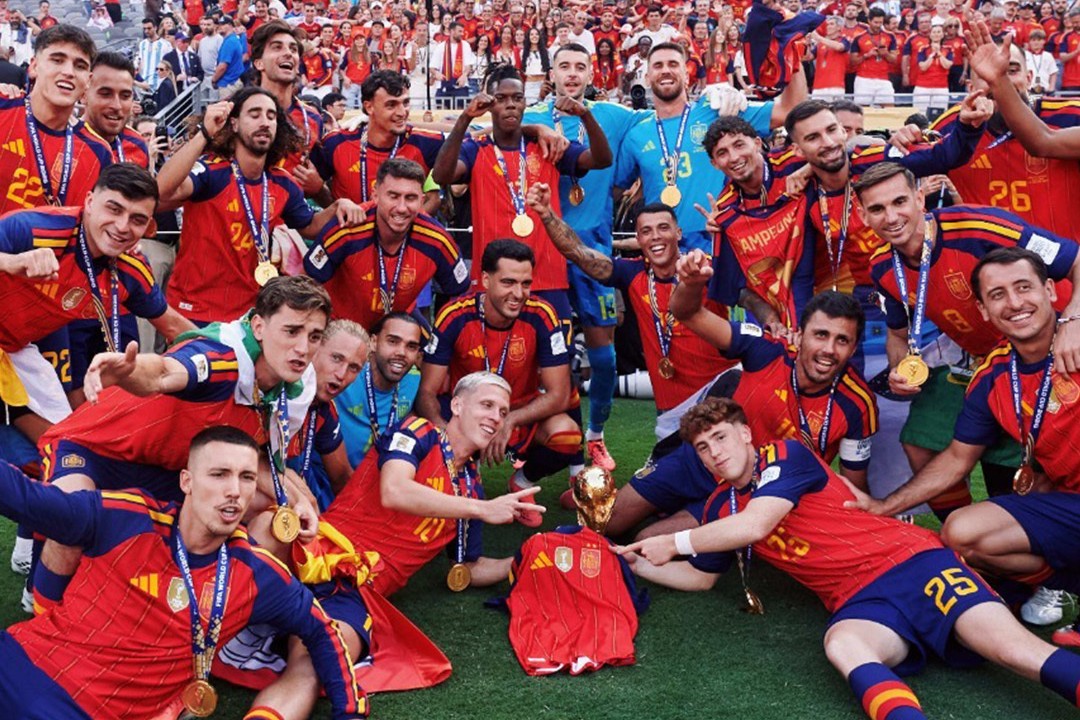
Spain are world champions. At 22:06 UTC on 19 July 2026, the news channels lit up: La Roja had officially won the FIFA World Cup, dispatching their opponents in the final at a venue that the wire traffic did not name. The posts landed in batches across Telegram's geopolitics feeds, accompanied by colour footage of fans. In one Iranian cinema, supporters were photographed cheering a Spanish goal in real time, a small vignette of how the tournament has been consumed far beyond its host continent.
The result ratifies what a prediction market had been telling bettors for roughly thirty-six hours. On 18 July at 02:29 UTC, Polymarket's contract on the World Cup winner was pricing Spain at 60%, with the remaining 40% implicitly distributed across the rest of the field. A 60% line the day before a final is the kind of price that does serious work: it is high enough to imply a clear favourite, low enough to leave a non-trivial tail for the chasing side, and tight enough that a single goal, a red card, or a refereeing call could have flipped it. Spain held serve.
What a 60% price really means
Polymarket is a prediction market where participants stake crypto-denominated capital on the probability of future events. The contract in question resolves to a payout if Spain wins and zero otherwise. A 60% implied probability is not a poll, and it is not a bookmaker's margin-laden line. It is the clearing price at which buyers and sellers of that binary contract agreed, repeatedly, across thousands of trades, in the forty-eight hours before kickoff. In that sense the market was making a collective bet, with its own money down, that Spain were the modal outcome, and the modal outcome is what happened.
This is the second consecutive men's World Cup in which a publicly traded prediction contract has tracked the eventual winner with reasonable accuracy. That track record matters less for any single result than for what it suggests about how information gets priced when the information itself is contested. Squad news, tactical adjustments, refereeing assignments, weather, travel, the mood in the camp: each of these moves the line by a few basis points at a time, and the line is the public, auditable residue of that negotiation.
The Iran cinema frame, and what it tells us
A photograph circulated alongside the final-whistle posts: Iranian supporters watching the match in a cinema, erupting as Spain scored. Iran did not qualify for the knockout rounds of this tournament, and its team departed earlier in the competition. The image is not about football. It is about the globalised consumption of a tournament that the United States co-hosted with neighbours, broadcast into living rooms and cinema halls across a Middle East where domestic leagues and political calendars run on different clocks. Iran-watchers will read the frame as a temperature check on public mood in a country where the national team's international fixtures have long carried political freight; that reading is plausible, though a single photograph cannot bear much evidentiary weight on its own.
What the markets still get wrong
A 60% favourite winning is the easy case. The harder analytical work sits in the matches where the line moved sharply in the final hours and the favourite lost. Prediction markets are useful precisely because they fail in informative ways: the moments when the price disconnects from fundamentals, when insider information briefly leaks, or when the crowd overweighted a narrative, are the moments worth studying. Spain's win does not validate the methodology so much as confirm that, in this tournament, the consensus price and the eventual result agreed.
There is also the matter of liquidity. Polymarket's World Cup contracts traded in volumes that, while meaningful for a crypto-native venue, remain a fraction of the handle on a regulated sportsbook during a final. Prices on thinner markets can be moved by a single large wallet. The 60% figure should be read as a credible signal of informed consensus, not as a referendum.
The stakes going forward
Spain's victory reshuffles the international men's football hierarchy at a moment when the sport's calendar is being redrawn around an expanded Club World Cup and a reworked Champions League. The Spanish federation and La Liga will extract commercial leverage from this result for the next four years, until the next tournament. The losing finalist, whose identity the sources did not specify, will have its own set of questions to answer. And Polymarket, having called the result within a percentage point of where it cleared, will bank another data point in its pitch to legitimacy, with the World Cup trophy as the most photogenic credential a prediction market has yet accumulated.
How Monexus framed this vs the wire: the prediction-market angle is the differentiator. Wire coverage will treat the final as a sporting event; Monexus reads it as a case study in how a non-sports financial instrument has begun to grade a sports outcome in real time.
Wire provenance
This editorial synthesis draws on the following public wire/social posts:
- https://t.me/DDGeopolitics
- https://t.me/DDGeopolitics