Saylor draws the line on Bitcoin's spam filter, just as Washington redraws its balance sheet
The largest corporate holder of Bitcoin rejects a plan to prune non-financial data from the chain, even as the US national debt hits a record $39.5 trillion.
On 19 July 2026, Michael Saylor walked into a Bitcoin policy fight carrying the largest corporate treasury in the industry and a simple warning: a popular proposal to clean up the blockchain would not clean it up at all. Writing on X and amplifying through a CoinDesk report the same afternoon, the Strategy executive chairman argued that BIP-110, a temporary soft-fork designed to filter non-financial "spam" data from Bitcoin blocks, would entrench a precedent that future regulators and core developers could weaponise against ordinary users. Hours earlier, a WatcherGuru post had captured Saylor musing about his next Bitcoin purchase with a four-word teaser: "What's next?" The juxtaposition is the story.
Saylor is no longer just a buyer. He is a structural participant in a network whose credibility rests on its inability to choose winners and losers among transactions. The objection he has now registered, that "spam" is in the eye of the beholder, is the kind of argument that lives in mailing lists and academic preprints in quieter weeks. On 19 July 2026 it broke through, because the man who turned a balance sheet into a Bitcoin vehicle is the same person telling a wider audience that the network's plumbing should not be touched by anyone, including the people trying to fix it.
The proposal and the pushback
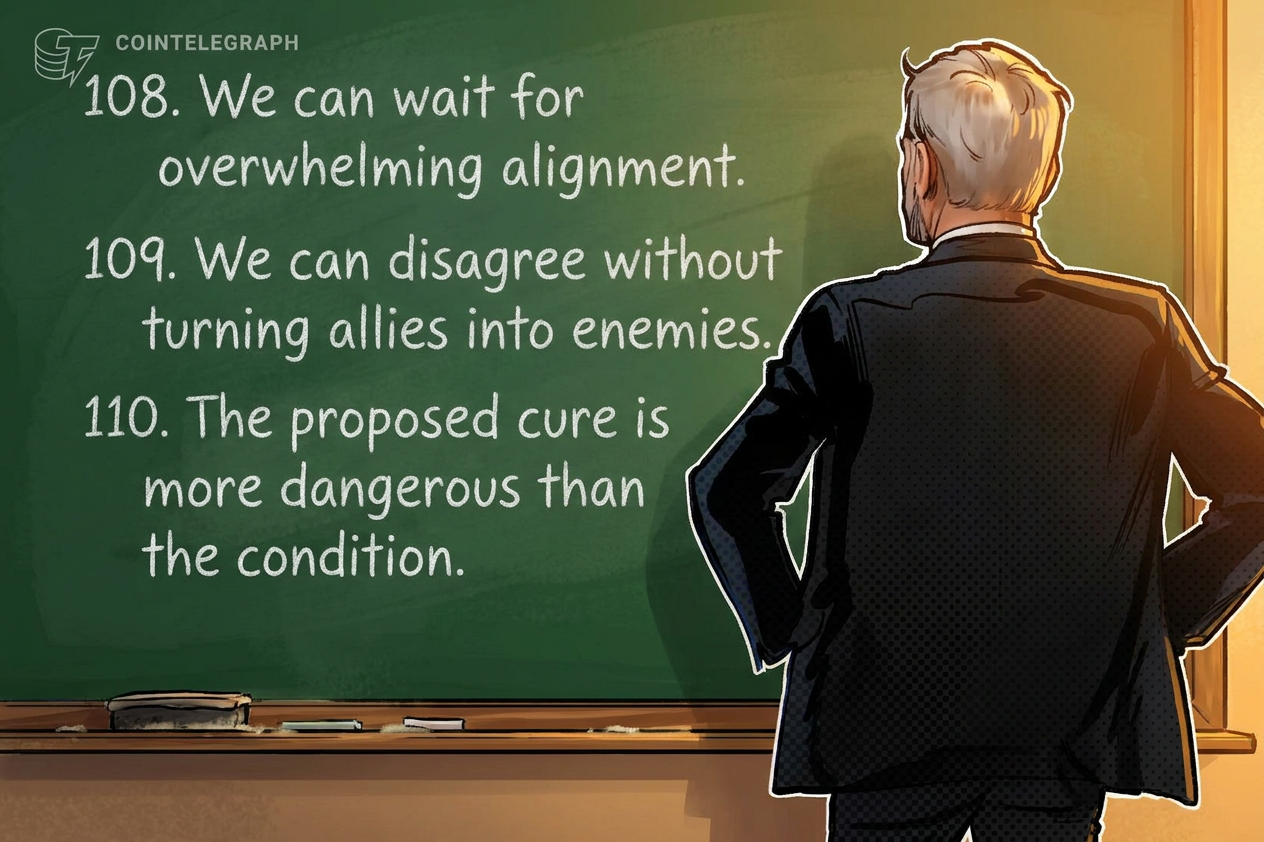
BIP-110 is the latest in a decade-long sequence of attempts to constrain non-payment data on Bitcoin, from OP_RETURN size debates to the ordinals flare-up of 2023-2024. The 110 version, covered in detail by CoinDesk on 19 July 2026, is unusually explicit about its political theory: a temporary consensus rule would let node operators decline to relay or include transactions that carry data the operator judges to be junk. The mechanism is opt-in rather than mandatory, and the rule would expire on a fixed date, a design choice intended to make the change feel reversible. Saylor's reply, carried by Cointelegraph on the same day, was that the proposal "shares the objectives" of keeping Bitcoin efficient but "disagrees about the remedy." His stated worry: once the network's relays can refuse to forward transactions on subjective grounds, the door to censorship is technically, even if temporarily, ajar.
The objection has force on its own terms. Bitcoin's value proposition to institutional treasuries, including Strategy's roughly 580,000-BTC position by mid-2026, is not merely price exposure. It is the assurance that no counterparty, not a sovereign, not a payment network, not a competing miner, can be given a switch to revoke a confirmed transaction. Any change that introduces operator discretion at the relay layer, even as a temporary carve-out, asks that constituency to trade a small amount of block-space inefficiency for a non-trivial amount of new discretion. Saylor, who has spent the better part of three years selling that very assurance to corporate boards, is doing the arithmetic out loud.
The balance sheet in the background
The same weekend, on 17 July 2026, the US Treasury reported a national debt of $39.5 trillion, an all-time high carried by WatcherGuru and consistent with Congressional Budget Office projections earlier in the year. The figure matters here because it is the macroeconomic backdrop against which Saylor's Bitcoin advocacy now operates. Strategy's pitch, refined through four successive corporate-debt offerings and a preferred-share structure tied to BTC performance, is that an inflation- and policy-exposed balance sheet can be hedged by parking a meaningful share of capital in a fixed-supply digital asset. The debt number is not a Bitcoin argument in itself, but it sharpens the audience for one.
This is where the two Saylor signals of the week cohere. The "what's next" purchase hint, broadcast 12:38 UTC on 19 July 2026, and the anti-BIP-110 essay, posted later the same afternoon, are the two halves of a single posture: accumulate the asset, defend the protocol. Both moves assume a world in which the dollar-denominated alternative continues to dilute, and in which the marginal institutional buyer needs not just a return but a settlement network that cannot be retroactively edited by a regulator who wakes up one morning worried about stablecoin reserve audits, sanctions evasion, or, less plausibly but not impossibly, the wrong kind of meme.
The structural frame, in plain language
Bitcoin's neutrality is not a marketing line. It is the specific property that distinguishes the asset from any other bearer instrument that governments already control. That property has been under quiet pressure for years as the chain has become host to inscriptions, BRC-20 tokens, and an expanding set of non-payment use cases. Each wave brings a recurring temptation: prune the clutter, free up block space, lower fees for payments users. The technical community's traditional answer has been that there is no politically neutral arbiter of what counts as clutter, and that the only safe rule is to let miners and relays include whatever pays the fee. BIP-110 reopens that argument with a more polite vocabulary: temporary, opt-in, expiring. Saylor's answer is the older one, dressed in corporate-risk language: do not build the switch, even temporarily, because someone will eventually reach for it.
The trade-off is real. Bitcoin blocks are not free. A network that hosts high-volume non-payment data raises fees for the small Lightning-channel user in Lagos or Buenos Aires who is trying to move ten dollars. A network that gives relay operators an editorial veto raises a different cost: it becomes legible to the kind of state actor who would, in extremis, lean on a sufficiently concentrated mining or relay industry to silence a particular address class. Saylor is arguing, in effect, that the second cost compounds in ways the first does not. It is not the strongest possible version of the case; critics will point out that mining concentration already gives large pools a de facto veto. But it is the version being made by the person with the most to lose from being wrong.
Who wins, who loses, what to watch
If BIP-110 ships and gains adoption, the immediate beneficiaries are block-template optimisers, fee-sensitive payment users, and a set of non-payment projects whose data would either migrate to other chains or simply disappear. The losers are the institutions that have built custody and treasury strategies on the explicit promise of an editor-free ledger. If BIP-110 fails to ship or fails to gain hash-rate adoption, the reverse holds, and the precedent set is the more cautious one: Bitcoin's neutrality survived another stress test, and the case for treating it as a balance-sheet-grade reserve gets marginally stronger.
The short-term calendar is straightforward. WatcherGuru's "what's next" post on 19 July 2026 is a tease, not a purchase; Strategy's 8-K filings are the actual record. Watch the next quarterly earnings call, due in early August, for incremental BTC-per-share guidance. On the protocol side, BIP-110 has to clear node-software adoption thresholds measured in months, not days; the meaningful vote is whether mining pools signal support through template choices, not whether developers merge code. And on the macro side, the $39.5 trillion debt print, recorded on 17 July 2026, will be revised monthly; it is the slow-moving variable that keeps both the BIP-110 fight and the next Saylor purchase inside the same frame.
What remains genuinely unsettled is whether the BIP-110 coalition can frame the proposal as a temporary fix in anything more than name. Temporary forks have a habit of becoming permanent institutions, particularly when the institutions they enable are staffed by people who would prefer the rules to stay. Saylor's intervention does not settle the question. It does ensure that the question is now being asked, publicly, by the constituency with the most concentrated interest in the answer being no.
This desk note describes how Monexus framed the story versus how the wires did. Cointelegraph and CoinDesk led on the BIP-110 mechanics and on Saylor's quoted objection. WatcherGuru carried the secondary purchase hint and the $39.5 trillion debt print. Monexus reads the two together: a balance-sheet actor defending a settlement network against a maintenance patch, against a backdrop of record sovereign debt.
Wire provenance
This editorial synthesis draws on the following public wire/social posts:
- https://t.me/WatcherGuru
- https://t.me/WatcherGuru