Jewish anti-war marchers step to the front of London’s Palestine solidarity movement
A Jewish-led march through central London on 19 July put anti-war Jewish activists at the visible head of a wider Palestine solidarity movement that organisers say faces growing state repression.
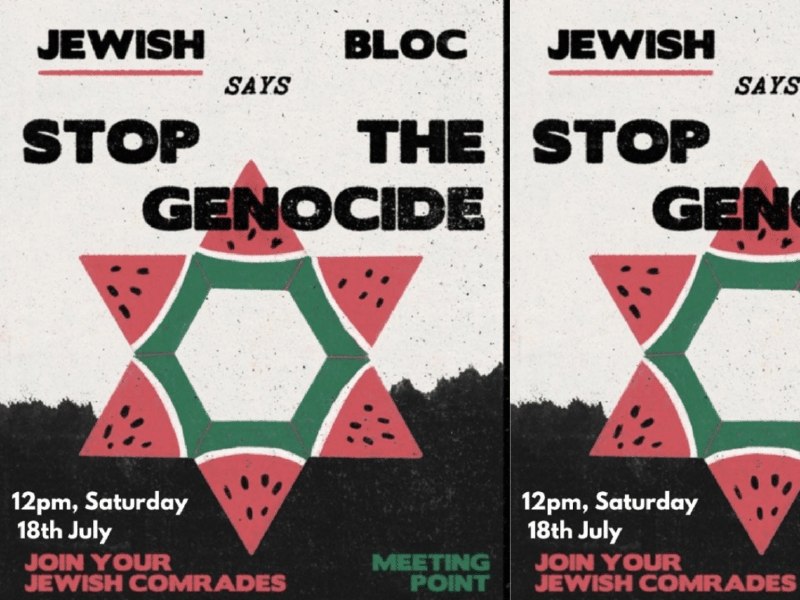
A column of Jewish anti-war activists marched at the head of a London demonstration for Palestine on 19 July 2026, an arrangement that puts a minority community traditionally characterised as politically marginal to the solidarity movement at its most visible edge. The image is unusual: marchers carrying banners that paired Jewish religious and cultural symbols with explicit opposition to the war in Gaza, walking under a Jewish-led bloc while a much larger Palestinian-solidarity crowd followed behind. Skwawkbox, the left-leaning UK outlet that published the photographs and a short report on 19 July 2026, framed the march as a direct rebuke to a British political class that, in its telling, has worked to criminalise anti-war speech while leaving the underlying war untouched.
The march matters less for its headline turnout than for who stood at its front. Jewish-led anti-war organising in the UK has, for the duration of the Gaza war, occupied an awkward political position: structurally inside a community the establishment claims to be defending through its foreign policy, and structurally outside a solidarity movement the same establishment has spent eighteen months trying to restrict. Putting visibly Jewish, visibly anti-war marchers at the head of a Palestine demonstration collapses the distance between those two positions. It also denies the government the cleanest line it has tried to draw: that opposition to the war is, by definition, opposition to Jewish safety.
A march the Home Office did not want
Skwawkbox's report carries an unmistakable edge. The outlet argues that the British establishment has worked systematically to demonise and repress anti-genocide protest, while protecting a foreign-policy posture the marchers describe as complicit in mass civilian harm. That framing lands inside a wider pattern the UK left has been documenting since autumn 2023: repeated police interventions under the Public Order Act 2023, attempts to use the definition of extremism in the now-defunct Prevent guidance to characterise Palestine solidarity as a radicalising pathway, and steady pressure on local authorities to treat pro-Palestine rallies as security events rather than political assemblies.
The 19 July march fits inside that record. Photographs show a heavy police presence along the route, and Skwawkbox's coverage positions the demonstrators as the disciplined, lawful face of a movement the state has tried to delegitimise before it reaches the street. The point of the photographs is not the crowd count. It is the order, the placards, and the demographics of the front line.
Why the Jewish bloc matters politically
The political value of a Jewish-led front is not symbolic. It is operational. Inside the British discourse on Israel-Palestine, two claims have done most of the work of suppressing Palestine solidarity: that opposition to the war is antisemitic, and that Jewish communities in the UK are uniformly Zionist. A march whose lead contingent is composed of Jewish activists carrying explicit anti-war messages forces a direct confrontation with both claims. It does not resolve them, but it makes them harder to assert without visibly erasing Jews who disagree.
There is a strategic logic to the choice. British Jewish anti-war groups, several of which have existed for decades and reactivated forcefully after October 2023, have spent the war arguing that the conflation of Jewish safety with Israeli state action is itself a form of antisemitism. Marching at the front of a Palestine demonstration, rather than alongside it, makes that argument visible in a way press releases cannot. It also pre-empts the most common media frame for any Palestine rally: the framing of counter-protesters as the day's real story.
The structural frame, in plain terms
What the march exposes is a long-running asymmetry in how the British state allocates the language of harm. When the cause is Israeli security, the apparatus of public order bends toward protection. When the cause is Palestinian life, the same apparatus bends toward restriction. The two postures are not symmetrical, and the disparity is the point. The march on 19 July is, in this sense, less a single protest than a counter-demonstration against a domestic political settlement that has held for nearly two years: a settlement in which support for Palestinian rights is treated as a security cost, and dissent from it as a policing problem.
That settlement has been challenged in the courts, in the high-street boycotts, in the university occupations of 2024, and now in the visible politics of who gets to lead a march. The pattern is consistent: the establishment prefers a Palestine solidarity movement it can describe as fringe, unrepresentative, and disproportionately young. A Jewish-led front complicates that picture without resolving it.
What remains contested
The 19 July march is documented, in the materials available to this publication, primarily through Skwawkbox's own reporting and its accompanying photographs. Independent verification of turnout, route, and any police action taken against marchers has not yet appeared in the wire reporting we have reviewed. The political reading of the event, in particular the characterisation of the British state as systematically repressive of anti-genocide protest, is Skwawkbox's framing rather than a neutral observation: it is a left outlet writing about a left cause, and the claims it makes about establishment behaviour should be tested against the court records, the Home Office statements, and the protest-monitoring data of bodies such as Netpol before being treated as settled fact. What is not in dispute is that Jewish activists chose, on 19 July 2026, to walk at the head of a London march for Palestine, and that the photographs of that choice are now in circulation.
The next test will be whether the mainstream press treats the march as a story about Jewish political dissent, or folds it back into the older frame in which any Palestine rally is read, by default, through the lens of communal tension. The marchers have done what they can to set the terms. The reporting will tell the rest.
Desk note: Monexus frames this story as a domestic UK question about protest rights and political representation, anchored to Skwawkbox's own on-the-day reporting and photography. The outlet's editorial position is named, not adopted wholesale; the underlying factual claim (a Jewish-led march on 19 July 2026) is treated as established, while the broader characterisation of UK state behaviour is held open for independent verification.
Wire provenance
This editorial synthesis draws on the following public wire/social posts:
- https://t.me/TheCanaryUK