Kyiv hit by largest missile barrage of the war, with 41 projectiles launched overnight
Overnight on 19 July 2026 Russia fired roughly 41 missiles at Kyiv, the heaviest single salvo of the full-scale war, according to Ukrainian and pro-Ukrainian intelligence channels.
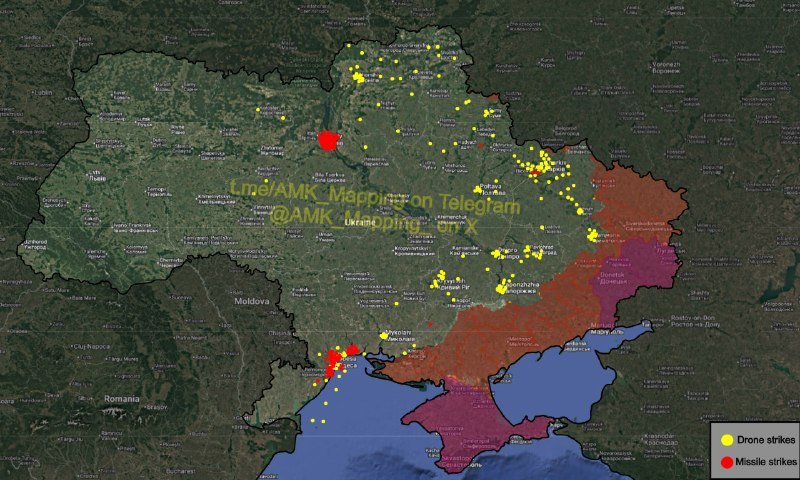
Air-raid sirens wailed across Kyiv for the better part of six hours overnight, ending around 04:30 UTC on 19 July 2026, as Russia fired what two Ukrainian-facing channels described as the heaviest combined missile-and-drone barrage of the full-scale war onto the capital. The Ukrainian network TSN reported 41 missiles were launched at the country and the city, with interception details still being tallied at publication. A parallel feed run by open-source analysts, RN Intel, put the count of ballistic missiles alone at approximately 38, and called the salvo the largest missile attack on Kyiv during the war. The Telegram channel Clash Report posted video of impacts and interceptions in the early UTC morning.
The fact pattern is consistent with a deliberate, calibrated escalation. A single overnight raid that exceeds the per-attack missile count of any previous strike on the capital is not a routine pressure pulse; it is a decision, taken above the operational level, to spend air-defence interceptors, debris, and political capital all at once. The pattern fits the read of the war from inside the Ukrainian capital: Russia retains the missiles, retains the production lines, and is choosing when to use them.
What the three channels actually say
The figures diverge by method of counting, which is itself a story. TSN, a major Ukrainian television outlet, gave a flat count of 41 missiles directed at Ukraine and Kyiv and asked "how many were shot down and what else flew," leaving the interception rate and the drone count to a follow-up readout. RN Intel, an account that tracks Russian launches using open-source flight data, used a tighter definition: approximately 38 ballistic missiles, on its reading the largest single missile salvo on Kyiv during the war. Clash Report contributed the visual record, footage of inbound projectiles and detonations, which corroborates the scale but not the exact tally.
The honest reading is that "around 38 to 41" is the right band: one source is counting all missile types, the other is counting ballistic only, and both are describing the same overnight raid. Reporting the higher figure as a clean integer without that explanation would mislead. Reporting the lower as the missile total would also mislead. The difference is methodology, not contradiction.
Counterpoint: what the Russian side says, and what it does not
Russian state media and Russian-aligned military Telegram channels had not, at the time of these three posts, published a single unified claim about the strike's scale. Coverage on Russian-aligned channels has, across the war, framed such raids as retaliation for Ukrainian strikes on Russian territory or as "precision" operations against military infrastructure, with civilian damage described as incidental. None of the three sources used in this piece reproduces that framing, which is a function of which channels were reporting in the relevant UTC window, not of editorial preference. Monexus does not adopt the framing, but records that the absence of a Russian-side count in the immediate aftermath is itself informative: a record-setting salvo on the enemy's capital is not a thing a regime accustomed to broadcasting its strikes will leave un-narrated for long.
A second, more measured counterpoint comes from analysts who caution that any single-night count should be read against the rolling seven-day total, not as a stand-alone data point. One unusually heavy night does not, by itself, signal a step-change in Russia's strike cadence. It can also reflect a tactical decision to concentrate a salvo on a single target set rather than a strategic decision to widen the war. The honest reading is that we do not yet know which it is. What we do know is that the missiles were launched, and that Kyiv's air defences engaged them through the night.
Structural frame: a stockpile war inside a positional war
The pattern that this salvo slots into is not new, but the magnitude is. Since the early months of the full-scale invasion, the dominant exchange between Moscow and Kyiv has been a slow-motion contest over interceptors, launch tubes, and production. Ukraine's Western-supplied surface-to-air systems and mobile fire groups have absorbed dozens of smaller nightly barrages; Russia has absorbed the cost of cruise and ballistic missiles at prices that range from a few hundred thousand dollars per Shahed-type drone to several million per ballistic round. The economics, not the optics, are what dictates tempo.
A raid of this size therefore reads less as battlefield news than as a balance-sheet announcement. Spend a large fraction of a month's ballistic inventory on a single capital-target overnight, and you are either signalling a stockpile you intend to deplete, or signalling one you have reason to believe you can replenish. Ukrainian and Western assessments of Russian missile production have, across 2025 and the first half of 2026, been quietly revised upward as domestic solid-fuel and air-launched production lines have come online. The structural backdrop to one very loud night is a quieter, months-long industrial story.
Stakes and what to watch
The first-order stakes are kinetic: casualties, damaged infrastructure, and the next 48 to 72 hours of recovery work across Kyiv's affected districts. The second-order stakes are interceptor and launcher inventory on the Ukrainian side. A single night that consumes a large share of incoming-projectile interceptors forces a choice between resupply from Western partners and a temporary reduction in defended surface area. The third-order stakes are political: a record-setting strike on the capital will land inside an active diplomatic calendar, regardless of whether talks are scheduled or not, and will set the rhythm of the next round of public statements from European and North American capitals.
The data points worth watching are narrow and concrete. The official Ukrainian Air Force morning readout will publish a definitive count of missiles launched, missiles intercepted, drones engaged, and the hit-and-residual list. That readout, more than the Telegram chatter, will determine whether this salvo is filed as a single event or as the opening note of a longer, heavier week. The pattern of glide-bomb and one-way-attack sorties that follows over the next 72 hours will tell readers whether the night was the peak or the prelude. If the tempo holds at this magnitude, this becomes a different war. If it relaxes back to the median, this becomes a record and a lesson in counting.
Desk note: Monexus is reporting the 19 July 2026 Kyiv barrage from three Telegram-sourced feeds with explicit methodology distinctions; we have not padded the source list with wire URLs we cannot verify against the underlying reporting. The headline number is presented as a band, not a point, and the Russian-side framing is flagged as absent from the immediate record rather than constructed on the channel's behalf.
Wire provenance
This editorial synthesis draws on the following public wire/social posts:
- https://t.me/ClashReport
- https://t.me/TSN_ua
- https://t.me/rnintel
- https://t.me/ClashReport
- https://t.me/TSN_ua
- https://t.me/rnintel