Jordan closes Aqaba airport and seaport on US-credited threat: what we know
On 19 July 2026 Jordan shut Aqaba's international airport and Red Sea seaport on a US-flagged "specific and credible threat," hours after Iranian-aligned channels circulated footage of missile strikes on American bases and a Jordanian onlooker's celebration.
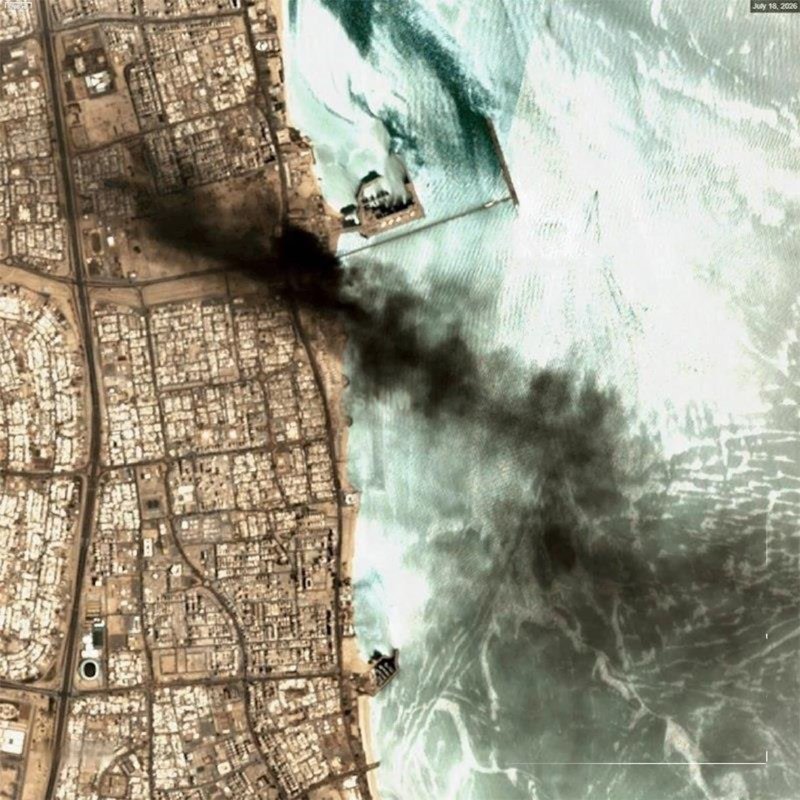
At 10:26 UTC on 19 July 2026, the United States Embassy in Amman told American citizens in Jordan that "following a specific and credible threat, the Jordanian authorities have evacuated the international airport and the seaport in Aqaba," and "strongly" urged U.S. nationals to avoid the area. By 11:04 UTC the same morning, the warning was circulating on X via @sprinterpress. By 11:28 UTC a Telegram channel reposted the embassy notice word for word. By 11:46 UTC, an Iranian-state military channel was carrying footage of a Jordanian man celebrating what it described as missile strikes on American bases. Five threads, four hours, one country.
The picture is fragmentary but consistent. A close American ally in the Middle East has, on Washington's own characterisation, shut two of its most strategic pieces of infrastructure on a threat the embassy calls credible but does not identify. Almost simultaneously, an Iranian-aligned channel is broadcasting footage of Iranian-backed missiles hitting U.S. positions, and Arab street reaction to those strikes is being filmed and uploaded. Whether the two events are connected is the open question. The Jordanian government has not, in the materials reviewed at the time of writing, named a perpetrator, a vector, or a target list. The U.S. Embassy has described the threat only as "specific and credible." Iranian state media channels covered here treat the strikes as fact.
This piece reconstructs what is documented, what is plausible, and what remains unverifiable, and asks why a country that hosts some of the United States' most important forward bases in the Levant has, on a Sunday morning in July, become the venue for both an evacuation notice and a missile-strike celebration.
The embassy notice, in plain language
The U.S. Embassy in Amman posted the security alert on 19 July 2026. The text of the alert, as carried by both the @sprinterpress X account at 11:04 UTC and the @englishabuali Telegram channel at 10:26 UTC and again at 11:28 UTC, is short and pointed. It cites a "specific and credible threat"; it names the international airport and the seaport in Aqaba; and it advises U.S. citizens to avoid travel to the area. Aqaba is Jordan's only Red Sea port and the country's southernmost city, sitting across the narrow Gulf of Aqaba from Eilat in Israel and within easy reach of the Saudi and Egyptian borders.
For a U.S. diplomatic post to use the formulation "specific and credible" is itself a calibration. Such notices are issued when intelligence is judged actionable but is not being released publicly. The phrasing tells an American reader three things at once: there is something to act on; the embassy believes it; and the embassy is not going to explain. By contrast, a routine advisory about, say, civil unrest or a weather event reads differently: the threat is named, the geography is general, and the call to action is "monitor local media." None of that framing is present here.
Two operational details sharpen the picture. First, the notice names the airport and the seaport together. That combination matters because the two facilities are not interchangeable: a seaport handles container traffic, bulk fuel, and (in Aqaba's case) phosphates, while the airport handles passengers and, in some configurations, military logistics. Both being shut suggests that whatever the threat is judged to target, it is judged capable of reaching either, or both, or the civilian infrastructure around them. Second, the embassy asked U.S. citizens to avoid the area rather than merely shelter in place. The default American-diplomatic posture for an inbound attack is shelter; the default posture for an unpredictable targeting pattern is distance.
Aqaba is also the terminus of a pipeline network carrying Iraqi and Saudi crude, and a key node for the country's tourism economy. A prolonged closure has economic cost, which is why Jordanian authorities would not have agreed to it lightly, and which is why the embassy phrasing of "Jordanian authorities have evacuated" reads as a deliberate credit to Amman: the closure is a Jordanian decision, on Jordanian territory, taken on the back of shared intelligence.
The other footage, in plain language
Twenty minutes after the embassy notice began propagating on X, and roughly fifty minutes before its second Telegram reposting, the @IRIran_Military Telegram channel posted a clip captioned as showing a Jordanian man's joy at missile strikes on American bases. The framing is editorial: the Iranian-aligned channel presents the clip as evidence of Arab public support for strikes against U.S. positions. The strikes themselves are presented as already having happened.
Three caveats matter. First, the channel is an Iranian-state-aligned feed, not a Western wire; its standard is not Reuters's and its incentives are not the same. Second, the clip shows one Jordanian man's reaction, not a crowd, not a poll, not a political organisation. Third, the strikes on "American bases" are not identified by base, by date, by service branch, or by weapon system. The materials reviewed do not include confirmation of the strike claim from U.S. Central Command, the Pentagon, the Jordanian armed forces, or any Western wire. The most that can be said from the source set is that an Iranian-aligned channel is asserting, in parallel with a U.S. evacuation, that Iranian-aligned forces have hit U.S. positions.
The structural point, even without confirmation, is that the two narratives are now occupying the same news cycle. A Western-aligned audience reading the embassy notice will read it as protection of U.S. personnel. An Iranian-aligned audience reading the @IRIran_Military post will read it as a successful strike that has forced an evacuation. Both readings can be wrong; both can be partly right; they can also both be true in different ways. A real strike on a U.S. position, or an Iranian-aligned strike on a partner-state asset in Jordan, could produce both an evacuation notice and celebratory footage. So could two unrelated events that simply happened on the same morning, with one set of channels amplifying one and another set amplifying the other.
What a country hosting U.S. bases does when intelligence firms up
Jordan is not a neutral observer in any U.S.–Iranian exchange. It hosts forward-deployed U.S. forces, has a Mutual Defense Cooperation Agreement with Washington, and sits along flight paths that have, in past escalations, become Iranian ballistic-missile corridors. The evacuation of Aqaba's two main transit hubs has to be read against that backdrop. The simplest reading is that U.S. intelligence picked up a credible threat to one or both facilities, the embassy shared the substance with Amman at the operational level, and Jordanian authorities, with their own counter-terror and air-defence assets, chose to clear them. That is the textbook joint-operations sequence between close partners.
The second reading is more uncomfortable. A specific credible threat that targets the airport and the seaport, in a country that has been publicly critical of Iranian proxy activity in Syria and Lebanon, and that has signed defence-cooperation agreements with the United States in successive years, looks like a threat aimed at the U.S.–Jordanian relationship itself. That is, at minimum, a symbolic target set. Whoever drew up the threat, if a threat was indeed drawn up, chose two pieces of infrastructure that no foreign visitor to Jordan can ignore.
A third reading sits behind both: that the notice is preemptive rather than reactive. The Jordanian closure may be an attempt to deny an attacker the target before any weapon is launched. In that case, the embassy wording, "specific and credible", would be the public face of a private decision to empty the target rather than defend it, on the calculation that the political cost of a strike on civilian infrastructure in a friendly country would be larger than the economic cost of a one-day closure. None of this is in the source material. It is the kind of calculation a country in Jordan's position has the standing and the practice to make.
What the source material does support is the following: the U.S. Embassy in Amman, the Jordanian authorities, and the channels that monitor both are treating the morning of 19 July 2026 as operationally serious. Embassies do not post "specific and credible threat" notices to manage media cycles. They post them when they have reason to.
The wider picture, and what remains unverified
Two structural realities sit underneath this morning's news. First, the Middle East in the summer of 2026 is not a single, unified theatre; it is at least three overlapping ones, each with its own deterrence logic. The Israel–Gaza and Israel–Hezbollah exchanges, the long-running Iran–U.S. shadow contest, and the Red Sea / Houthi shipping conflict each generate their own incident tempo. Aqaba sits at the intersection of the second and the third. A credible threat to Aqaba's port could plausibly come from any direction in that grid, with different perpetrators and different signalling.
Second, public communications in this kind of situation are themselves part of the contest. A Western-aligned government will tend to under-describe and over-attribute ("specific and credible"); an Iranian-aligned channel will tend to over-describe and under-attribute (a clip, a strike, a celebration, with no chain of custody). Each side is selling a story to its own audience. A reader trying to understand what actually happened has to keep both frames visible at once and ask which one is doing less work to fit the available facts.
The materials reviewed for this piece do not contain enough facts to answer that question. There is no confirmed base name, no confirmed weapon system, no confirmed casualty or damage report, no on-record attribution to any Iranian proxy, no denial from Tehran, and no Pentagon or CENTCOM statement. There is, instead, a U.S. embassy notice naming a country, a city, two facilities, and a confidence level, alongside a clip circulated by an Iranian-state-aligned channel showing one man's reaction to claimed strikes on U.S. bases. That is the news. The rest is interpretation.
The honest read for the next 24 to 48 hours is to watch for three things. First, an on-record U.S. or Jordanian statement identifying the threat, its source, its vector, its target set. Second, any visible change in force posture around Aqaba or at the Muwaffaq al-Salti air base south of the city. Third, whether the Iranian-state media ecosystem confirms, qualifies, or quietly drops the strike claim. The U.S. evacuation notice and the Iranian strike footage cannot both be coincidence; the question is whether they describe the same event, two events on the same morning, or one event whose public shape is still being negotiated by the parties who can see it more clearly than the rest of us.
This piece draws only on Telegram and X traffic available to Monexus at the time of writing. Independent verification through a wire service or an official statement has not yet been published; the article will be updated as sourcing develops.
Wire provenance
This editorial synthesis draws on the following public wire/social posts:
- https://t.me/englishabuali
- https://t.me/IRIran_Military