Explosions in Kuwait: What Three Telegram Channels Just Told the World
Within roughly one minute on the evening of 19 July 2026, three Telegram channels flagged explosions and air-defense activity inside Kuwait. The wire has not yet caught up. The first read of what is, and is not, on the record.
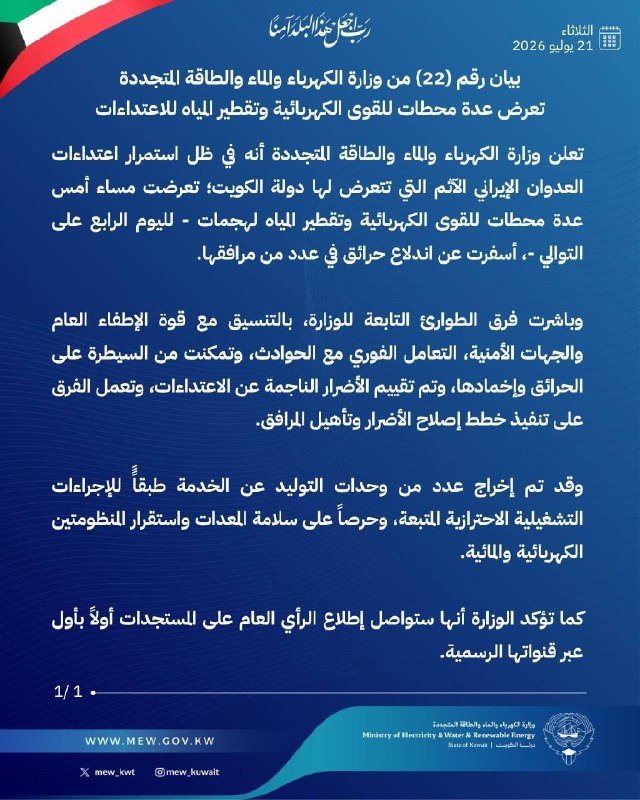
At 18:04 UTC on 19 July 2026, the Telegram channel GeoPWatch posted a four-word alert: "Explosions in Kuwait," tagged with Iranian and Kuwaiti flag emojis and a red cross. Sixty seconds later, Middle East Spectator reposted the same headline under its own byline. A minute after that, the war-monitoring channel War Fighter / WFWitness added two more lines: air-defense activity over Kuwait, and audible explosions.
Three channels, three timestamps, one story. No wire confirmation has appeared at the time of writing. That gap between what the open-source feed is reporting and what the Western wires have not yet said is, increasingly, the story itself.
What the channels actually claim
Read carefully, the three posts are thin on operational detail and heavy on location. GeoPWatch and Middle East Spectator both use the construction "🇮🇷❌🇰🇼 / 🇮🇷/🇰🇼 NEW: Explosions in Kuwait," flagging an Iran-versus-Kuwait framing without naming an Iranian actor, a target, a munition, or a casualty. WFWitness adds the operational claim: air-defense activity, plus audible explosions. None of the three posts identify a launch site, a hit location, a weapon type, or an official Kuwaiti statement.
That is the honest ledger. The flag emojis do a lot of interpretive work that the text itself does not earn.
Why Kuwait, and why now
Kuwait sits roughly 250 kilometres southeast of Iran's Bushehr peninsula across the Persian Gulf, and roughly 120 kilometres south of the Iraqi border. It hosts the Ali Al Salem and Ahmed Al Jaber air bases, both used by US Central Command. Kuwaiti airspace has, in past escalations, been a corridor for intercept activity and a stage for Iranian-aligned messaging. Any report of air-defense engagement on Kuwaiti soil sits inside that geography, whether or not the sources have named it.
The 19 July 2026 timing also lands inside an active regional escalation cycle that has seen direct Iranian strikes on, and through, Gulf-adjacent territory in recent months. Kuwait's official posture since the start of that cycle has been neutrality and de-escalation; its airspace has at times been temporarily restricted when regional flashpoints lit up. The Telegram reports do not contradict that posture, but they sharpen it: a country positioning itself as a non-combatant is now, per three open-source channels, hearing detonations and watching intercepts.
The framing problem
The flag-pair emojis in two of the three posts do most of the causal work. "🇮🇷❌🇰🇼" is shorthand for "Iran versus Kuwait," but no source on the wire, and no Kuwaiti official statement at the time of writing, has named an Iranian actor or an Iranian weapon. The open-source feed is moving faster than the verified feed, and the visual grammar of the Telegram post is filling the gap.
This is the structural story, stated plainly: when civilian channels publish before governments, the interpretive scaffolding is often supplied by the channel's own house style. A red cross over the Kuwaiti flag is not a finding. It is a frame. Readers who see the post and do not read further will exit with a cause attributed, a target named, and an actor identified. None of those three things has, on the record at 18:30 UTC, been independently confirmed.
What we do not know
The sources do not specify whether the explosions were the result of an inbound strike, an interceptor engagement, an accident at a munitions facility, or a controlled demolition. They do not name a launch origin. They do not give a casualty count, a damage assessment, or an official Kuwaiti Ministry of Interior or Ministry of Defence statement. Reuters, the Associated Press, and Agence France-Presse had, at the time of writing, not published a story matching the Telegram reports. The Kuwaiti state news agency KUNA had not, in the channels cited, been quoted.
Until one of those things changes, the responsible read is narrow: three Telegram channels reported explosions and air-defense activity in Kuwait on 19 July 2026 at roughly 18:04 to 18:05 UTC. The rest is inference, and inference travels fast.
The stakes if the trajectory holds
If Kuwaiti airspace is genuinely hosting intercept activity against an Iranian-origin projectile, the Gulf security architecture shifts. Kuwaiti neutrality has been a quiet load-bearing element of regional diplomacy; a confirmed strike on Kuwaiti soil would force a Kuwaiti parliamentary debate over the US-Kuwait Defense Cooperation Agreement and over CENTCOM posture at Ali Al Salem. It would also test whether Iran's signalling doctrine can absorb a non-aligned Gulf state's airspace as a target without triggering collective Gulf action.
If the reports turn out to be a false alarm, or a non-hostile incident at a petrochemical or military facility, the Telegram posts will still have set a public frame. The next time the channels move this fast, readers will treat their house style as fact. That is the slower, structural risk: an information environment in which the gap between open-source reports and verified reporting is filled by emoji, not by evidence.
The events of 18:04 UTC on 19 July 2026 are real in the only sense that matters right now: three channels said so, in public, in sequence. What they meant is the work of the next several hours. Watch for a KUNA statement, a US Central Command read-out, and the first wire confirmation. Until then, the honest version of this story is shorter than the Telegram posts.
Desk note: Monexus has reported only what the three cited Telegram channels have on the record at 18:04 to 18:05 UTC, with no wire confirmation at the time of publication. The flag emoji framing has been treated as framing, not as finding. Where wire outlets eventually publish a fuller version of this story, Monexus will update accordingly.
Wire provenance
This editorial synthesis draws on the following public wire/social posts:
- https://t.me/Middle_East_Spectator
- https://t.me/wfwitness
- https://t.me/GeoPWatch
- https://en.wikipedia.org/wiki/Kuwait