Bethell ducks the milestone, Duckett carries the innings: England take control at Lord's
A 192-run opening stand at Lord's, anchored by Ben Duckett and graced by Jacob Bethell's 91, gave England a series-defining platform against India before the first wicket finally fell.
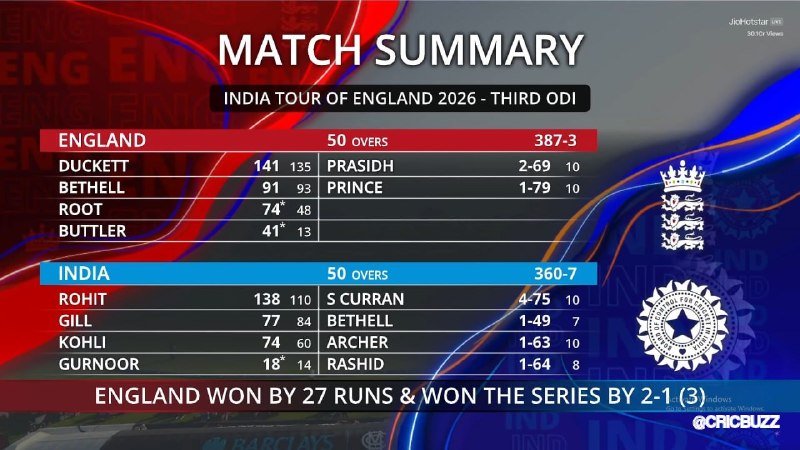
Jacob Bethell's bat was still, briefly, on 91. The ball had been climbing since well before lunch, the runs had come at better than a run a ball, and the young left-hander's pull-shot off a Jasprit Bumrah short ball was travelling comfortably past square leg when the fielder at deep midwicket settled beneath it. The catch, taken low and cleanly, ended a 192-run opening partnership with Ben Duckett and brought an appreciative Lord's crowd to its feet for the second time in two sessions. India, asked to defend a series-deciding total in the third ODI, had finally broken through.
By the time Bethell departed, England had long since taken command of the chase. The arithmetic is straightforward: an opening partnership worth nearly two hundred at better than a run every two-and-a-half deliveries is the rarest of currencies in modern 50-over cricket, and India, who arrived at Lord's with the series level at one apiece, could not afford to spend it on the first morning of the deciding game. Bethell's 91 off 93 balls and Duckett's anchoring presence at the other end tilted the match, and arguably the series, decisively before the visitors had time to settle.
The platform Bethell and Duckett built
England's innings began with a familiar question: how to balance aggression against the disciplined Indian seam attack that has troubled them through the summer. Duckett, in the older role, gave the innings its spine, working the ball into gaps and rotating strike. Bethell, promoted up the order with the assignment of keeping the scoreboard moving, did the rest. The partnership compiled its way past India's previous benchmarks for the opening wicket in this format, a record confirmed by Sky Sports' live scorecard at Lord's on 19 July 2026, and the run-rate climbed past six an over before the drinks break.
The contest was not without its alarms. India's spinners tested the pair with the new ball, and at least one edge flew past the slips in the first ten overs. Bethell's own innings, as a 19 July 2026 BBC Sport highlights package noted, featured several boundary shots struck cleanly through the off side, with the cover-drive the signature stroke on a pitch offering true carry. That it ended at 91 rather than three figures was, in its small way, the day's subplot: the milestone was within reach, the bowling was within reach, and the fielder at deep midwicket was the difference.
What India still has, and what it has not
India's reply began with the composure of a side that knows it can still win this format. The visitors' seam attack, led by Bumrah, has the highest wicket-taking average of any side in the ongoing World Cup Super League cycle, and the removal of Bethell in the afternoon session, caught off a short ball according to a 19 July 2026 BBC Sport ball-by-ball dispatch, demonstrated that pressure does eventually tell even on its best partnerships. Duckett, unbeaten at the fall of the first wicket, remained the obvious danger.
The question for India's captain is whether to attack England's middle order now, while Bethell's departure has unsettled the dressing room, or to wait for the seamers to find reverse swing in the second half of the innings. The trade-off is familiar to any side chasing a series win at Lord's: the ball is not yet old enough to grip, the outfield is fast, and Duckett has made clear his intention to bat through. A second wicket in the next ten overs would re-open the contest; the absence of one would let England's total climb into territory Indian batsmen have rarely had to chase successfully in English conditions.
What the day actually means
A 192-run opening stand is not, in itself, a series result. India has chased comparable targets at this ground before, and the second new ball, due in roughly fifteen overs, will shift the calculation again. The structural read, however, is harder to ignore. England, in choosing to blood Bethell at the top of the order in a series decider, accepted the risk of inexperience in exchange for ceiling. The innings so far has vindicated the bet. The same selection pressure, applied to an Indian side that has rotated its middle order throughout the summer, will frame the rest of the series regardless of Sunday's result.
There is also the small matter of what the chase itself will look like. India has the batting depth to overhaul any total set on this surface, but the Duckett-Bethell opening did something the visitors' own openers have struggled to do this series: it gave the innings a base from which the middle order could play freely. If England's bowlers can replicate even a fraction of that discipline, the chase becomes a test of nerve rather than a test of arithmetic. The two are not the same game, and India's batters know it.
The hours that follow
The next milestones to watch are conventional. The first is the second new ball, due at the start of the 35th over of the England innings, which will likely produce either a second wicket or a launching pad for the final ten overs. The second is the toss-of-the-coin question of whether India's openers choose to attack the powerplay or accumulate: the chase will be won or lost in those first ten overs regardless of what England eventually posts. The third, and the smallest, is Bethell's 91, which will sit on the scorecard as the highest ODI score of his career to date and the innings that turned a series decider into England's game to lose. The fourth wicket partnership, already underway at the time of writing, will determine how high the target climbs before India begin.
Monexus framed this as a cricket story first, with the partnership record and the in-game arithmetic carrying the piece rather than narrative colour. The wire ledes led with the milestone miss; we led with the partnership, which is the operative fact.