Tehran's talking points won't save the next negotiation
Iran's foreign minister is performing grief and grievance in the same breath. The framing tells us less about what happened than about what Tehran wants the post-war debate to sound like.
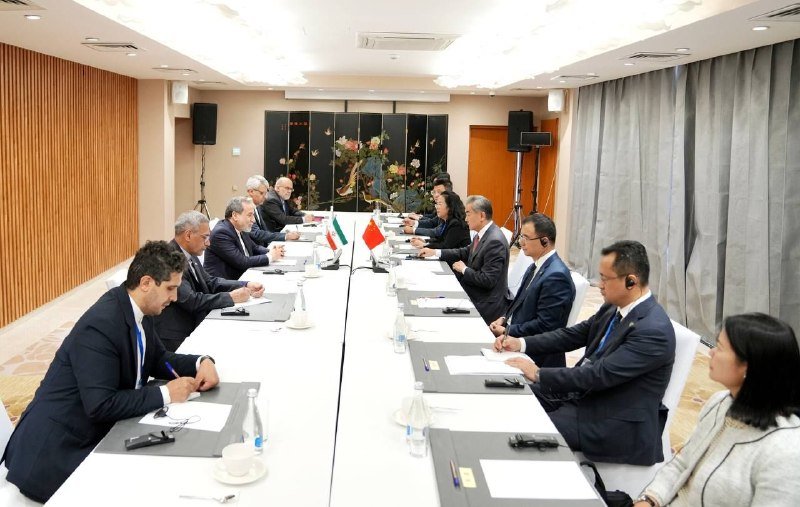
On 19 July 2026, Iran's Foreign Minister Abbas Araghchi told journalists that a ceasefire concluded ten days earlier would have preserved Iran's wartime gains, kept Ali Larijani alive and secured Asaluyeh, the petrochemical hub on the Persian Gulf coast. He said, separately, that the only reason Tehran sat down with Washington was to demonstrate, on the record, that negotiation with the United States and Israel is futile. He said the enemy had prior knowledge of senior Iranian meetings, which he framed as evidence of a still-unresolved security breach inside the Islamic Republic.
Read those three claims together and a posture emerges. Tehran is grieving in public, blaming an internal leak for the decapitation of its wartime command, and pre-emptively immunising the next round of diplomacy against any expectation of reciprocity. The framing is coherent. It is also, on the available evidence, doing a lot of work that the evidence will not bear.
What Araghchi is actually arguing
The minister's case has three moving parts. First, that Iran fought well enough that the terms it could have extracted in early July were superior to whatever it signed later. Second, that the killing of senior figures such as Larijani was enabled by a penetration of Iran's security perimeter rather than by an Israeli or American intelligence breakthrough on its own. Third, that diplomacy was always a forensic exercise: a recorded demonstration, not a negotiating track, designed to lock Washington and Jerusalem into a public admission that talks produce nothing.
Each strand is contestable in its own way. The first is unfalsifiable on present sourcing. The second is the most operationally interesting. If the regime's leadership was compromised at the meeting level, that is a finding of consequence for Iran's allies as much as for its adversaries. The third, that Iran negotiates only to prove negotiation is useless, is the line that will be quoted back at Tehran every time a foreign minister from the Gulf, Ankara or Beijing asks why the next channel is taking so long to open.
The leak the minister cannot quite name
The most consequential sentence in Araghchi's remarks is also the most elliptical. The enemy, he said, was aware the meetings were taking place, which points to a security breach that has probably not been completely closed. He did not say who. He did not say when. He did not say which service.
That reticence is itself a tell. A foreign minister blaming an unnamed mole is not briefing allies; he is reassuring a domestic audience that the institution still has a perimeter. It is the language of an establishment that has decided the chain of failure runs through its own hallways rather than through Tel Aviv's targeting cycle. Whether that judgment is correct is a question Israeli intelligence has every incentive to leave unanswered, and one Iranian intelligence will, by definition, only address obliquely.
The framing that does not survive contact with the map
Iran's post-war narrative has to do two jobs at once. It has to dignify the dead without admitting that the dead were reachable. It has to honour the wartime gains without conceding that those gains were negotiable in the first place. Araghchi's remarks try to square the circle by arguing, in effect, that Iran won on the battlefield, lost the ceasefire clock, and was betrayed from within.
That is a hard story to tell because the alternative is harder: that Israeli intelligence located senior figures, struck them at the meetings where they were physically present, and that Iran's much-vaunted operational security was, in this war at least, equal to the task of hiding reservists in basements, not to the task of protecting a wartime command.
What the next negotiation will actually sound like
Araghchi's line that Iran entered talks only to demonstrate their futility is the part most likely to age poorly. Gulf states and Turkey, both of whom have an interest in a stable Strait of Hormuz shipping lane and a non-nuclear Iran, will not accept a foreign minister who treats every channel as a courtroom exhibit. Beijing, which brokered elements of the back-channel, will read the same quote and conclude that the political cost of any future mediation has just gone up.
The structural pattern here is familiar. A regime that emerges from a war with its command structure damaged and its economy under sanctions tends to convert grief into posture. Posture travels well on television. It does not travel well in the small rooms where ceasefires are extended, prisoners are exchanged, and the next incident is de-escalated before it becomes a casus belli.
What is still genuinely uncertain is whether Araghchi's framing is the regime's opening position or its closing one. The minister is, by training, a diplomat rather than a security official. That he is the one delivering this line suggests the Foreign Ministry has been tasked with setting the public baseline, while the IRGC and the Supreme National Security Council reserve the right to move off it. The next forty-eight hours will tell us which it is.
This publication framed Araghchi's remarks as a coherent but contestable post-war position rather than as a literal account of events; the claim of an unresolved internal breach is taken at face value but not independently corroborated.
Wire provenance
This editorial synthesis draws on the following public wire/social posts:
- https://t.me/megatron_ron
- https://t.me/englishabuali
- https://t.me/abualiexpress
- https://t.me/megatron_ron
- https://t.me/ClashReport