Anthropic's valuation wobbles, Kimi K3 panics the room: the distillation fight is now a market fight
A Chinese model release knocked Anthropic's implied valuation lower on prediction markets. Beijing is already pushing back on the U.S. "distillation" frame.
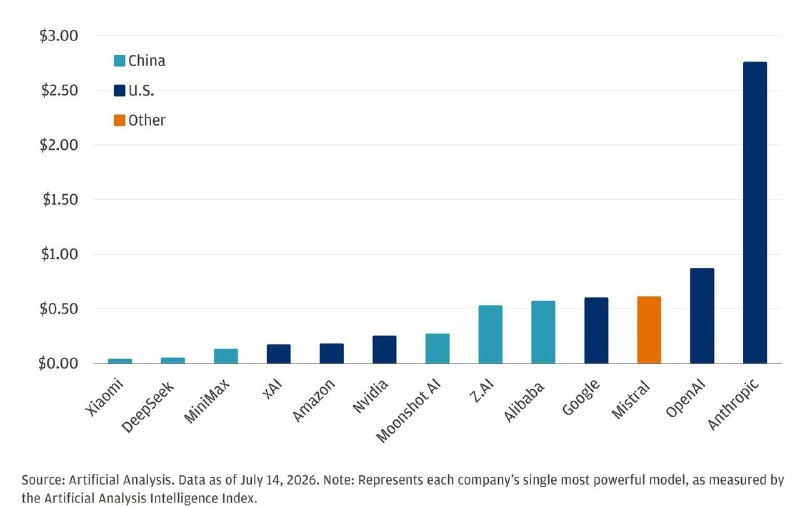
On 17 July 2026, prediction-market traders marked Anthropic's implied valuation lower within hours of Moonshot AI releasing its next-generation Kimi K3 model in China, pushing the year-end contract on whether the U.S. artificial-intelligence lab touches a $1.5 trillion valuation to 67%. The timing is the news: a single product launch from a Chinese lab, distributed mostly inside the world's second-largest AI market, moved a privately-held U.S. company's equity-implied price tag.
What the market is pricing, in other words, is not Kimi K3's benchmark performance. It is the chance that the closed frontier of American model developers narrows faster than the capital flowing into them assumes. That is a different bet than the one Silicon Valley has been making for two years, and it is now showing up in numbers.
The model that moved the tape
Anthropic had been the cleanest expression of the U.S. private-AI thesis: an enterprise-first lab with a defensible safety posture, a fast-growing API business, and a Series-F valuation that implied a high single-digit-sum multiple of plausible 2028 revenue. Polymarket's year-end contract on $1.5 trillion was the cleanest, tradable expression of that bet. As of 17 July it sat at 67%, according to the Polymarket screenshot circulated on X that evening.
The trigger was K3. The Polymarket update, posted to X at 23:03 UTC on 17 July, said the release of Moonshot AI's Kimi K3 had "taken a hit" on Anthropic's implied valuation. Two days later, Beijing was already contesting the diagnosis. A 15:29 UTC X post on 18 July carrying a Polymarket wire item reported that China had called U.S. allegations that its AI firms illicitly distill American frontier models "misguided and counterproductive."
That is the shape of the fight. On one side, a price-discovery event in an unregulated market: a Chinese model launch knocked a U.S. valuation contract. On the other, a diplomatic frame: Beijing argues the U.S. is using intellectual-property policing as a structural tariff on Chinese progress. Both are true, and only the second one ever gets explained on the record.
The demand side nobody brags about
Part of what is moving on prediction markets is the gap between two facts about American AI. The first: U.S. labs have raised record sums on the bet that consumer and enterprise AI spend will compound for years. The second, more prosaic one: U.S. households aren't actually paying for it yet. According to a PNC Bank survey cited on X via Polymarket at 14:48 UTC on 18 July, just 2.2% of U.S. households currently hold a paid AI subscription.
That 2.2% figure is the kind of number that should sit alongside every breathless model-release story in the American tech press. It does not, because it punctures the premise. If a sub-3% household-penetration rate is the consumer base underlying the largest private valuations in modern U.S. technology, then the downside risk on any price-discovery event is mechanical: the multiple is built on a future user base that does not exist yet, and any credible foreign competitor erodes the time horizon on which that base has to materialise.
This is where Kimi K3 enters with a different lever than the usual "China catches up" narrative. Moonshot AI has been selling to Chinese consumers and Chinese cloud customers for years. The marginal new user of Kimi K3 is not a U.S. subscriber who switches. It is a Chinese household or business that, until today, might have been a default OpenAI or Anthropic API customer via offshore routing. Every closed account on that side of the Pacific is revenue that never compounds into the American valuation thesis.
The "distillation" frame, and what China says back
American coverage of Chinese frontier models has converged on a single frame: distillation. The allegation, surfaced most prominently in U.S. policy and reporting over the past year, is that Chinese AI developers train or fine-tune their models on outputs from U.S. frontier systems, OpenAI's GPT family, Anthropic's Claude, in ways that amount to unlicensed appropriation of the underlying capability.
China's response, as carried on X via Polymarket on 18 July, is to call the frame itself "misguided and counterproductive." That phrasing tracks the standard Chinese diplomatic register on tech disputes: deny the underlying characterisation, recast the dispute as protectionism, and reframe the U.S. position as a strategic bid to slow a competitor whose products are now demonstrably competitive on their own merits.
Both readings have weight. Distillation at scale is a real industrial technique and is documented across the open literature; some of it is licensed through official API partnerships, much of it is not, and the boundary is genuinely contested. But the U.S. narrative has been more confident than the evidence warrants, and it leans on assumptions about Chinese AI's dependence on American systems that the recent K3 release is designed to retire. By the time the U.S. frame reaches a reader in 2026, the underlying competitive picture is already several quarters ahead of the talking points.
The diplomatic complaint is the structural one. Beijing's framing, that distillation allegations are an industrial-policy tool, not an IP-enforcement tool, has a coherent internal logic. So does the U.S. position. Neither side is being dishonest. Both are optimising for the future competitive landscape, and the line between "rule of law" and "non-tariff barrier" is being drawn, in real time, by exports of model weights.
What to watch by year-end
Three concrete signals will settle whether Polymarket's 67% is the right number, or whether the K3 effect compounds further.
First, Moonshot AI's API and consumer pricing moves in the third quarter. Aggressive price cuts to clear Chinese incumbents off the stack would be a tell that the competitive pressure is being priced into the market in a way the validation set alone does not capture.
Second, the next PNC household-survey print. If the 2.2% paid-AI household rate moves above 4% on a one-quarter basis, the consumer-monetisation thesis reasserts itself and the year-end contract climbs back toward 80%. If it stays flat or slips, the structural argument against the U.S. valuation is doing more work, not less.
Third, any U.S. Commerce or Treasury action on Chinese model exports or chip flows. The distillation conversation becomes policy when it travels from a press conference to an export-control rule. Watch for that filing.
The prediction market is a thin instrument to express this. But it is also the only public market where the U.S.–China AI fight shows up as a live price, in real time, the moment a competitor ships a product. Two years into this cycle, that is the more honest quote than the press releases.
Wire provenance
This editorial synthesis draws on the following public wire/social posts:
- https://x.com/polymarket/status/1947264918234583104
- https://x.com/polymarket/status/1947258492018208773
- https://x.com/polymarket/status/1947038119472947564