Anita Lasker-Wallfisch turns 101: the last cellist of the Auschwitz women's orchestra
The only surviving member of the Auschwitz women's orchestra marked her 101st birthday on 17 July 2026, a quiet milestone that has come to carry the weight of an entire disappearing witness generation.
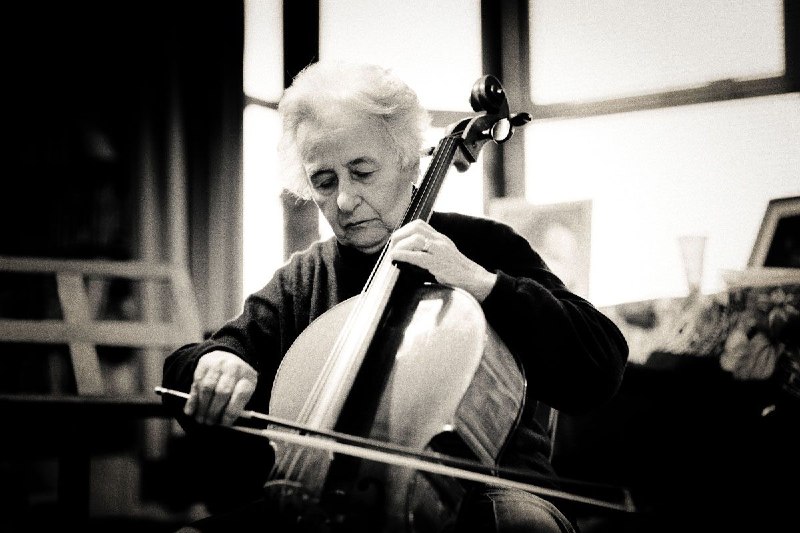
On 17 July 2026, Anita Lasker-Wallfisch turned 101. The German-British cellist, born in Breslau in 1925, is the last surviving member of the women's orchestra at Auschwitz-Birkenau, and by extension the last living musician who played inside the camp system as a prisoner. Her birthday passed without gala fanfare, as her birthdays tend to: a few remarks from the Holocaust Educational Trust, where she has served as a trustee for decades, a handful of interviews republished for the occasion, and the steady hum of a public that knows, by now, that each marker she passes is the last marker of its kind.
That is the substance of the story this publication wants to mark. Lasker-Wallfisch's longevity is no longer a personal curiosity; it is a closing aperture. With her, a chain of first-hand musical testimony of the camps goes dark. The instruments she carried, the Kapo who chose her for the ensemble because she could sight-read, the airless hours of rehearsal and performance inside Birkenau, then Bergen-Belsen, where she played until liberation in April 1945, will, in time, be reachable only through recordings, memoirs and the work of historians. The 101st birthday is the editorial event; the demographic fact behind it is the news.
The cellist who was saved by a stand partner
The facts of her early life have been told often enough to treat them as settled record. Transported to Auschwitz in 1943, the then-teenager Lasker-Wallfisch was told by a block elder that she would be killed unless she could play an instrument. She could, barely: enough cello to pass an audition organised by Alma Rosé, the orchestra's conductor and a niece of Gustav Mahler, who was herself murdered at the camp in 1944. The orchestra's role was twofold and unenviable. It accompanied prisoners marching to and from forced labour, and it played Sunday concerts for SS personnel at Birkenau. Lasker-Wallfisch has described the Sundays as among the worst hours of her life, the camp commandant's children sitting in the front row while the musicians performed under armed watch.
She was later transferred to Bergen-Belsen, where she joined another women's orchestra under the direction of Anita Türk, and where she remained until British forces liberated the camp on 15 April 1945. By that point, typhus had killed her parents and her sister Renate, who had also been deported. The cellist weighed, by her own account, roughly six stone. Her survival she credits, in interviews over many years, less to luck than to a refusal, conscious or otherwise, to stop being useful inside a system designed to render her disposable.
The post-war career that followed is itself a small rebuke to the idea that survival and artistic seriousness are opposites. Lasker-Wallfisch moved to Britain in 1946, co-founded the English Chamber Orchestra in 1960, and played as its principal cellist for the next two decades. She recorded the Bach unaccompanied suites; she played under Daniel Barenboim, Sir Colin Davis, and Benjamin Britten; she taught at the Guildhall School of Music and Drama. The decision to keep performing publicly, year after year, looks in retrospect like an act of argument against the Nazis' categorisation of her as subhuman cargo.
Why 101 is not a sentimental anniversary
The milestone matters because the alternative framing, that this is simply a venerable musician reaching a venerable age, hides what is actually happening. The cohort of survivors who can speak in the first person is collapsing on a known schedule. The Claims Conference and the demographic arm of Yad Vashem have, for years, published the shrinking numbers; the rhetorical hook of "the last" has moved, in the cultural memory of the Holocaust, from Anne Frank to Primo Levi to the Kindertransport children to Lasker-Wallfisch herself. With her, the specifically musical witness goes. There were other Auschwitz survivors who were not in the orchestra, and there are other musicians who survived other camps. The precise intersection of "musician + Auschwitz women's orchestra + still alive + still willing to testify" is now a set of one.
This places a particular burden on institutions that have, for decades, treated her as a near-permanent fixture. The Holocaust Educational Trust, which she helped build into one of Britain's principal outreach organisations, has built its school-testimony programme around survivors willing to address classrooms in person. The Trust's own materials note that Lasker-Wallfisch has spoken to tens of thousands of British schoolchildren, many of them in the same Camden Town offices where she volunteers. The question her 101st birthday quietly raises is not whether the Trust will continue but how it will change shape once its most bankable living witness is no longer available to take questions from a Year 9 history class in Stoke-on-Trent.
The German reckoning has its own version of the same problem. In Berlin, the Bundeszentrale für politische Bildung (the federal agency for civic education) has, since the early 2000s, used Lasker-Wallfisch as one of the faces of what Germans call Erinnerungskultur, the work of keeping memory alive. Her German-language memoir, Inherit the Truth, originally published in 1996, has gone through multiple editions. German school curricula name her directly. When she is gone, German institutions will need to substitute, and the substitute is not just a different interviewee but a different epistemology: from a survivor's embodied recall to archival mediation, from memory to history in the strict sense.
The counter-read: hagiography is not the same as witness
There is a legitimate strain of scepticism inside the historiography of the camps that resists treating any single survivor as the synecdoche for the whole. Lasker-Wallfisch's account is unusually measured for a Holocaust memoir; she has said, repeatedly, that the worst of what she saw she saw at Auschwitz II-Birkenau, not at the orchestra's concerts, and she has resisted the temptation to claim a moral authority she does not feel entitled to. The English Chamber Orchestra's institutional history, by contrast, leans on her in ways that occasionally blur the line between member-for-life and solo exhibit. The point is not to fault her. It is to notice that the production of "the last survivor" is itself a cultural industry, with the survivor at one end of the rope and the institution at the other.
A second counter-current runs through Polish and Czech scholarship on Birkenau, where the women's orchestra has been studied less as a touching anomaly than as a component of camp administration. Alma Rosé, in this reading, was a brutal taskmaster as well as a brilliant musician; the orchestra's usefulness to the SS sat alongside its usefulness to its members. Both readings can be true. The honest version is that Lasker-Wallfisch has always held both, which is part of why her testimony has worn better than most.
What the cello carries after her
The cello she plays, in recent portraits, is the one she acquired in London in the late 1940s, a modest instrument by any concert-standard reckoning, but the one she chose. The decision matters. Survivor witnesses who have made their careers have often done so on instruments lent by patrons or gifted by institutions; she has not. The implication is that the music, as a professional practice, has always been the point, not the testimony. The testimony happened to come with the music, and the country she made in Britain was the country where the two were allowed to be separate.
For the record, the practical stakes of her 101st birthday are mundane and severe. The Holocaust Educational Trust will, within the next several years, lose the capacity to book a survivor for a Tuesday-morning school assembly. The BBC's archive of survivor interviews, the Wiener Holocaust Library's oral history project, the USC Shoah Foundation's Visual History Archive, and the smaller German, Austrian and Czech collections will carry her voice forward in the way archives carry voices: technically present, experientially absent. The cello itself is not a sufficient bridge. The clarinet at Birkenau, the harmonica at Sachsenhausen, the silent upright piano at Theresienstadt; instruments have their own memorial logic, but they remember without answering back.
What remains contested, even now, is whether institutions of memory are adequately preparing for that handoff. The Trust's annual reports speak of new digital-school programmes and trained volunteer ambassadors, but they do not pretend that a thirty-year-old historian, however gifted, is the same artefact as a hundred-and-one-year-old who was there. The honest assessment is that no preparation is sufficient, only more or less graceful.
The cultural desk framed Lasker-Wallfisch's 101st not as a sentimental occasion but as the closing of a specific window: the last first-hand musical witness of the camp system. Where wire coverage tends toward tribute, this piece holds the institutional handoff in view.
Wire provenance
This editorial synthesis draws on the following public wire/social posts:
- https://t.me/c/1782549818/14498
- https://en.wikipedia.org/wiki/Anita_Lasker-Wallfisch
- https://en.wikipedia.org/wiki/English_Chamber_Orchestra
- https://en.wikipedia.org/wiki/Alma_Ros%C3%A9