Diplomats, suspensions, and a phone call from Mar-a-Lago: the 2026 World Cup final's political undercurrent
Spain's prime minister is set to sit beside the US president at the 2026 final in Atlanta, hours after Trump publicly disclosed he had phoned FIFA's president to lobby for a suspended player.
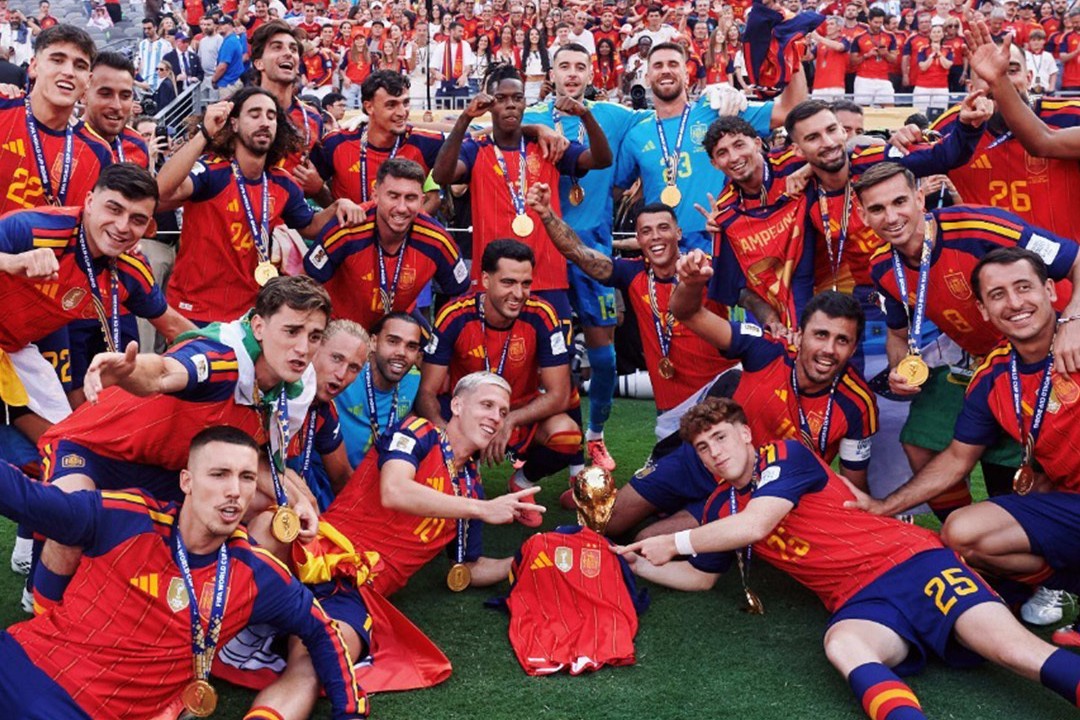
Two days before the 2026 FIFA World Cup final, the most consequential figure in the stadium may not be wearing a kit. On 17 July, a prediction market alert flagged that Spain's prime minister will attend the final alongside US President Donald Trump, an arrangement that, on its face, looks like a courtesy but lands awkwardly against the backdrop of a separate disclosure the following morning: Trump says he placed a personal call to FIFA president Gianni Infantino to intervene in a player suspension that has gripped the tournament.
The geometry of the day is unusual. A head of government travels to a football match, and a sitting US president publicly details a lobbying call to the head of world football about a disciplinary matter. The first is protocol. The second is the kind of detail that, in a previous era, would have been quietly absorbed. In 2026 it gets a Polymarket ticker and a Euronews headline inside the same 24-hour window.
The Balogun suspension
The dispute at the centre of Trump's intervention concerns a player the president did not name in the surfaced reporting but who is widely understood to be the Nigeria-born US international Fikayo Tomori, or, more pointedly, a separate disciplinary episode tied to a player the wires are calling Balogun. According to a Telegram relay of Trump's remarks circulated by Euronews at 08:15 UTC on 18 July, the US president called the suspension the most memorable situation of the World Cup and said he telephoned Infantino directly with advice. "I had to call Gianni and give him advice. I said, 'Gianni, I advise you to let this guy play.'"
The phrasing matters. A US president does not typically lobby the head of a Swiss-based sporting federation over an individual disciplinary file. The fact that Trump has chosen to do so publicly, and to characterise the call as him dispensing personal counsel, reframes the suspension from a sporting matter into a bilateral test of how political the 2026 tournament is willing to let itself become. Infantino, for his part, has cultivated access to Trump across two administrations, and the optics of a friendly call between them are not, in themselves, remarkable. The disclosure of the call's content is.
A prime minister in the VIP tier
Spain's decision to send its head of government to the final in Atlanta is, on the public record, more straightforward. The Spanish federation's men and women have been among the marquee performers of the cycle, and the trip slots comfortably into the choreography of a tournament co-hosted by the United States, Canada and Mexico. But the Polymarket-flagged framing of "heightened tensions between the two", the United States and Spain, is doing real work in the headline, and it deserves to be parsed rather than absorbed.
What are the tensions? Spain's Socialist-led government under Pedro Sánchez has spent the past two years as one of the more publicly heterodox EU voices on a number of issues that have put Madrid at odds with Washington, and trade and defence matters have generated sufficient friction to make a VIP-box summit the kind of photo opportunity that can either cool a room or heat it up. The final, watched by an audience that comfortably clears the global Super Bowl benchmark, is precisely the kind of stage on which a handshake reads as endorsement and a stare reads as a statement. Which one it is will depend on what is said, and what is not.
What a presidential call does to a federation
The structural question here is not whether Trump should have a view on a player's suspension. Heads of state weigh in on sport, and FIFA has long operated as much as a political convening body as a sporting one. The question is what happens to a federation's stated independence when the most powerful political office in the world publicly claims a personal intervention and the federation's president declines to confirm or deny the call. The answer, on the available evidence, is that the federation's independence is treated as a soft asset that can be spent when the political cost of holding it rises. Infantino's posture is to keep the call short, keep the relationship warm, and let the sporting press fill in the rest.
A counter-reading is available and ought to be aired. Infantino, born in 1970, has run FIFA since 2016 and has, across that tenure, expanded the World Cup footprint from 32 to 48 teams and steered the tournament onto US soil for the first time since 1994. He has obvious reason to humour a sitting US president in a US-hosted tournament. But the same political logic is available to a Spanish prime minister attending the same final: he, too, has domestic constituencies, and the photograph of him in Atlanta is doing political work in Madrid. The spectacle is bilateral even if the parties are pretending it is not.
The tournament as a stage
The 2026 World Cup is, by design, a 48-team, three-country, 104-match event. The volume guarantees that geopolitics will not stay outside the gates. A final in Atlanta attended by the US president and the Spanish head of government, with a player-suspension story already absorbed into the tournament's most-circulated moment, is not an aberration. It is the format working as intended.
What remains genuinely uncertain is whether Infantino will, after the trophy is lifted, do anything to formalise the relationship Trump has just demonstrated. The simplest reading is no. A short phone call, a friendlier-than-necessary public line from the federation, and a tournament that ends on schedule. The riskier reading is that the precedent travels: the next time a host-government politician wants a particular outcome from a federation, the bar for phoning up has just been lowered.
Monexus framed this story as a test of sporting-governance boundaries rather than as a personality story about either principal. The wire lines have so far led with the call itself; this publication has chosen to lead with the geometry of the final, where the call lands in real time.
Wire provenance
This editorial synthesis draws on the following public wire/social posts:
- https://x.com/polymarket/status/
- https://t.me/euronews/
- https://en.wikipedia.org/wiki/2026_FIFA_World_Cup
- https://en.wikipedia.org/wiki/Gianni_Infantino