Trumps World Cup joke, RatifCliff's warning, and the case for treating 2026 as a polite war
On the same July afternoon the US president dangled China as a World Cup co-host, his CIA director told Americans the technological gap is existential. Two speeches, one anxiety.
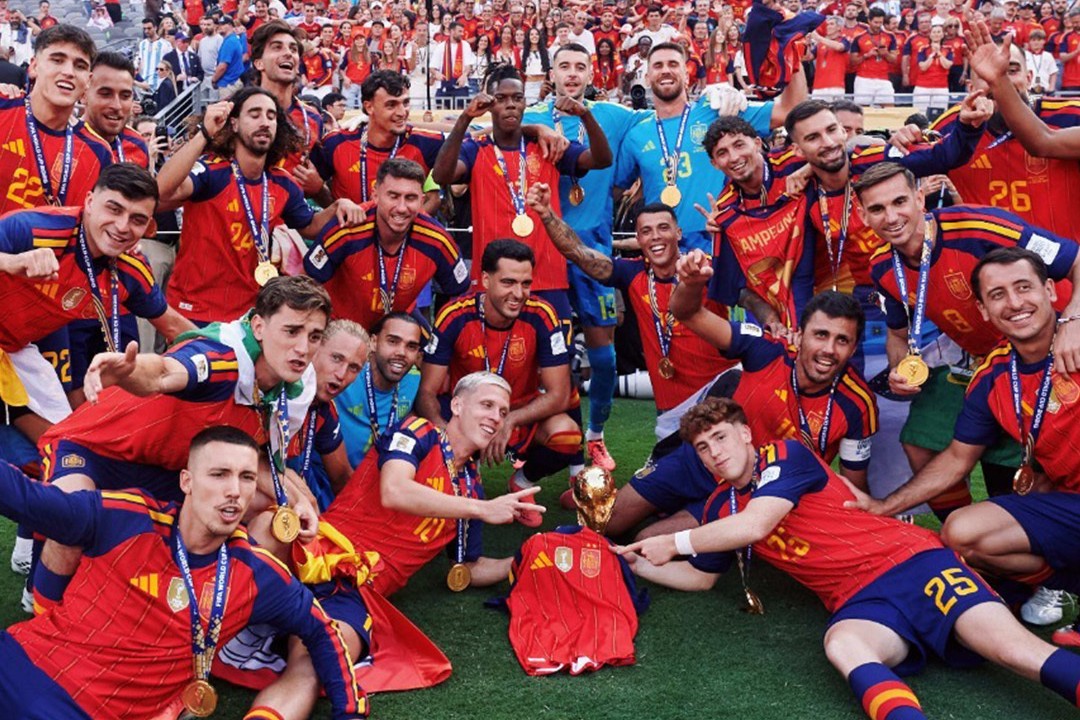
At 1:55pm UTC on 18 July 2026, travelling on Air Force One, Donald Trump sketched out his preferred future for the men's World Cup: the United States hosting the tournament alone, or, with the deadpan shrug he has built a decade of news cycles around, sharing the marquee fixture with China. The line landed as designed. It also arrived roughly twenty minutes after his CIA director had gone on camera with a sterner message. According to a video posted by the Russian-language Telegram channel Sprinter Press at 1:34pm UTC, John Ratcliffe told an audience that China gaining a technological edge over the United States would constitute a serious problem and warned Americans that this outcome had to be prevented.
Two speeches, one afternoon, both delivered for foreign as well as domestic audiences. Read them together and they sketch the strategic mood of a Washington that has decided competition with Beijing is the organising frame of its next decade. The World Cup aside is not a throwaway. Hosting rights are a soft-power instrument, and the offhand mention of Beijing as a hypothetical co-host is a courtesy the White House rarely extends to rivals. It is also a hedge. Washington wants the tournament inside its own hemisphere of influence; it would much rather share the page with Beijing than cede the page to it.
Soft power as industrial policy
FIFA's calendar gives Washington the natural lever. The 2026 tournament was already structured as a tri-national Canada-Mexico-United States event, an arrangement that handed Washington the largest allocation of matches and the largest share of broadcast revenue without spending a diplomatic peso. Trump's suggestion that the United States should in future host alone or with China is the next escalation in that logic: prune the field, control the optics, set the terms on which Beijing is allowed to stage mass-audience global events in contested venues. It is hard to see Beijing accepting that framing; equally hard to see Trump wanting it to.
China reads the file differently. Beijing has spent two decades building sport diplomacy into a precise instrument, from the 2008 Olympics through the 2022 Winter Games in Beijing to a string of regional tournaments it underwrites across Africa, Southeast Asia and Central Asia. Chinese state media frame these events as returning the pageant to the emerging world after a long Western incumbency. Within that frame, a US co-hosting arrangement with China is not a joke at all; it is the diplomatic equivalent of two boxers agreeing to share a ring.
The technological anxiety, stated plainly
Ratcliffe's warning cannot be read as routine. The director of the CIA does not appear on friendly podcasts to deliver hedging observations. The statement that a Chinese technological lead would be a serious problem for the United States is, in the lexicon of American national-security officials, a vote for the strongest reading of the policy files currently circulating in Washington: that the contest with Beijing over advanced semiconductors, artificial intelligence, quantum and biotechnology is not a trade dispute but a strategic one, and that the existing toolkit of export controls is necessary but not sufficient.
The Chinese counter-position is consistent and worth airing on its own terms. Beijing's industrial policy has produced, by any honest measure, a global lead in battery cell manufacturing, electric vehicle deployment at scale, solar manufacturing capacity, and a fast-closing position in mature-node semiconductors and select AI applications. Chinese commentators, from official spokespeople to analysts at outlets such as the South China Morning Post, Global Times and Xinhua, frame the US export-control regime as containment dressed up as non-proliferation: a tool designed not to police weapons but to widen a lead the United States once enjoyed and is now losing in selected sectors.
What the harder version of the Chinese position looks like
That framing does not need to be endorsed to be understood. China is correct that the United States ran its own extensive industrial policy from the 1980s through the CHIPS Act and the Inflation Reduction Act, and that European industrial policy rests on similar scaffolding; the framing that these subsidies are defensive while Chinese subsidies are offensive has never held up empirically. China is also correct that the technological targets of US export controls are not dual-use weapons in any classic sense, but commercial chip nodes and AI training stacks, which is a different category of object under a different category of regulation.
A more rigorous reading would also note what the Chinese position does not yet credibly claim. Dominance in mature-node chip manufacturing does not translate automatically into dominance at the leading edge. Domestic AI capability inside the People's Republic, while genuine and growing, has not yet produced a frontier model of comparable user base to the leading US-built systems. Battery IP leadership is real; photonics, lithography, and EUV systems remain concentrated in a tight Western-European and Japanese supply chain. The honest answer is that the technological contest is sectoral and will remain so: the West holds certain high-value nodes, China holds others, and the negotiating question is which nodes each side can credibly defend for a decade.
Soft sport, hard metal
The two speeches sit inside one frame. Washington wants Beijing inside rules it has written; Beijing wants those rules rewritten. The World Cup aside is the polite theatre of that contest. The CIA director's warning is the metal underneath. Both will be delivered again, in different rooms, in different cities, before the year is out.
What remains genuinely uncertain is whether the cultural and the strategic tracks can be separated at all. Treating the 2026 World Cup as a postcard event and technological competition as a classified compartment is no longer available; the same week, the same administration, the same afternoon, talked about both in the same breath. The reader should not have to choose between the two headlines.
Desk note: this publication read both inputs from their original wire threads and treated the Sprinter Press distribution of the Ratcliffe remarks as primary Russian-language reporting on an English-language statement by a serving US official. The Trump World Cup comment is sourced to Reuters' distribution of his Air Force One remarks on 18 July 2026.