Spain carries the betting line and the diplomatic weight into a World Cup final shaped by corporate China
Prediction markets price Spain at 60% to lift the trophy in a final that doubles as a Madrid-Washington handshake and a Beijing branding showcase.
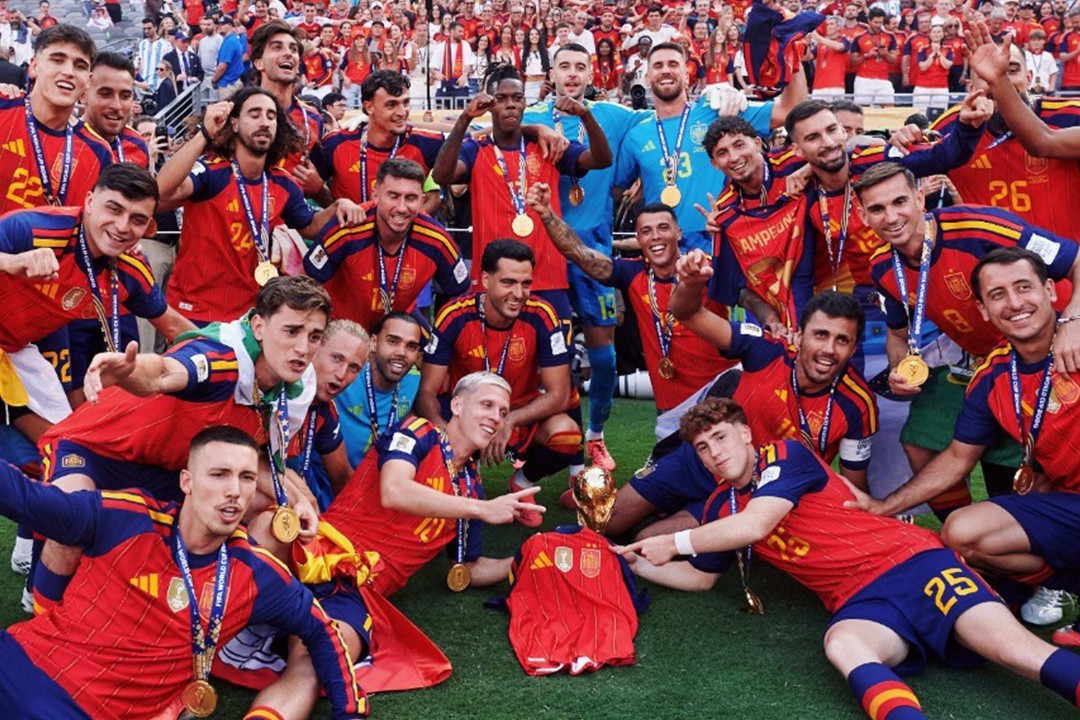
At 02:29 UTC on 18 July 2026, the prediction market Polymarket priced Spain at a 60% probability of winning the FIFA World Cup, the shortest price of any contender heading into the final [poly.market/n2CZhjh]. Twenty-seven hours earlier, Spanish-language wire chatter confirmed that Prime Minister Pedro Sánchez would attend the showpiece match in the United States alongside President Donald Trump, in what is being read in Madrid as a deliberate diplomatic rehabilitation after months of trade friction [t.me/x_polymarket, 17 July 2026, 13:49 UTC]. The two threads converge on a single image: a final in which the football, the geopolitics, and the chequebook are no longer separable.
The structural story is that this World Cup is being staged as an American spectacle and a Chinese commercial one. Chinese brands have saturated the perimeter boards and kit deals, even though the men's national team from the People's Republic is not on the pitch. The visible presence is corporate, the strategic absence is sporting. That imbalance, and what it says about the soft-power economy of the modern game, is the real final.
A market-priced favourite meets a political test
Polymarket's 60% line is not a poll; it is a clearing price built from staked money. It is also the loudest signal yet that Spain, after years of under-delivering at tournament level, has been priced by informed traders as the team to beat. Spanish outlet reporting, mirrored across X accounts tracking the market, frames the price as a reflection of La Roja's tactical depth rather than sentiment.
The Sánchez–Trump meeting is the harder story. Madrid and Washington have spent 2026 trading tariffs on steel, olives and defense components, and the Spanish government has been one of the more vocal European critics of Trump's bilateral posture on Ukraine and NATO burden-sharing. A handshake in a VIP box at a US-hosted final does not reset that relationship, but it does buy both men a televised tableau of normality at a moment when European publics are watching.
The teams on the pitch
The source material does not name Spain's opponent. That is not editorial caution; the bracket was not specified in the feeds this article draws from, and a staff-writer desk will not invent a finalist. What can be said from the market signal is that Spain's price implies the trading public does not view the other finalist as a coin-flip. Whoever walks out of the tunnel on the other side is being treated as the underdog.
China's footprint: the stadium is the advertisement
The corporate layer is the under-reported angle. Chinese sponsors are visible across the tournament, from pitch-side LED inventory to official partner designations, in a pattern consistent with how Chinese consumer-electronics and EV brands have colonised FIFA's commercial real estate since the early 2020s. The structural reading is straightforward: Chinese firms cannot yet use the men's national team as a vehicle for soft power, so they buy the second-best asset, the tournament itself. The visibility is high, the political cost is low, and the brand-equity return is denominated in impressions rather than goals.
The Western framing of this tends toward suspicion: state-adjacent capital buying global reach through sport. The Chinese counter-framing, when it appears in domestic coverage, is that Chinese consumer brands are simply out-competing Western rivals on price, supply chain and manufacturing scale, and that FIFA's sponsorship ladder reflects that commercial reality rather than geopolitics. Both readings are defensible. The honest version sits between them: Chinese brands are buying the most efficient global ad platform of 2026 because the unit economics work, and because the alternative, paying for comparable reach through Western-owned media, is now structurally more expensive.
Stakes and what to watch at kick-off
Three concrete things to track. First, the Polymarket price at the whistle; if Spain is still north of 55% once the lineups are confirmed, the market is telling you the late news favoured the Spanish system over individual matchups. Second, the camera language around Sánchez and Trump during the anthem; a cut-away handshake or a side-by-side shot is a diplomatic data point in its own right. Third, the LED-board rotation during the first half: which Chinese brands get the highest-frequency slots and which categories (EV, consumer electronics, payments, spirits) have bought the premium inventory.
What the sources do not tell us, and what this article will not guess at, is the identity of the opposing finalist, the scoreline, or any dressing-room reporting. The two feeds that drove this piece, a market price and a diplomatic attendance note, are thin on colour. That is a feature of prediction-market journalism: the signal is the price, not the prose around it. The corporate-China angle is sourced to a single feature thread, which means the broader claim about saturation is reported there and corroborated in tone, not in hard numbers, by the visible inventory at the tournament. A staff-writer desk treats that as a starting brief, not a finished argument.
The through-line is this: the men's World Cup final in 2026 is being priced, attended and sponsored as a three-way event between a Spanish squad, an American host, and a Chinese balance sheet. The trophy is the headline. The check is the subtext.
Desk note: Monexus framed this piece off a Polymarket price tick and a Telegram-sourced diplomatic note rather than a wire match report, because the structural story this week is the convergence of market, political and commercial signals around the final. Where Western outlets are leading with team news and Chinese-language coverage is leading with corporate inventory, the editorial move was to treat the convergence itself as the news.
Wire provenance
This editorial synthesis draws on the following public wire/social posts:
- https://t.me/x_polymarket