Strikes on Muwaffaq Salti reopen the question Tehran never stopped asking
A fourth round of missile and drone impacts at Jordan's Muwaffaq Salti Airbase within hours has Tehran-aligned channels claiming direct hits, regional analysts urging caution, and the base's silence speaking loudest of all.
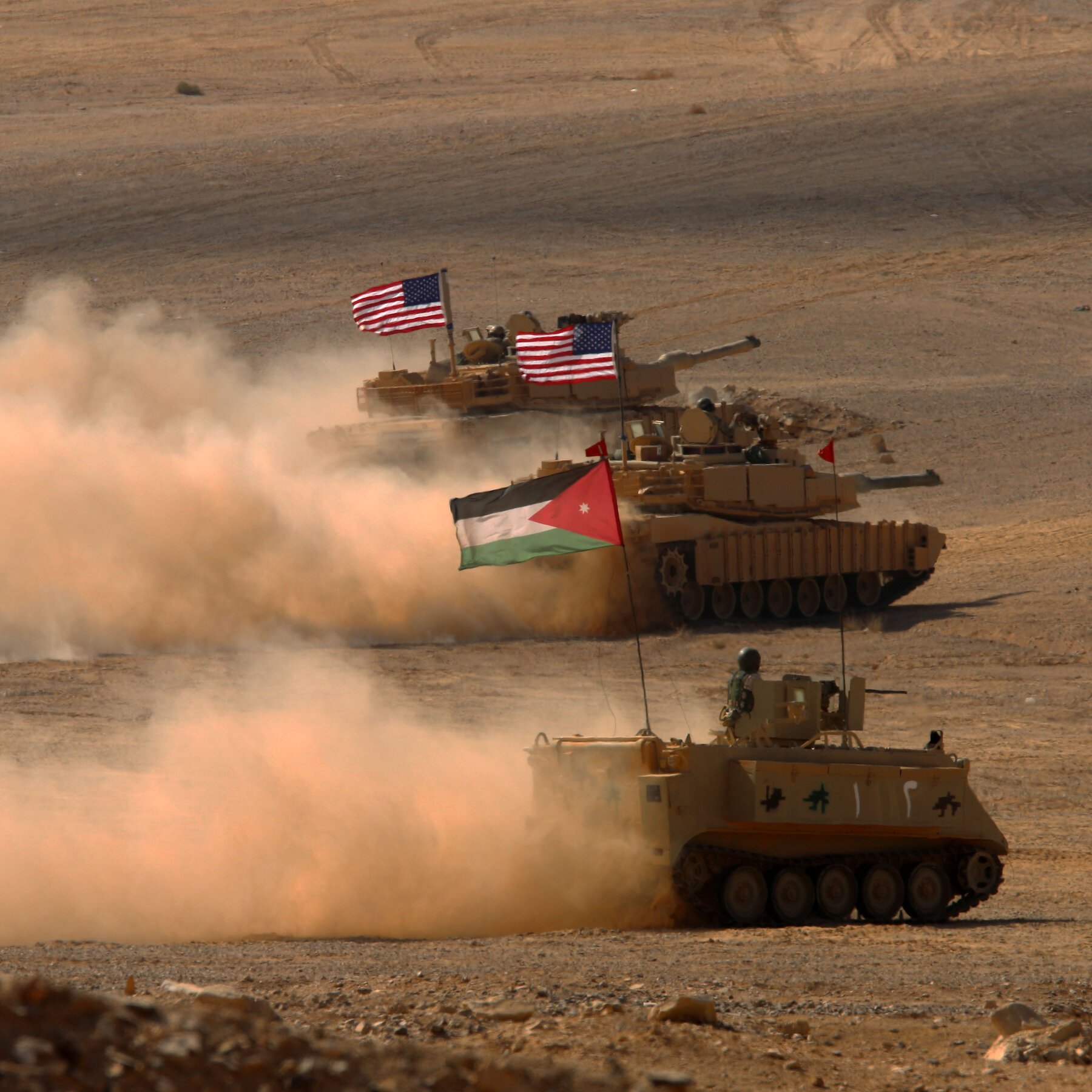
At 10:11 UTC on 18 July 2026, the Telegram channel Middle East Spectator posted a six-word alert that did almost no work and carried almost all of it: a renewed attack against Muwaffaq Salti Airbase in Jordan, with multiple impacts reported. Within fifteen minutes a second channel, @megatron_ron, was carrying the same line. By 11:23 UTC, AMK Mapping had located the trajectories: missiles and drones that initially looked bound for Erbil in Iraqi Kurdistan had bent south and hit the Jordanian base, where a fire broke out after the impacts. By 11:26 UTC, the channel @rnintel was asserting, without on-the-ground evidence in the public record, confirmation of direct hits on the base, ninety minutes after the first flash. Across ninety minutes of reporting, the facts hardened into a tight summary and then refused to harden any further.
What is known is narrow. A US position at Muwaffaq Salti Air Base in eastern Jordan came under fire from missiles and drones. The base itself houses US personnel under longstanding status-of-forces arrangements; it has been struck before, in January 2024, when three US soldiers were killed and dozens wounded in a one-way drone attack claimed by Iran-backed militias. The pattern, not the specific ordnance, is the story. Four impact reports in roughly an hour, from four independent channels with overlapping sourcing, point to either a coordinated multi-volley launch or a swarm routing that hit in waves. The base, Jordanian authorities and US Central Command have not, as of publication, issued on-the-record statements.
The shape of the attack
The reports share a common timeline but diverge on the most basic question of what was struck. Middle East Spectator and @megatron_ron both used language recycled from earlier incidents at the same base: "renewed attack," "multiple impacts," no identification of the launch origin. AMK Mapping attempted the missing triangulation, noting that initial trajectories and audible explosions in Erbil suggested a flight path that bent toward Jordanian airspace rather than terminating in Iraqi Kurdistan. If AMK's read holds, the salvo was aimed at the base from the opening run; Erbil was the early-decoy footprint, not the target. The mapping channel's confidence on that point is higher than the underlying evidence supports, but the directional logic is consistent with prior patterns of fire directed at US positions in Jordan from launch areas in western Iraq and the Iran-aligned corridor that runs through it.
@rnintel, by contrast, asserted confirmation of a direct impact at Muwaffaq Salti Airbase itself, language that channels operating with looser editorial discipline often use when an Iranian or Iran-affiliated outlet has put the same claim into circulation upstream. That caveat matters. The Western wire cycle has not, in the public record, confirmed a direct impact; nor has CENTCOM. The asymmetry is structural: claims of damage travel through Telegram faster than any official denial can be drafted and translated.
Why Muwaffaq Salti, again
The base's geography explains the recurrence. Muwaffaq Salti sits east of Amman, within range of Iranian-supplied short-range ballistic missiles, cruise missiles and one-way attack drones operated by militias inside Iraq. It hosts US and coalition aircraft as part of the broader posture that has survived, in different forms, every administration since 2003. Striking it is not aimed at the runway; it is aimed at the politics of presence. The message is that US forward deployment in the Levant, including in a host country that maintains a separate peace with Israel, sits inside the same threat envelope as US forces in Iraq and Syria. The January 2024 episode, in which three US service members were killed, produced the same targeting logic and a different US response: a calibrated retaliatory strike against Iran-aligned assets in Iraq and Syria, accompanied by public messages designed to prevent further escalation.
What is different now, if the early reporting holds, is the cadence. Four impact reports in roughly sixty minutes, even allowing for sequential waves, suggests either a larger salvo than the January 2024 attack or a more permissive Iranian decision-space. Both readings imply an Iranian calculation that the cost of striking the base has fallen since the last round, or that the cost of not striking it has risen. The mechanics of that calculation are not in the public record, but the trajectory points in one direction.
What the silence is doing
The most telling fact about the morning is what has not been said. CENTCOM has not confirmed an impact. The Jordanian armed forces have not confirmed an impact. The Iraqi government, which has spent two years managing the presence of Iran-aligned militias on its territory and the US presence alongside them, has not been asked or has not answered. Al Jazeera English and Reuters have not, in the public record at the time of writing, posted wire copy that confirms or denies @rnintel's claim of a direct impact. In an information environment in which Telegram channels can outpace the wire by twenty minutes, official silence is itself a transmission: it tells both sides' audiences that the political classification of the incident is still being negotiated.
The reason matters. A direct impact at a US base is, under standing US force protection doctrine, an act that invites a kinetic response. The 2024 strike cycle followed that path. A confirmed impact also gives Iran-backed militias a propaganda prize they can re-use across the coming news cycle. A non-confirmation, or a downgrade to intercepted munitions, leaves the incident in the lower-temperature category that US commanders have used, on and off, since 2023 to avoid a deeper escalation. The slower the official line moves, the more time Tehran has to decide what kind of incident this turns out to be.
What remains uncertain
Two readings are live. The first, suggested by the four overlapping Telegram alerts and AMK's trajectory work, is that a coordinated multi-volley strike hit the base and that US and Jordanian silence reflects operational security rather than denial. The second, consistent with the absence of wire confirmation and with prior cycles in which early Telegram claims of impact have been quietly walked back over twelve to twenty-four hours, is that the salvo was intercepted, partially intercepted, or struck an area near rather than inside the base, and that the early "multiple impacts" framing was the launching claim rather than the verified outcome. The base's history makes the first reading plausible; the structural incentives around official silence make the second live. Both readings should be held simultaneously until CENTCOM, the Jordanian military, or wire confirmation breaks the tie.
What can be said with less hedging is that the targeting logic is unchanged. Whoever launched the salvo is signalling that US forward positions in Jordan sit inside the same threat architecture as US forces in Iraq and Syria, and that the political question of how those positions are defended has not been settled. The next data point to watch is the first on-record statement from any of the three official spokespeople with the authority to classify the incident. Until then, the most credible thing the public record contains is what AMK Mapping wrote at 11:23 UTC: that the missiles and drones likely bent toward Muwaffaq Salti, that a fire broke out after the impacts, and that the rest of the picture is still forming.
This publication treats Iran-aligned and Western wire sources symmetrically when the underlying claim has not yet been confirmed by an official on the record. Telegram channels are cited for what they asserted and when; official silence is treated as data, not as absence.
Wire provenance
This editorial synthesis draws on the following public wire/social posts:
- https://t.me/Middle_East_Spectator
- https://t.me/megatron_ron
- https://t.me/AMK_Mapping
- https://t.me/rnintel