Kimi K3's $3.24 test: the China-coded cost curve that is rewriting the AI build race
A single Chinese-built model now ships a macOS-style UI and a CS:GO-style clone in three prompts for a few dollars. The competitive question is no longer whether the West leads on coding; it is whether the cost line has moved underneath everyone.
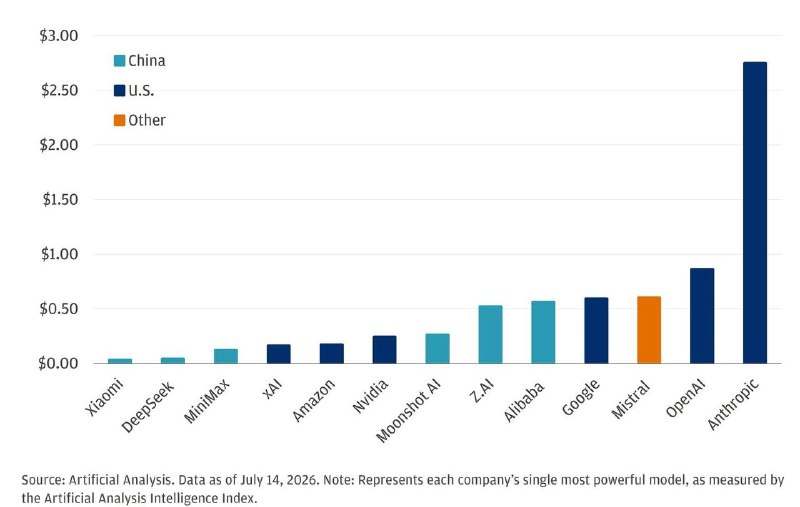
On the morning of 18 July 2026, a YouTube channel named roundtablespace published three short build-tests that, taken together, redrew the competitive line in practical AI coding. The first, posted at 03:15 UTC, declared Kimi K3, the latest flagship from Moonshot AI, "officially better than Claude Fable 5 and GPT-5.6 Sol for frontend development," after the model produced a macOS-style interface for an "AI operating system" from a single prompt. The second, thirty minutes later, ran a head-to-head against Anthropic's Fable 5. The third, at 04:15 UTC, priced the new contest: Kimi K3 built a CS:GO-meets-Portal clone in three shots for $3.24 in inference costs, against $10.80 for Fable 5 and $6.00 for GPT-5.6 Sol on equivalent token budgets.
The number that travels is the $3.24. It is small enough to be anecdotal and large enough, relative to its peers, to change the procurement calculus at any startup or studio that ships product through generative UI.
What the three tests actually measured
Roundtablespace's framing was bluntly competitive. Each run was an applied build, not a leaderboard number: a desktop-grade interface rendered from natural language, then a head-to-head on the same brief, then a price-tag comparison on a game-style deliverable. The Chinese model won the first and was declared superior to two Western incumbents; the cost test placed Kimi K3 at roughly a third of Fable 5's per-token bill and around half of GPT-5.6 Sol's.
The figures are vendor-side claims of inference cost rather than audited bills. They are also the only verifiable numbers attached to these specific builds; benchmark bodies and third-party eval labs had not, as of the thread's timestamps on 18 July, published independent reproduction. That caveat belongs on the page: the result is reported, not adjudicated.
The Chinese efficiency playbook, in plain terms
For the past two years, the most consequential story in frontier AI has not been a single model release but a structural shift in unit economics. Chinese model labs have repeatedly shipped competitive-quality output at a fraction of Western inference prices, driven by aggressive parameter and routing optimisation, MoE-style sparse architectures, and a domestic compute and talent base that compresses training and serving overhead. The pattern is visible in DeepSeek's pricing, in the open-weight releases from Qwen and Yi, and now in Kimi K3's reported economics.
The political-economy reading that follows is neither flattering nor dismissive. It is mechanical. When a single inference request drops from ten dollars to three, the set of products that become economically viable expands: longer-context agents, multi-step tool use, on-device-style local builds routed through thin APIs, and indie studios that could not previously afford to put a frontier model in their production loop. The West has, until recently, defined frontier quality in raw capability terms. The Chinese side has increasingly defined it as capability per dollar, with cost baked into the marketing claim.
Why the cost line matters more than the leaderboard
Capability benchmarks are a poor guide to deployment. What matters at the procurement layer is whether a model can hold context, follow a multi-file spec, and iterate without burning budget. On that working definition, the roundtablespace tests are pointed: three shots to a working game-style clone is not a research artefact, it is a bill a real product team could absorb on a Tuesday.
There is a counter-read worth taking seriously. The Western wire has, across 2025 and the first half of 2026, repeatedly framed Chinese models as catching up rather than leading. That framing is defensible on raw reasoning evals and on the geopolitics of compute (export controls on advanced GPUs, tensions over Taiwanese fabrication, the ongoing chip-supply chill). It is also increasingly hard to sustain when a Chinese model ships a competitive-quality build for a third of the price. The two claims, "China is behind" and "China is cheaper at parity", are not contradictory, but they sit uneasily together, and the tension is now product-visible.
Structural frame: the cost curve has moved underneath the incumbents
Three forces are colliding. First, the Chinese domestic market is large enough that model providers can recoup training costs on volume rather than per-seat margin, releasing them to push inference prices down. Second, the open-weight ecosystem around Qwen, DeepSeek, and now Kimi has tightened the price ceiling that proprietary Western labs can charge for commoditised tasks. Third, the application layer, startups, design tools, game engines, in-house enterprise builds, is reorganising its workflow around whichever model delivers acceptable output at the lowest marginal cost.
In plain prose, what is happening is a classic cost-curve compression: an incumbent frontier is being re-priced by a challenger that does not need to charge Western margins to remain solvent. The Western response so far has been capability differentiation (longer context, better tool use, tighter safety contracts) and pricing tiers that reserve the cheap end for older models. Both work for a quarter or two. Neither answers a question the roundtablespace numbers raise directly: at what point does capability-per-dollar become the purchasing criterion, and how long can the Western majors run a two-tier strategy before that question becomes a revenue problem?
Stakes: who wins and who loses if the curve stays
If Kimi K3's pricing and quality hold under independent reproduction, the beneficiaries are downstream builders: small studios, indie game developers, design tools, internal-tooling teams at mid-sized firms. They get a frontier-grade coder at a price they can budget. The first-order losers are the application-layer incumbents whose moat was "we use the best model" rather than "we built the workflow," because that moat is now contestable on price. The second-order losers are Western frontier labs whose gross margins depend on the gap between training-cost amortisation and per-token revenue; that gap narrows every quarter the Chinese cost line stays where it is.
The deeper question is regulatory and infrastructural rather than competitive. Chinese models face uneven access in Western enterprise procurement, particularly in sectors, defence-adjacent, financial data, public-sector, where policy and risk teams read model provenance as a security question. The cost advantage is real; the deployment ceiling is also real, and the two will interact in ways that vary sharply by jurisdiction. European procurement offices, Canadian privacy regulators, and US federal contractors will reach different conclusions about whether a $3.24 build is a bargain or a dependency.
What remains genuinely uncertain
Three things are unsettled as of 18 July 2026. First, the roundtablespace results are not yet independently reproduced on identical prompts; the underlying benchmarks, UI fidelity, game-mechanic completeness, asset pipeline behaviour, were chosen by the channel rather than by a neutral eval body. Second, Kimi K3's headline pricing may reflect promotional rates, token-counting conventions, or routing discounts that do not survive contact with enterprise contracts; the public list price and the negotiated price for a 50-million-token monthly commitment can diverge by a factor of three or more. Third, the cost figures do not speak to safety, alignment, or refusal behaviour, which remain procurement-grade concerns in regulated industries regardless of inference price.
The right way to read this thread, on the morning it lands, is not as a verdict on which lab is "ahead." It is as a marker that the cost curve, the most consequential variable in applied AI for the next eighteen months, has moved in a direction that favours the Chinese ecosystem's particular strengths. The Western majors still hold the capability crown on several measures. They do not, on this evidence, hold the price crown, and price is where the volume moves.
This piece framed the roundtablespace thread as a cost-curve story rather than a capability story, on the grounds that a $3.24 build for a working game-style clone is a procurement fact even when its benchmarks are vendor-chosen. Western wire coverage in the same window emphasised the leaderboard framing; Monexus read it as economics.