Iran widens the strike set: US troops wounded in Jordan as the Gulf theatre expands
US service members are injured in Iranian strikes on Jordan, according to CBS, marking an expansion of Iran's target set into four Arab states overnight.
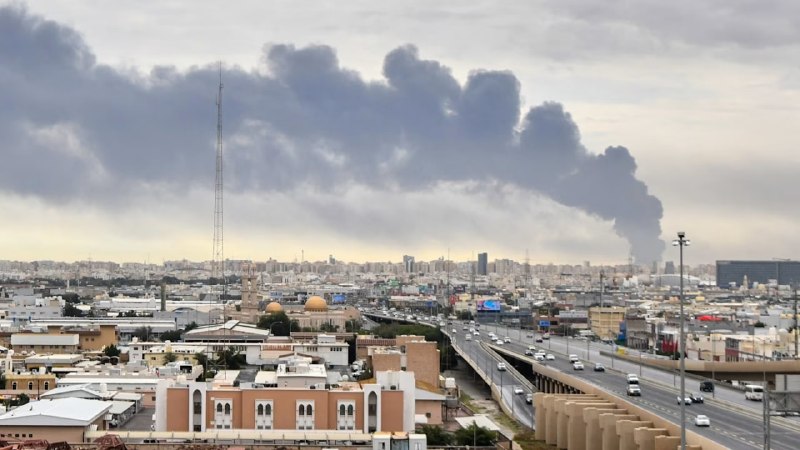
At 08:39 UTC on 18 July 2026, CBS News reported that multiple US soldiers had been injured in the latest wave of Iranian strikes on Jordan. The network, cited by X account @shaykhsulaiman and amplified by Telegram channel @megatron_ron within minutes, said there were no fatalities among American personnel hit in the attacks.
By mid-morning the strike set had widened. A separate Telegram brief carried by @englishabuali at 08:15 UTC listed four Arab states hit overnight: Jordan, Bahrain, Iraq, and Kuwait. The geography matters. These are not frontier positions. They are host governments of US Central Command's forward posture in the Gulf, sitting alongside the Fifth Fleet base in Bahrain and the air corridors that have carried American airpower into the Levant and the Iranian plateau for two decades.
What begins as a missile exchange between two states has, by sunrise over Amman, become a wider war fought on the territory of four American partners. The escalation is fast, the public sourcing thin, and the question that hangs over every wire report is whether this is the campaign Tehran planned, or the campaign Tehran got.
What CBS actually said
The reporting that is animating the news cycle is short and specific. CBS reported multiple US service members injured in Iranian strikes on Jordan, with no American fatalities attributed to the recent attacks. The wire characterisation, carried by @shaykhsulaiman at 08:39 UTC, did not specify the installation hit, the unit involved, the weapon type, or the medical status of the wounded. It named no Iranian order of battle, no missile type, and no Iranian claim of responsibility attached to a particular salvo.
What is also absent from the publicly circulating reports is a US Central Command confirmation. As of the timestamps available, the framing rests on a single US network's reporting, echoed by regional channels and amplified across social platforms. That is a thin foundation for the scale of inference being built on top of it.
The geometry of the strikes, as best as the public thread material permits, points at four separate national jurisdictions within a single overnight window. That is not the profile of a single retaliatory salvo. It is closer to a calibrated campaign of pressure across the host-state network that underwrites the US military presence in the Gulf.
The target set, country by country
The four states named in the @englishabuali brief at 08:15 UTC each sit at a different node of the American architecture in the region, and each carries a different risk calculus for Tehran.
Jordan is a treaty ally hosting US personnel and aircraft at Muwaffaq al-Salti air base and other facilities. A strike there tests whether Amman's airspace can be penetrated at will, and whether the political cost of hosting US forces can be made visible to a domestic audience already restive over the Gaza war and the kingdom's quiet cooperation with Israel.
Bahrain is home to the headquarters of the US Navy's Fifth Fleet, the anchor of Western naval power in the Gulf since 1995. Any strike on Bahrain is, by definition, a strike on the most visible American flag in the region.
Iraq hosts US forces in a transactional arrangement with Baghdad, where the Iraqi government's tolerance of the US presence is itself a domestic political liability. Strikes there raise the cost of that arrangement and put pressure on a prime minister already navigating militia politics.
Kuwait, finally, sits on the Strait of Hormuz transit corridor and hosts US Army pre-positioned stocks. A strike on Kuwait is a strike on the logistics tail that would feed any sustained American air campaign.
Four capitals, four different pressure points, one overnight window. The selection is not random. It reads as the targeting logic of a state that has mapped the US regional architecture and chosen, deliberately, to hit at every joint at once.
The information fog
What is striking about the reporting is how little of substance has been confirmed beyond the headline. There is no public Iranian readout of the strikes as of the timestamps available. There is no US Central Command press release naming bases hit. There are no casualty figures from Jordanian, Bahraini, Iraqi, or Kuwaiti authorities. There is no missile count, no intercept timeline, no operational name attached to the salvo.
What there is, in abundance, is amplification. The CBS report moved from a single network bulletin to a multi-platform talking point inside an hour. The same two lines, "multiple US soldiers injured" and "no American fatalities," are now the spine of dozens of posts across X and Telegram, with regional outlets and independent analysts treating them as confirmed baseline.
That is how a thin factual layer becomes the foundation for a much larger story. The factual layer is real: CBS is a major US network with access to Pentagon and administration sources. The story built on top of it, asserting intent, strategy, and trajectory, is doing a lot more work than the underlying sourcing will bear.
A reader sitting with this thread at 09:00 UTC knows three things with reasonable confidence: Iranian projectiles hit Jordan, US personnel were injured, and the strike set widened to at least three other Arab states overnight. A reader sitting with the same thread should be careful about claiming more.
What this sits inside
Even on the limited public sourcing, the strikes describe a recognisable pattern in the long-running Iran-Israel-US war. The architecture of the conflict has, since 2023, featured an exchange in which Iranian retaliation is calibrated not to destroy a single target but to demonstrate reach across the host-state network that makes the US posture in the Gulf possible.
This is a particular kind of war. It is not a contest of mass armies on a defined front. It is a contest over the political cost of presence. Each strike on a host state's territory raises, by a measurable increment, the domestic political price of continuing to host American forces. Hit four host states in one night and the price compounds. The strategic logic, to the extent one can be read from the target selection, is to make the US forward posture politically expensive for the governments that sustain it.
The Iranian position inside that logic deserves to be stated plainly. Tehran's framing, carried by outlets aligned with the Islamic Republic, has long held that the US military presence in the Gulf is an occupation rather than a partnership, and that strikes on facilities used by American forces are strikes on a foreign deployment rather than on the sovereignty of host states. That framing is rejected by Washington and by most Arab Gulf governments. It is, however, a coherent strategic narrative, and it is doing real work in shaping how this overnight salvo will be read inside Iran and across the wider region.
Stakes, and what to watch
The immediate stakes are kinetic. Injured US personnel on the territory of four Arab states is, on its face, a casus belli sufficient for expanded American retaliation if Washington chooses to treat it as one. The question over the next 48 hours is whether the US response is calibrated, at scale, or absorbed.
Three forward indicators are worth tracking.
First, the Iranian state readout. Tehran's official channels will frame the salvo in language designed for a domestic audience and for an audience of fence-sitting Arab governments. The language chosen, restraint or escalation, will signal whether Tehran believes it has won a round or needs to play another.
Second, Central Command's confirmation. The Pentagon's first formal statement will set the American framing. The gap between CBS's reporting and the Pentagon's confirmation will tell readers how much confidence the US government itself has in the early picture.
Third, the response of the four host governments. Jordan, Bahrain, Iraq, and Kuwait will each issue statements calibrated to the political pressure of the moment. The variation between those statements will be the most informative single signal about whether the strikes have damaged, or reinforced, the regional architecture the United States has spent two decades building.
What remains genuinely uncertain, on the public sourcing available, is whether this overnight salvo is a chapter or a campaign. The targeting logic suggests a deliberate strategy. The thinness of the public record suggests that the strategy may also be designed to operate in the gaps, where the political cost of presence compounds faster than the factual record can be established.
That is the read this publication finds most plausible on the present evidence, while reserving the right to revise it sharply as more of the underlying record emerges.
Desk note: Monexus is treating the 18 July strikes as a four-country expansion of the Iranian target set, led by CBS reporting on US personnel in Jordan and corroborated in direction by a separate Telegram channel's enumeration of strikes on Bahrain, Iraq, and Kuwait. We are not yet attributing intent beyond what the target selection implies, and we are flagging the gap between a single US network's reporting and the absence of a confirmed Pentagon, Central Command, or host-government readout.
Wire provenance
This editorial synthesis draws on the following public wire/social posts:
- https://t.me/megatron_ron
- https://t.me/englishabuali