Strikes on Erbil and Muwaffaq Salti: Iran opens a second front as US pressure on Tehran hardens
Explosions hit Erbil and a US-aligned airbase in Jordan within hours, as Iraqi and regional channels blamed Tehran and the US pressed a sanctions track alongside the guns.
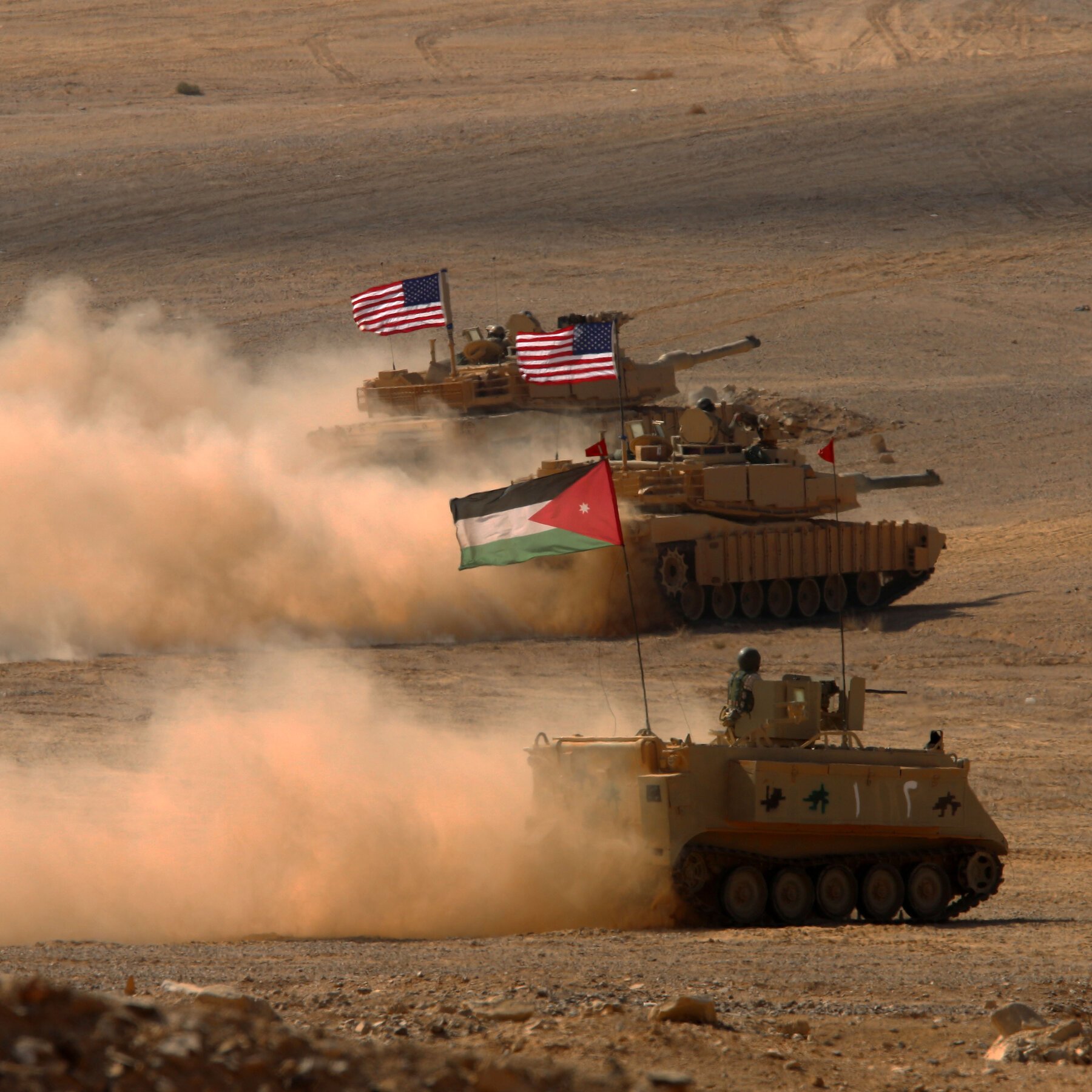
At 11:32 UTC on 18 July 2026, monitors tracking military traffic across the Kurdish north and the Jordanian desert began lighting up at the same time. A drone attack on Erbil, capital of the Kurdistan Region of Iraq, sent explosions through the city's airspace within the hour; roughly nine minutes earlier, a separate strike wave had been reported against Muwaffaq Salti Airbase, a facility long used by US and Jordanian forces in the country's northeast. Iraqi Prime Minister Ali Al-Zaidi's office publicly condemned the Erbil incursion. Regional channels pointed in the same direction: Iran.
Two cities, one morning, two very different targets. Read together, the strikes suggest that Tehran is no longer content to test Israeli airspace alone. The geometry of the day points to a widening of the confrontation, with Iraqi Kurdish territory and a US-aligned Jordanian base joining the list of places where the war between Iran and the United States can now touch ground.
What actually happened on the morning of 18 July
The first reports surfaced in Telegram channels at 10:11 UTC, when Middle East Spectator carried a flash alert claiming multiple impacts on Muwaffaq Salti Airbase in Jordan. A second channel, Megatron, repeated the framing three minutes later. By 11:23 UTC, the AMK Mapping account had begun posting more granular detail, noting that missiles and drones had likely targeted Iraqi Kurdistan and that explosions had been heard in Erbil; the same account flagged a fire breaking out at Muwaffaq Salti after the impacts. By 11:32 UTC, the GeoPolitical Watch channel was reporting an outright drone attack on Erbil and circulating the Iraqi prime minister's condemnation. The sequencing matters: the Jordanian base appears to have been hit first, with Erbil following.
The Iraqi prime minister's response, quoted in regional channels, was unusually pointed for an Iraqi government statement, calling out a "drone attack" that violated Erbil's airspace. Baghdad has been careful in past months not to escalate publicly against any particular neighbour; the directness of the language is itself a signal that the strike registered inside the Iraqi system as something more than a routine probe.
The two targets are not the same kind of target
Muwaffaq Salti Airbase, in northeastern Jordan, has hosted US trainers, fighter aircraft rotations, and elements of the regional air-defence architecture tied to Operation Inherent Resolve. Strikes there carry a direct message to Washington: forward bases that American planners treat as sanctuary are inside the conversation now.
Erbil is something different. The Kurdistan Region has been, for two decades, the quiet partner of US operations in northern Iraq, and is also the host city of the US consulate and a range of Western energy and logistics investments. A drone strike on Erbil's airspace is a strike on a place the United States has invested politically, not just militarily. Baghdad's swift condemnation, and the use of the word "violation", points to the political cost Tehran is now willing to impose on its Iraqi interlocutors.
The same source items record both events in the same morning. That coincidence is the story.
Why now: the sanctions track and the wider corridor
The strikes do not arrive in a vacuum. American and Iranian negotiators have spent much of the first half of 2026 trading terms for a possible nuclear and sanctions package, while the United States has continued to tighten secondary sanctions on Iranian oil exports and on the network of intermediaries that move that oil through the Gulf and the Levant. Iran's missile and drone programme, and the proxy network that surrounds it, have continued to absorb the squeeze without breaking.
In that context, the morning's two strikes look less like an outbreak and more like a calibrated reply. A hit on a US-aligned base in Jordan speaks to the American military presence directly. A drone attack on Erbil speaks to Iraqi politics, to the Kurdish question, and to the energy corridor that runs through the Kurdistan Region. Iran's playbook when cornered has historically been to widen the geography of the conflict, not to narrow it. The 18 July pattern fits that script.
The counter-read is straightforward and has to be on the page: it is possible that some or all of these impacts were the work of militia groups operating under Iranian direction rather than uniformed Iranian forces, which would let Tehran keep the plausible deniability it has cultivated in previous escalations. The sources available at the time of writing do not settle that question; they point at Iran without specifying the launch authority. Both readings should be held.
What this changes, and what to watch next
If Tehran is the author of both strikes, three things follow. First, the geography of US-Iran confrontation has formally extended into Jordan, a US treaty ally that has so far kept its head down. Jordan's response, both public and behind the scenes at CENTCOM, will tell us how Washington reads the escalation. Second, Iraq is now paying a political price inside its own constitutional bargain: Baghdad needs Kurdish cooperation to govern, and Kurdish airspace is now a target. The Iraqi prime minister's unusually sharp language is the leading indicator of that strain. Third, the negotiation track, which had been the West's preferred off-ramp, becomes harder to walk. Iran has historically used kinetic signals to harden its bargaining position; the question is whether Washington reads the same way or treats the strikes as crossing a line that ends the talks.
The next 72 hours will be diagnostic. Watch for CENTCOM attribution, for any Iraqi request for US air-defence reinforcements around Erbil, and for the Jordanian government's first formal statement beyond initial damage reports. The Iranian foreign ministry has not, at the time of writing, commented on either strike; that silence is itself a kind of comment, and it will not last.
What the morning of 18 July makes harder to argue is that the US-Iran contest is a contained one, fought at the negotiating table and along the nuclear file alone. The map has changed.
This article was drafted from Telegram monitoring traffic and does not yet incorporate wire-service attribution; readers should treat strike authorship as preliminary until CENTCOM or the Jordanian and Iraqi governments publish formal findings.
Wire provenance
This editorial synthesis draws on the following public wire/social posts:
- https://t.me/GeoPWatch
- https://t.me/AMK_Mapping
- https://t.me/megatron_ron
- https://t.me/Middle_East_Spectator
- https://t.me/s/AMK_Mapping