An Iranian strike hits a US base in Jordan, and the question nobody is asking
Iranian missiles struck the Muwaffaq Salti airbase overnight. The wire notices the helicopters. The harder question is what comes next.
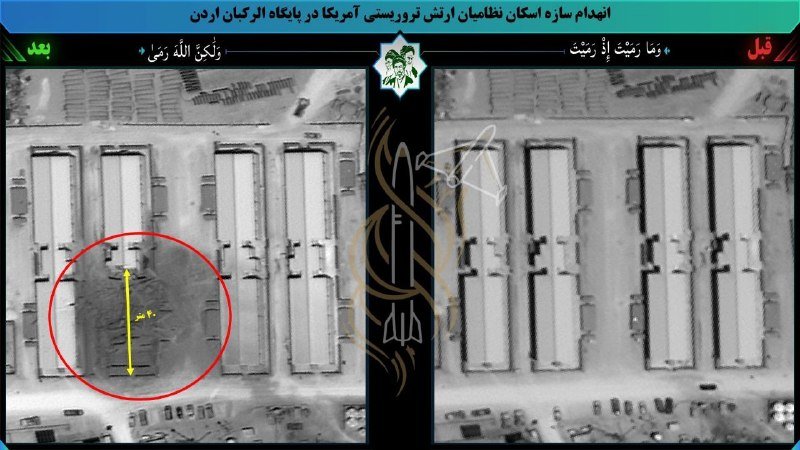
At 20:39 UTC on 18 July 2026, satellite fire-detection data published by NASA's FIRMS showed a thermal signature expanding across the billeting quarters at Jordan's Muwaffaq Salti airbase. By 21:26 UTC, The New York Times, citing US officials, was reporting that American forces at the base had come under Iranian attack within the preceding five days, with deaths and injuries. By 21:18 UTC, footage filmed by a US soldier on the ground had been amplified across X, showing a strike on the same compound. The infrastructure damage is partial: several helicopters were damaged, twenty US soldiers were injured 48 hours before the official US confirmation reached the wire, and the ground footprint of the attack sits inside allied territory on Jordanian soil.
What is unfolding is not a single strike but a sequence. The detonations on 18 July follow an Iranian bombardment of the same airbase reported by The New York Times via US officials roughly two days earlier, on or around 16 July. The first event produced casualty reports that US authorities confirmed only after satellite imagery and soldier footage forced the timeline into the open. The second event sits inside an arc that already includes Iranian strikes on US positions in Iraq and Syria, an Israeli campaign against Tehran-aligned assets across the region, and a renewed sanctions architecture stretching from Washington through the Gulf. The question is no longer whether Iran is willing to hit US assets directly. The question is what Washington decides to do about it, and on whose timetable.
The base that does not officially exist publicly
Muwaffaq Salti is a Royal Jordanian Air Force installation in northeastern Jordan, long associated in regional reporting with US Central Command forward-deployed aviation and intelligence assets. Israeli and US coverage routinely treats its precise inventory as undisclosed. Iran's choice of target, billeting quarters, by the satellite signature, not hardened flight-line infrastructure, is read consistently by military analysts as calibrated: enough pain to signal reach, not enough damage to force a full retaliatory cycle.
This calibration is the detail that does not survive translation into the Western wire lens. In that framing, an Iranian strike on a US base is an Iranian strike on a US base, and the debate collapses into escalation versus restraint. Iranian state-aligned coverage, by contrast, frames strikes on US positions as defensive responses to Israeli action and as enforcement of a regional balance. Both readings are partial. The harder observation is that Iran has now demonstrated the ability to put satellite-detectable thermal signatures on a US-allied airbase twice inside three days, which is a military fact that survives any framing disagreement.
The information war is moving faster than the event
The most revealing element of the 18 July reporting is the order in which it arrived. Soldier footage hit X at 20:24 UTC. Hebrew-language outlets flagged helicopter damage at 20:57 UTC. The New York Times, via US officials, surfaced casualty accounts at 20:53 UTC and full incident language at 21:26 UTC. The astronomical-telegram channels and the wider Arabic-language OSINT feed reached roughly the same conclusions simultaneously, sometimes within seconds.
Wire-service journalism and Telegram-channel reporting now compete in the same time window, on the same factual material, with different sourcing standards. The result is a fragmented public record in which a reader can assemble an accurate timeline from open-source material before the official statements have cleared military review. The Pentagon's instinct toward information control, visible in the 48-hour gap between incident and confirmation, is no longer fast enough to set the narrative.
What the strike is not
It is not, on the evidence available, an Iranian operation against the Hashemite kingdom. Jordanian territory was used; Jordanian framing of the incident as a violation is itself an open question the sources do not resolve. It is also not, as some initial social media posts framed it, an attack on a US logistics node comparable to the January 2024 tower strike on Tower 22 further east. The hardware loss is real but bounded: damaged helicopters, injured personnel, no reported command-and-control decapitation. The strike is large because it is now the second in 72 hours, and because the first took 48 hours for US authorities to acknowledge.
What to watch next
The next four to seven days carry the decision. A US retaliatory strike against Iranian assets, almost certainly outside Iranian territory given the air-defence picture over the Islamic Republic itself, is the conventional expectation. The less conventional outcome, and the one with longer structural consequences, is escalation management via Jordanian and Gulf-state back-channels, which would imply a price paid in concessions rather than detonations. Either path is consistent with the strike's apparent calibration. Neither is consistent with the 48-hour information lag, which is a problem for Washington even before it becomes a problem for Tehran.
The honest summary on the morning of 19 July is straightforward: the strike happened; the casualty and damage figures in the sources are partial and US-government-confirmed only in broad terms; the strategic intent is contested between read-as-restrained and read-as-punitive; and the information environment around the event is now faster than the officials whose job it is to explain it.
This piece treats an active event. Figures are drawn from US-official briefings relayed through The New York Times, Hebrew-language coverage, NASA FIRMS satellite data, and soldier-filmed footage on X. Where the sources disagree, that disagreement is named rather than resolved.
Wire provenance
This editorial synthesis draws on the following public wire/social posts:
- https://t.me/alalamarabic
- https://t.me/osintlive
- https://t.me/alalamarabic/157
- https://t.me/alalamarabic/156
- https://t.me/rnintel
- https://x.com/sprinterpress/status/2078590239728115712