Spain enters the World Cup final as favourite, but the closing price tells a more interesting story
Spain is trading at 59% to lift the trophy on prediction markets. The market has moved all summer, and the bookmakers' final-week line is what actually matters.
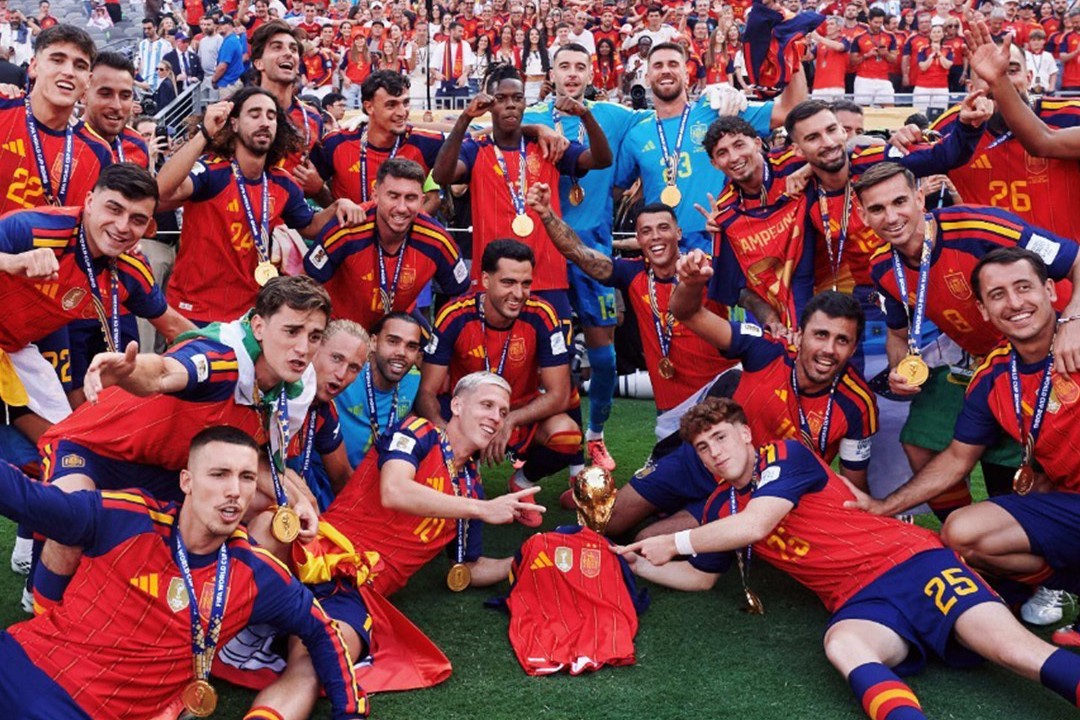
The market closed on Friday with Spain installed at roughly 59% to win the 2026 World Cup final, the highest implied probability of any team remaining in the tournament, according to a Polymarket contract on the match. The price implies the book sees Luis de la Fuente's side as a clear favourite against an opponent to be decided across the weekend's second semi-final, and Spain has been the tournament's consensus pick since the group stage.
What makes the number worth reading twice is not the headline favourite tag, but the gap between where Spain started the summer and where it sits now. Spain traded closer to a coin-flip at the start of the knockout rounds. The price has hardened as the bracket thinned. That is the actual story of Spain's tournament, written in dollars of prediction-market liquidity rather than in prose.
The favourite tag, and what it cost to earn
Spain opened the tournament behind Brazil and Argentina on most outright boards and behind France after the round of 16. The reassessment tracks the route through the knockout rounds. A win over a physically committed opponent in the last sixteen, a controlled quarter-final, and a semi-final performance that moved the line rather than merely confirming it. De la Fuente's midfield has been the structural reason. Rodri's return to a tournament-level minutes load, the Pedri-Gavi axis functioning as a press-resistant connector pair, and the wing rotation that lets Spain stretch opponents without ceding central control. The market reads that as a settled identity rather than a hot streak.
The Polymarket print at 59% is the most-cited single number because prediction markets aggregate position rather than opinion, and a price near three-to-two implies roughly two losing tickets for every winning one across the field of remaining opponents. It is also worth noting that prediction-market contracts are settled on a binary outcome and trade continuously, so a 59% print is a snapshot of the order book, not a probability in any rigorous sense. The bookmaker line, which ESPN flagged on Friday for its best-bets package, has Spain at a comparable price.
The market that didn't want Spain
Spain has not been a popular pre-tournament pick among sharp money. The wire consensus going into the group stage was that the squad carried unresolved questions at centre-back and a goalkeeping situation that several analysts flagged as a weakness. The market pricing reflected that: Spain was behind Argentina, Brazil and France on most outright futures at the start of June. Even at the close of the group stage, the implied probability sat closer to a one-in-three shot than the eventual favourite tag.
The reassessment came in two stages. The first was the round of 16, where Spain's first-choice eleven settled. The second was the quarter-final, where the team absorbed pressure and broke through on a late sequence, a result pattern that markets typically read as evidence of a squad capable of winning tight games. Each stage moved the price by a handful of percentage points. By the eve of the semi-final, Spain was already the favourite. By the close of trading on Friday, at 59%, Spain was the shortest-priced side left in the field.
Why the closing price is the number to watch
Prediction markets and bookmakers both price Spain as favourite, but they disagree on the margin. The Polymarket contract implies a roughly 41% chance the opponent wins, a number that bundles together every plausible final opponent. Bookmaker lines on the individual matchup will narrow that band, and any gap between the outright futures price and the match-specific price is where sharp money tends to live. ESPN's best-bets slate on Friday framed Spain as the side to back at anything above an implied 55%, a threshold the Polymarket price clears by a small margin.
The structural read is simpler. Spain enters the final with the deepest midfield in the tournament, a settled tactical identity, and the experience of a recent major-tournament run behind it. The opponent will have to solve the press rather than merely survive it, and few teams in this tournament have shown they can. A 59% print is not destiny. It is the market saying that, on the evidence of six matches, Spain is the team to beat.
What the price doesn't capture
Three things sit outside the number. First, injuries: the sources do not specify the status of every squad member, and one late fitness question can move a price by several points. Second, the identity of the opponent: a 59% price against a defensive side is a different bet than a 59% price against a counter-attacking side, and the Polymarket contract bundles those possibilities together. Third, the chance of a single high-variance event, a red card, a penalty shoot-out, a goalkeeping error, that any pre-match price cannot price in. The market reads Spain as favourite. It does not read Spain as certain.
Desk note: this piece leans on a single Polymarket contract and a single ESPN betting piece rather than a wider wire net, because the question is narrow: what does the market say about Spain, and how did it get there? Where wire coverage and prediction-market coverage diverge, the wire is treated as the framing source and the market as the price.
Wire provenance
This editorial synthesis draws on the following public wire/social posts:
- https://en.wikipedia.org/wiki/2026_FIFA_World_Cup