Iran strikes Kurdish opposition targets in Sulaymaniyah as explosions rock ammo depots
Iranian strikes hit weapons stores and party headquarters in Iraq's Sulaymaniyah province on 17 July, with footage showing fires and secondary explosions at ammo depots.
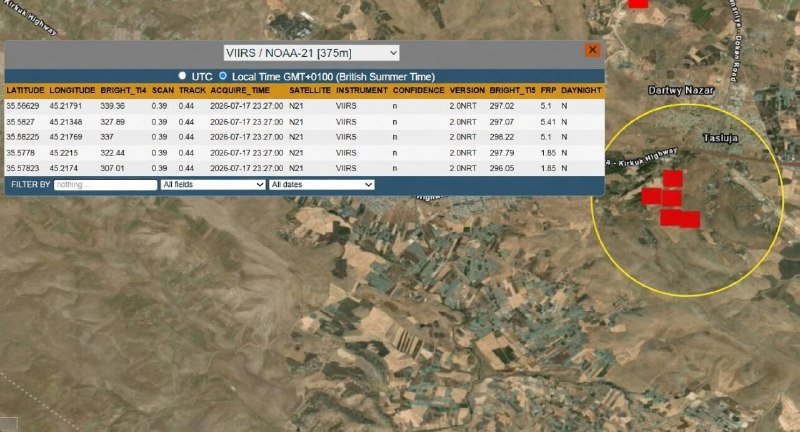
Explosions tore through ammunition depots and the reported headquarters of Kurdish opposition parties in Iraq's northern Sulaymaniyah province on the evening of 17 July 2026, in a wave of Iranian strikes that Iranian state media framed as a blow against separatist groups operating across the border. Footage circulating on Telegram channels showed fires and secondary blasts at the struck sites, with detonations continuing from stored rockets and munitions.
The strikes land the day after Iran's continuing confrontation with Kurdish parties exiled in Iraqi Kurdistan, and they sit inside a longer, quieter campaign: Tehran's periodic cross-border operations against the Kurdistan Free Life Party (PJAK) and Iranian Kurdish opposition factions whose rear bases in Sulaymaniyah and Erbil provinces have long been a pressure point in Iran-Iraq relations.
What hit, and where
Tasnim News, Iran's state-run English wire, reported at 17:58 UTC on 17 July that weapons warehouses belonging to Kurdish separatist groups in Sulaymaniyah had been destroyed. Minutes later, the Telegram channel Clash Report cited incoming footage of strikes on ammo depots and bases in northern Iraq, with fires visible at the impact sites. By 18:37 UTC, The Cradle and its parallel channel account were circulating reports that the headquarters of Kurdish opposition parties in Sulaymaniyah had been attacked, triggering continuous explosions from stored rockets and munitions.
The geography matters. Sulaymaniyah is administered by the Kurdistan Region's rival faction to Erbil, with closer ties to Turkey and to the Kurdistan Workers' Party (PKK) network that has historically hosted Iranian Kurdish offshoots on the same mountain terrain. Strikes here are not new: Iran's Islamic Revolutionary Guard Corps has hit similar targets at least twice in the past two years, including operations in September 2023 and a renewed round in early 2024, each time drawing Baghdad's diplomatic protest and quiet acquiescence from the Kurdistan Regional Government.
Tehran's framing, and the Kurdish counter
Iranian state media presented the operation as counter-terrorism work against separatists responsible for cross-border attacks inside Iran. Tasnim's brief used the term "Kurdish separatist groups" rather than naming a specific organisation, a framing that lumps together PJAK, Komala, and the Democratic Party of Iranian Kurdistan (PDKI), all of which maintain political or paramilitary presence in Iraqi Kurdistan. The Cradle, which covers the region from a Beirut editorial desk skeptical of Western and Israeli postures, framed the strikes as an assault on legitimate Kurdish opposition infrastructure and noted the visible secondary explosions consistent with ammunition storage, not insurgent fighting positions.
The Kurdish parties themselves have not yet, as of the time of writing, issued a unified casualty statement. The pattern across previous rounds is consistent: Iraqi Kurdish authorities publicly condemn the strikes as a violation of sovereignty, file diplomatic notes through Baghdad, and quietly limit the operations of the Iranian Kurdish groups on their soil for a period of months, before the status quo resumes.
What this sits inside
The strikes are best read not as a one-off retaliation but as the operational expression of a long-running structural tension. Iran has for two decades used cross-border firepower and diplomatic pressure on Baghdad to constrain Kurdish opposition groups that Tehran classifies as terrorists. The September 2023 strikes, the January 2024 round, and earlier episodes all followed the same template: IRGC or Iranian air force assets hit depots and headquarters; Iraqi federal authorities summon the Iranian ambassador; the KRG issues a condemnation; and the underlying arrangement, in which Iraqi Kurdistan tolerates a low level of Iranian opposition presence in exchange for economic and security cooperation with Tehran, remains intact.
For Tehran, the calculus is domestic: every cross-border attack inside Iran by Kurdish armed groups, and every protest flare inside the Kurdish-majority provinces, raises the political cost of tolerance. Strikes on Iraqi soil are partly a warning to the exiled groups and partly a message to the KRG that the cost of hosting them is paid in fire, not in negotiated language.
What to watch next
Three indicators will mark whether this round is escalation or business as usual. First, an Iraqi federal statement from Baghdad: previous rounds produced a foreign ministry summons and a public condemnation within 48 hours. The wording matters more than the protest itself: references to sovereignty are standard; references to self-defence or to Article 51 of the UN Charter would be notable. Second, a KRG statement from Sulaymaniyah: a sharp public line from the Sulaymaniyah-based Patriotic Union of Kurdistan (PUK) would mark the strikes as politically costly in a way earlier rounds were not; silence or a perfunctory note would suggest quiet accommodation. Third, secondary explosions visible in footage: The Cradle's account described continuous blasts from stored rockets and munitions, which is consistent with depots rather than forward operating bases. Whether the opposition groups can reconstitute their infrastructure quickly is the operational question Tehran will be monitoring, and the timeline of that reconstitution is the metric by which this round will be judged a success or a temporary disruption.
The sources reviewed here do not specify casualty figures, the number of strike sorties, or the specific party headquarters involved. What they do establish is that strikes took place in Sulaymaniyah on 17 July 2026, that ammunition storage sites were hit, and that Iranian state media and Beirut-based regional outlets framed the operation in materially different terms, a split worth reading carefully rather than resolving.
This Monexus piece was framed against Iranian state wire and Beirut-based regional coverage; readers should expect Western wire confirmation of casualty figures and target identification to follow in the next 24 to 48 hours.
Wire provenance
This editorial synthesis draws on the following public wire/social posts:
- https://t.me/tasnimnews_en
- https://t.me/ClashReport
- https://t.me/thecradlemedia