Trees, then walls: Bint Jbeil loses another layer of cover
Israeli forces have cleared roadside trees and demolished a sports complex in Bint Jbeil, the latest visible stage of a buffer-zone logic that strips a border town of both sightlines and civic landmarks.
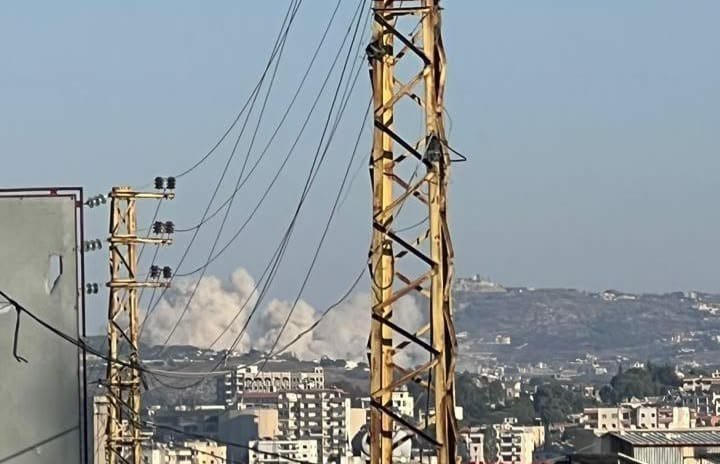
Rows of mature trees that once framed the approach to Bint Jbeil, in south Lebanon's Bint Jbeil district, stand felled. The Cradle Media reported on 17 July 2026 at 14:27 UTC that Israeli forces had "destroyed all the trees lining the roads leading to Bint Jbeil in southern Lebanon," with a separate account from the wider field network, relayed by @wfwitness at 14:42 UTC, describing the same operation as having stripped the entrance roadway of its tree cover and framing the action in the language of international humanitarian law.
In any border war, the first casualty of a buffer zone is usually the scenery. Bint Jbeil has now lost two visible layers in the same afternoon. Clearance of roadside vegetation, reported in the morning, was followed by demolition of the Hajj Mousa Abbas Sports Complex, a municipal stadium and surrounding buildings, as documented by The Cradle Media at 14:01 UTC on 17 July 2026.
The pattern matters more than either incident alone. Bint Jbeil sits in a strip of south Lebanon that has been shaped, repeatedly since the 1980s, by a simple Israeli security premise: that cover, elevation, and the civilian landmarks embedded in them must be removed if cross-border ground assault is to remain tenable. The trees and the stadium are not interchangeable targets in tactic, but they share a strategic logic; to deny the next fight, you first have to deny the next fight its geography.
What the cameras caught
The Cradle Media images show the same roadway from two states: tree-lined, then bare. Both the morning trees-down bulletin and the explicit reference to Bint Jbeil as the affected town appear under a single outlet banner. A second, parallel field account, relayed by @wfwitness under a distinct handle, repeats the trees-down claim and adds a normative frame, calling the work a destruction of civilian infrastructure under international humanitarian law. The two accounts converge on the place, the timing, and the basic description; they diverge in editorial register. @wfwitness is explicitly framing the action, while The Cradle is, in this case, primarily documenting it.
The demolitions reporting at 14:01 UTC is more granular. The Hajj Mousa Abbas Sports Complex, with its municipal stadium and the buildings in the immediate vicinity, is named. The phrasing, "after Israeli demolition operations," puts the Israeli military in the operator's seat. Israeli authorities have not, in the material available to Monexus in real time, publicly disputed the tree-cutting at Bint Jbeil's entry or the demolition of the sports complex; nor have they issued a detailed explanation specific to either site. The IDF routinely describes clearance work in southern Lebanese border towns as necessary for the security of northern Israeli communities, but the wire channels reviewed for this dispatch do not contain a confirmation or denial from an IDF spokesperson addressing Bint Jbeil's tree cover or the stadium on 17 July 2026.
A wider logic, applied in plain sight
Buffer-zone engineering in this part of the world has a long memory. After 1948, after 1967, and again after 1978, Israeli forces cut orchards, bulldozed roads, and razed the masonry between themselves and a frontier they considered insecure. The 1982 invasion widened that practice into a permanent occupation strip, with Bint Jbeil becoming, in 1982 and again in 2006, a district capital defined by what was rebuilt on top of what had been destroyed. Each cycle produced the same idiom of clearance: trees first because they provide overhead concealment; stone walls and the buildings attached to them next, because they cast shadows at dusk and anchor the next building.
Seen against that memory, the 17 July reports are less an aberration than a routine application of an established operational template. What makes them feel like a departure is the dual use of the day: roadside vegetation cleared within the same stretch of hours as a named sports facility destroyed. Both moves are consistent with the same premise, that the terrain between the border fence and the next inhabited block must be denuded of anything that could shelter the next missile team, the next observation post, or the next ambush.
There is a counter-read worth naming. Israeli officials have, in prior iterations of the south Lebanon buffer, argued that visible destruction is a lagging indicator, that the real engineering is the demolition of subterranean infrastructure and tunnel shafts that never appear on camera. Tree felling and stadium demolitions, on this view, are not the operation so much as the collateral theatrical release. Monexus cannot independently adjudicate that version against the material available in real time, and the reporting on 17 July does not adjudicate it either. Both versions can coexist; neither is exculpatory for the visible destruction.
Stakes for the town and the frontier
Bint Jbeil is one of the larger historic towns of the south Lebanon district and the administrative capital of its own caza. A name change at the municipal stadium is more than cosmetic; the Hajj Mousa Abbas Sports Complex is a designated civic landmark, the kind of structure whose destruction reads locally as a renaming of the town by other means. For a town that has been rebuilt several times already in living memory, the demolition of a sports facility is a fresh entry in a register the population has had to learn by heart.
Regionally, the daily arithmetic of clearance shapes both deterrence and revulsion. Israeli planners read each metre of cleared tree line as a line of sight recovered; Lebanese and diaspora audiences read each cleared line as a further confirmation that buffer-zone logic is a permanent, not provisional, doctrine. A town that loses its entry corridor and its stadium in the same afternoon is not a military problem to be solved; it is a place that someone, somewhere, has decided not to need for the duration of this campaign.
The day itself
By 14:42 UTC on 17 July 2026 the visible record is already more than a bulletin and less than a closure. The Cradle Media has published twice in roughly forty minutes, once to document the complex and once to document the trees. The wire channels reviewed in real time have not, as of the moment of this dispatch, added independent confirmation specific to either site. What is on the record, in two near-simultaneous accounts, is the order of work: trees first, then walls. Both are reversible in principle. Neither is planned for, by any of the relevant actors, to be reversed soon.
Desk note: Monexus leads with the primary local-source documentation on the ground (The Cradle Media, with corroboration via @wfwitness) rather than western wire round-ups, which have not yet published specific confirmation of either Bint Jbeil incident on 17 July 2026. Israeli security framing, buffer-zone necessity, denial of cover to hostile infrastructure, is acknowledged in the counter-narrative section; the visible destruction is not soft-pedalled either way.
Wire provenance
This editorial synthesis draws on the following public wire/social posts:
- https://t.me/thecradlemedia/
- https://t.me/TheCradleMedia/
- https://t.me/wfwitness/
- https://t.me/TheCradleMedia/
- https://t.me/thecradlemedia/