Bint Jbeil under pressure: an Israeli detonation sequence and a checkpoint approach that didn't quite resolve
Two incidents separated by twenty minutes and thirty kilometres: an Israeli vehicle at a Lebanese Army checkpoint at Mansouri, then three controlled detonations inside Bint Jbeil. The reporting is consistent. The meaning is not.
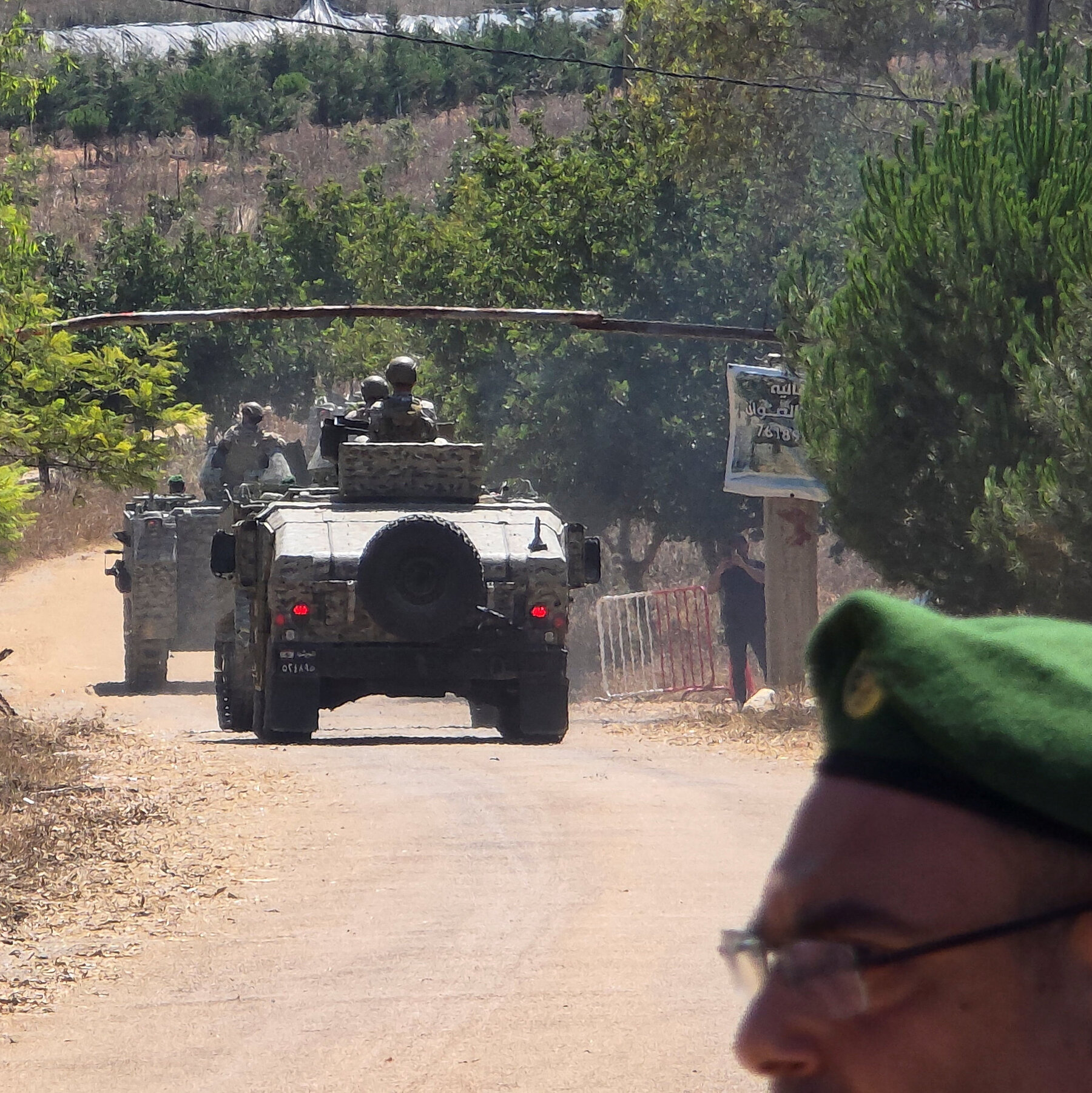
Twenty minutes and thirty kilometres separate the two southern Lebanese incidents that defined the wire at 12:13 and 12:33 UTC on 17 July 2026. The first was a slow-moving one: an Israeli military vehicle crossed toward a Lebanese Army checkpoint in the border town of Mansouri. The second was loud and contained: three controlled detonations carried out by Israeli forces inside Bint Jbeil, a city long associated with the war of 2006 and, more recently, with the post-ceasefire friction that has defined the line between the Litani and the Blue Line since late 2024. By 12:40 UTC, video of the Bint Jbeil aftermath was circulating on Lebanese, Iranian-aligned, and pan-Arab channels. The reporting converged on the facts. The strategic meaning of those facts has not yet resolved, and any reading of where the escalation meter sits has to be hedged accordingly.
The sequence is short, surgical, and consistent across regional outlets that do not usually agree on much. The Cradle's English channel flagged the Mansouri vehicle at 12:13 UTC; the same item was repeated on the Arabic-language handle two minutes later. Field correspondent channel @wfwitness carried it at 12:17, then again at 12:37 with an updated line that added a fresh reference to Israeli detonations in Bint Jbeil and the adjacent town of Al-Tiri. By 12:33 UTC, The Cradle had pushed the BREAKING line: "Israeli occupation forces carry out 3 explosions in the southern Lebanese city of Bint Jbeil." Al Alam's Arabic feed carried an "urgent" line at 12:38, describing "several bombings." The footage of struck buildings and dust-filled streets, the kind of cellphone clips that travel fastest in the first hour, followed the same path. What is unusual is the sequence, not the substance: a checkpoint approach north of the border villages, then an engineering operation inside a major southern hub, in the same twenty-minute window.
What is actually known
The earliest sourcing on Mansouri is straightforward. A single Israeli military vehicle, not a convoy, is shown approaching the position manned by the Lebanese Army. The clip is short; the Lebanese Army checkpoint is identifiable by its sandbagged sangar and the characteristic LAF lighting rig; the Israeli vehicle is identifiable by its markings. There is no footage in the public reporting of a standoff, of shots fired, or of a forced entry. The item reads, on its face, as an approach that did not resolve into contact. Whether that means a deliberate test of Lebanese posture, a navigational error on a familiar route, or a probe timed to coincide with a separate engineering task further south is impossible to determine from the open-source footage alone.
The Bint Jbeil item is materially different. "Controlled demolition" is the term used by military engineers when structures along a contested line are brought down to deny their use as observation posts, firing positions, or covered infiltration routes. Three detonations in a single urban block, as the Cradle's BREAKING line states, is consistent with an operation that targeted infrastructure rather than personnel, but the open-source footage does not specify which buildings were brought down, whether civilians had been ordered to evacuate before the charges were set, or what the IDF's operational rationale was. The IDF spokesperson's office had not, as of the wire freeze, issued a Hebrew- or English-language statement placing the detonations inside any declared operational framework.
The Bint Jbeil template
Bint Jbeil is not an arbitrary target. Through 2006 and in the period since, the city has functioned as the symbolic centre of the south, the place where communiqués from Shia political and paramilitary organisations are addressed first and where international press corps converge when they want to demonstrate that a strike has landed on something other than an open field. The southern suburbs that ring it, Aita al-Shaab, Maroun al-Ras, Yaroun, the cluster of villages east of the Bint Jbeil ridge, were, during the war of 2006, the heartland of the paramilitary force whose presence drew Israeli ground forces into the kind of house-to-house fighting that political planners in Tel Aviv had hoped to avoid. A detonation sequence inside the city, even a limited one framed as engineering rather than bombardment, has a signalling weight disproportionate to its tonnage.
That signalling, in turn, depends on who the audience is supposed to be. The Lebanese state, sovereign, cash-poor, and trying to enforce a fragile ceasefire along the line, is one plausible audience. A southern Lebanese public being asked to weigh the costs of paramilitary presence in their midst is another. The Israeli domestic audience, which has spent much of the past eighteen months cycling through warnings, alerts, and a slow grinding attrition, is a third. None of these readings is supported by the open-source footage; all of them are consistent with what the footage shows. Monexus does not have access, in this reporting cycle, to the closed briefing material that would narrow the field.
Two reads of the same hour
The optimistic reading is a contained one. A single vehicle approaches a Lebanese Army checkpoint, does not push through, and the encounter ends without exchange of fire. Three controlled detonations inside a single Bint Jbeil block displace infrastructure, not people, and are followed by no follow-on activity reported in the next hour. The video that emerges is dramatic, but it is the video of a demolition, not of a strike. Read this way, the events of 17 July are the kind of friction that gets folded, with some difficulty, into the diplomatic channel that has been running since the November 2024 framework.
The pessimistic reading takes the same footage and the same wire, and reads them as sequencing. A probe further north, at Mansouri, against an LAF position rather than against a paramilitary emplacement, establishes whether the Lebanese state is willing to physically resist an Israeli incursion on this specific afternoon. Three detonations in Bint Jbeil, with footage circulating rapidly, impose a psychological cost on the southern Lebanese public that an air raid would impose at three times the financial cost and twice the diplomatic exposure. Read this way, the morning's incidents fit a pattern of calibrated pressure: probing the state line, signalling to the population, leaving the paramilitary layer to respond or absorb.
The wire does not pick a winner. The Cradle's English framing, "Israeli occupation forces carry out 3 explosions", adopts the establishment-Arab terminology that treats the territorial frame as occupied; this is consistent with how Al Alam Arabic phrases the same events. Western wire services had not, at the time of writing, put a corroborated line through the channel. Israeli Hebrew-language coverage was not in the open-source feed reviewed for this piece. The asymmetry of the naming, "Israeli occupation forces" rather than "Israeli troops", is itself a record of where the dominant framing in Arabic-language regional press currently sits.
What doesn't yet resolve
Three items remain genuinely unresolved. First, the operational link between the Mansouri approach and the Bint Jbeil detonations. The two occurred in the same hour and in the same general area, but the open-source reporting describes them as separate events, and there is no public sourcing connecting them as a single operation. Second, the targeting logic inside Bint Jbeil. Controlled demolitions in this region are usually associated with infrastructure tied to paramilitary observation or weapons storage; the reporting reviewed here does not state what infrastructure was detonated, only that three explosions occurred. Third, the Lebanese state's posture going into the next 48 hours. The LAF checkpoint at Mansouri was approached, not breached; the encounter ended without an exchange. Whether that non-event is read in Beirut as the checkpoint having done its job or as the checkpoint having been bypassed without consequence depends on where you sit on the spectrum of southern Lebanese confidence in Beirut.
Monexus will watch for three things over the next 24 hours: an IDF statement that places the Bint Jbeil detonations inside an operational framework; a Lebanese Army statement on the Mansouri approach that names what happened at the checkpoint in the minutes after the clip ends; and any second-order activity, particularly around the LAF coordination mechanism that has been the single most consequential piece of the post-2024 ceasefire architecture. If the next twelve hours pass cleanly, the morning's wire will be properly read as friction. If they do not, the same footage will be read very differently by Friday.
Desk note: Monexus is leading with the Arabic-language and Lebanon-focused regional wires (The Cradle, Al Alam, field correspondent @wfwitness) on this story because the mainstream Western wires had not, at the time of writing, put a confirmed English-language line through the channel. The vocabulary used here, "Israeli occupation forces," "the city of Bint Jbeil" rather than nominalised locations, follows the framing in those regional sources; subsequent updates will reconcile against IDF and Lebanese Army statements as they become available.
Wire provenance
This editorial synthesis draws on the following public wire/social posts:
- https://t.me/TheCradleMedia
- https://t.me/wfwitness
- https://t.me/TheCradleMedia
- https://t.me/wfwitness
- https://t.me/alalamarabic
- https://t.me/thecradlemedia
- https://t.me/TheCradleMedia
- https://t.me/thecradlemedia
- https://t.me/thecradlemedia