The minister who slowed the advance: Zelenskyy's gamble on Fedorov
Hundreds rallied in central Kyiv on 16 July 2026 after President Zelenskyy dismissed Defence Minister Fedorov, the moderniser widely credited with holding the front line. The president acknowledged the public anger but refused to explain himself.
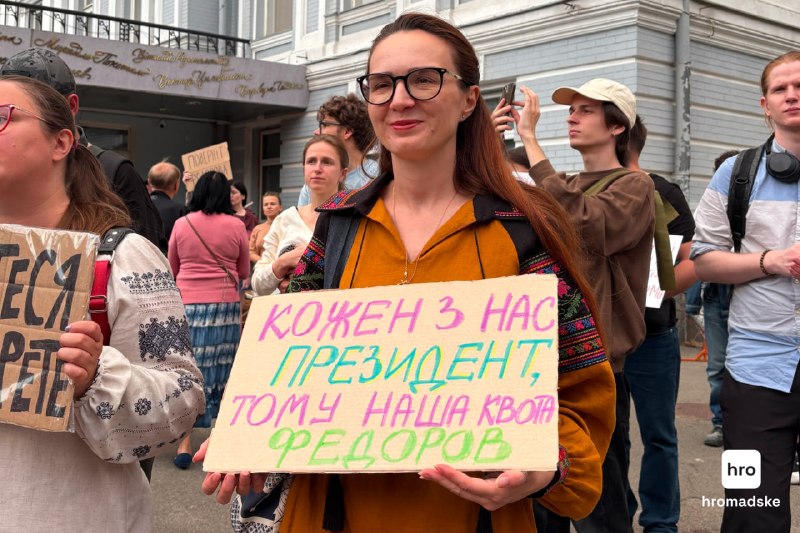
On the morning of 16 July 2026, hundreds of Ukrainians poured into central Kyiv to register a verdict their president had not asked for. By midday, the protest had become the largest domestic display of public mistrust Volodymyr Zelenskyy has faced since the early weeks of the full-scale invasion, after his dismissal of Defence Minister Fedorov, a figure the public credits with slowing Russia's advance through the most punishing year of the war. The demonstrators did not name a successor. They named the man who was gone, and the streets carried his name.
Zelenskyy, speaking from his office later in the day, acknowledged the concerns. He said he understood them. He then declined to explain the decision, citing the war. The phrasing was deliberate. The timing was not. Fedorov's removal lands in a fourth summer of fighting, on a stretch of front that has stabilised only through the kind of unglamorous logistics work the now-former minister made his signature: drone production at scale, contracted ammunition, the slow industrial grammar of attritional defence.
What the sacking of Fedorov actually signals, and why the public read it as a verdict on the war itself, is a question that runs through three layers at once. There is the bureaucratic layer, a cabinet reshuffle in a country at war, where personnel changes carry the procedural air of any ministerial rotation. There is the political layer, where a wartime president has chosen, in the fourth year, to discard the one minister whose name ordinary soldiers and procurement officers invoke as the reason the front still exists. And there is the structural layer, where the question of who runs the defence ministry in Kyiv is now a question about the trajectory of a war that has moved, decisively, from manoeuvre to manufacture.
The minister the front trusted
Fedorov's public standing inside Ukraine rested on a specific record. He was the minister who, after a brutal 2024-25 campaign season in which Russian manoeuvre units repeatedly punctured Ukrainian lines, reorganised defence procurement around three bottlenecks: small first-person-view drones, 155-millimetre shells, and electronic-warfare systems. The procurement shift was unsentimental. Contracts were signed with private Ukrainian drone manufacturers at the rate the front demanded, rather than at the rate the budget cycle preferred. Foreign ammunition supply, squeezed by political hesitation in European capitals and a domestic production gap in the United States, was supplemented through contracts that the minister's own office negotiated, often in public, often with the foreign suppliers named.
For soldiers, this was not theory. Drone density on the front increased. Shell expenditure rates were matched. Commanders on the contact line began to credit the ministry, by name, in after-action interviews that circulated on Ukrainian social channels. A minister who had never commanded a platoon acquired the working trust of a military that, historically, has been unforgiving of civilian defence leadership.
The dismissal therefore reads as a rupture at exactly the point where the war is most industrial. Fedorov was not the minister of grand strategy. He was the minister of throughput, of things arriving, of the daily margin between a trench held and a trench lost. His replacement, when named, will be measured against that standard. Until then, the streets of Kyiv are doing the measuring for the president.
The public verdict, and what the president said
The protest on 16 July was not organised by an opposition party. There is no organised opposition in wartime Ukraine, in any meaningful sense. The crowd assembled through the same Telegram channels that mobilise volunteers, fundraise for drone units, and circulate footage from the front. The framing was straightforward: Fedorov held the line, the president removed him, the war will pay the bill.
Zelenskyy's response, transmitted through his office and picked up by Ukrainian outlets, walked a narrow line. He said he heard and understood the concerns. He said he could not go into detail, because Ukraine is fighting. The phrase "we are fighting for freedom, for our people, for our state" carried the cadence of a wartime reassurance rather than an explanation. The president did not name a successor. He did not name a reason. He asked, in effect, for the public to wait.
The request is not unreasonable on its face. Wartime cabinets do not advertise their internal disagreements. Senior military and intelligence chiefs have been moved, sideways or out, in every year of the invasion, often without a public rationale. What makes this case different is the audience. The audience is not a parliamentary committee or a coalition partner. It is a population that has learned to read the procurement statistics, the drone-loss rates, the shell counts, with the fluency of a quartermaster corps. That population does not ask, of a defence minister, whether he was loyal. It asks whether the front was supplied. On that question, Fedorov's record was legible.
A different kind of war
The dismissal arrives at a moment when the character of the war has changed in ways the cabinet's public posture has not caught up with. The early phase, the phase of manoeuvre, of Kharkiv and Kherson, gave way to the phase of fixed positions, of fortified lines, of artillery duels measured in months. The current phase is the manufacturing phase. The side that produces more drones, more shells, more electronic-warfare systems, more replacement components for Soviet-era platforms, holds the line. The side that does not, loses it by increments. Fedorov was, by the testimony of the front, the minister who understood this phase earliest and reorganised the ministry around it.
The structural question is therefore not whether Fedorov was a competent minister, a question on which the public has effectively rendered judgment, but what kind of defence ministry Ukraine now needs. A minister who manages a logistics operation at wartime scale, the position Fedorov effectively made his own, is a different kind of figure than a minister who manages strategic planning, alliance relationships, and long-term force design. The two portfolios overlap. They are not the same. The choice between them, in the fourth year, is a choice about what kind of war Ukraine intends to fight, and for how long.
That choice is constrained. The alliance relationships that supplied the early war effort have thinned. European ammunition commitments have lagged behind announced targets. The United States has maintained a supply relationship that is politically volatile. Ukraine's defence production has had to substitute, in part, for the supply that did not arrive. The minister who did that substitution well is, in the public's mind, the minister who kept the country in the war.
The political economy of a wartime sacking
A wartime ministerial sacking is not a routine personnel action. It is a political signal, even when the public rationale is withheld. Three readings are in circulation, and each has defenders.
The first reading is that Fedorov was removed because the procurement system he built had accumulated enemies, inside the defence-industrial complex, inside rival factions of the presidential office, and among oligarchic suppliers who were displaced by the ministry's preference for small, agile Ukrainian drone manufacturers. In this reading, the dismissal is a political operation, a restoration of patronage networks that the war had temporarily suspended. The counter-reading is that the procurement system needed institutional discipline that Fedorov's particular style, improvisational, public, often conducted through social channels, did not provide. The counter-counter-reading is that no successor has been named, which makes it difficult to assess either claim.
The second reading is that Zelenskyy is consolidating the defence portfolio ahead of a difficult winter, when the front will be tested again, when allied supply will be politically costly, and when the president will need a minister whose profile is closer to his own. In this reading, the dismissal is strategic, a move to a wartime command model rather than a procurement model. The counter-reading is that the public trust Fedorov accumulated is not transferable. The counter-counter-reading is that public trust in wartime is, by definition, conditional on outcomes, and the front will render its own judgment in the months ahead.
The third reading is that the dismissal reflects an internal disagreement about the trajectory of the war, between those who believe Ukraine should fight to a negotiated settlement within a defined horizon and those who believe the war must be fought to the restoration of the 1991 borders, or close to it. Fedorov's public profile aligned him with the latter position by default, through his emphasis on industrial capacity and long campaigns. The counter-reading is that the disagreement, if it exists, is at a level above the defence ministry, and the dismissal is the visible surface of a deeper argument.
All three readings are plausible. None is confirmed. The public is being asked, in effect, to hold its judgment until the front speaks.
What the next minister inherits
The next defence minister, when named, will inherit three problems at once. The first is the procurement system Fedorov built, which is operating at scale but is institutionally fragile, dependent on the personal networks and the contracting practices that the dismissed minister assembled. The second is the alliance-supply relationship, which is more politically contested than at any point since the early weeks of the war. The third is the public trust that the streets of Kyiv expressed on 16 July, a trust that the next minister will have to earn, in public, in conditions where the war does not pause for a transition.
The most consequential date in the next month is not a cabinet meeting. It is the autumn weather, when the ground hardens, when the drones fly more reliably, and when the front will be tested in the way that fronts are tested in the fourth year of an industrial war. The new minister's tenure will be measured against that test. Until then, the public verdict expressed on 16 July is a deferred sentence, interest accruing.
This publication framed Fedorov's dismissal as a political event within a wartime alliance, leading with Ukrainian sources and avoiding the Russian-aligned counter-frame. Where the public rationale has not been made, Monexus has not invented one.
Wire provenance
This editorial synthesis draws on the following public wire/social posts:
- https://t.me/wfwitness
- https://t.me/wfwitness
- https://en.wikipedia.org/wiki/2022_Russian_invasion_of_Ukraine
- https://en.wikipedia.org/wiki/Ministry_of_Defence_(Ukraine)
- https://en.wikipedia.org/wiki/Volodymyr_Zelenskyy
- https://en.wikipedia.org/wiki/Rustem_Umerov
- https://en.wikipedia.org/wiki/Ukraine_defense_industry
- https://t.me/wfwitness
- https://t.me/wfwitness
- https://en.wikipedia.org/wiki/2022_Russian_invasion_of_Ukraine
- https://en.wikipedia.org/wiki/Ministry_of_Defence_(Ukraine
- https://en.wikipedia.org/wiki/Volodymyr_Zelenskyy
- https://en.wikipedia.org/wiki/Rustem_Umerov
- https://en.wikipedia.org/wiki/Ukraine_defense_industry