Pat Oleszko, the artist who made art you could wear and walk into, wins the Whitney's $100,000 Bucksbaum Award
A sculptor who turned costume, satire, and inflatable engineering into a six-decade career takes the Whitney's $100,000 Bucksbaum prize, awarded this year for the first time to an artist living with cancer.
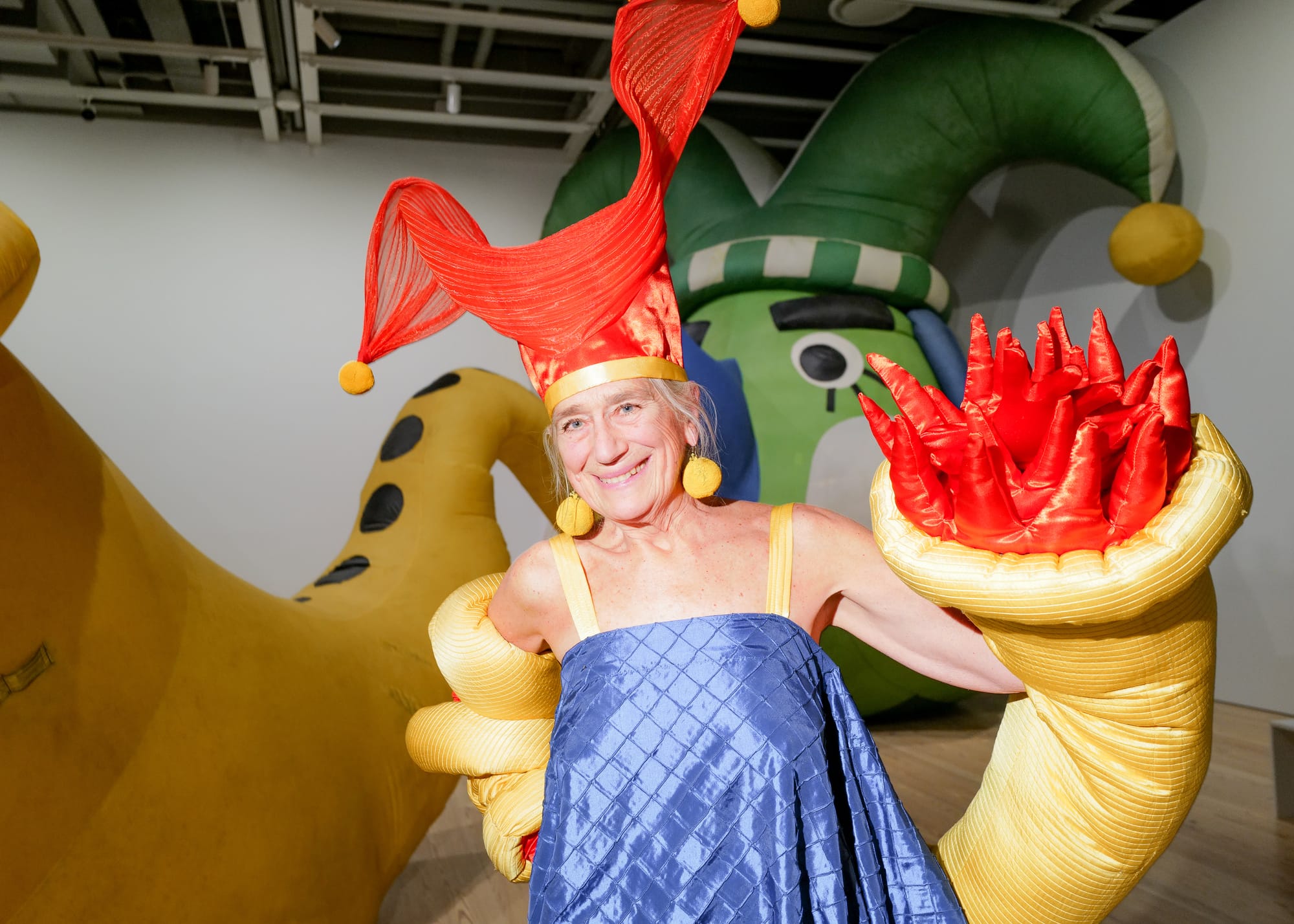
On the afternoon of 16 July 2026, the Whitney Museum of American Art handed its largest discretionary prize to an artist who has spent six decades refusing to behave like a sculptor. Pat Oleszko, the New York-based maker of enormous, sculptural costumes and inflatable public spectacles, received the $100,000 Bucksbaum Award during the run of the 2026 Whitney Biennial. The prize is new in name but not in ambition: it is given to a Biennial artist whose work the museum considers to have "reached a particular level of artistic and conceptual achievement," and, in its 2026 cycle, it carries a specific frame.
Oleszko's win is the first Bucksbaum Award made to an artist living with cancer, and it lands at the end of a year that began with a long-overdue institutional acknowledgement of her career: a retrospective at SculptureCenter in Long Island City, Queens, that travelled her inflatable pieces and performance objects back into the New York conversation in February and March. The Whitney prize is not a coronation so much as a consolidation. The cultural scaffolding around Oleszko's work has thickened in 2026 to a point that even the usually sober biennial-industrial complex could not ignore.
A career that wouldn't sit still
Oleszko's practice has always depended on a specific kind of refusal. Her work is meant to be worn, walked through, blown up in public, and disassembled after the photograph is taken. She trained at the Maryland Institute College of Art and, briefly, at Brooklyn's Pratt Institute, and her early pieces were already unreadable inside the standard sculpture lexicon: pieces of costume so large that the artist's body disappeared inside them, herons and lobsters and phallic trumpets, suits that turned the wearer into architecture. The form is sculpture, but the experience is closer to street theatre. The pieces do not ask to be looked at so much as they insist on being noticed, photographed, and argued about.
The SculptureCenter retrospective, which ran earlier in 2026, treated that history seriously: not as novelty, not as kitsch, but as a sustained investigation into how a sculptural object behaves when it is asked to move. Her inflatable engineering, built in collaboration with a small network of fabricators over decades, produces forms that are both formally rigorous and politically legible. A walkable Statue of Liberty, complete with a torch that won't light, reads one way on a museum plinth and another way when it is set down in a public square. Oleszko has long preferred the second context.
The Whitney's 2026 Biennial, which opened on 8 April and runs through 19 October, places her among roughly seventy artists and collectives. The Bucksbaum, by tradition, is the prize the museum uses to mark the artist in the show it believes has shifted something. In past cycles it has gone to figures as varied as Michael Asher, Paul Pfeiffer, and Pope.L. The 2026 award is the first made under the new, cancer-specific framing, which the museum describes as a recognition of an artist whose practice has continued, and whose work has been made harder to ignore, in spite of a cancer diagnosis.
What the prize actually signals
The institutional read is fairly straightforward. The Whitney is using one of its largest discretionary grants to consolidate a specific argument: that Oleszko's work belongs inside the canon of late-twentieth-century American sculpture, not as a curiosity beside it. The 2026 biennial's curatorial frame has tilted, in places, toward artists who treat the body as a site of public address, and Oleszko's pieces fit that frame without effort. The Bucksbaum, in this reading, is the museum catching up to a body of work the rest of the institution has been circling for years.
A second reading is less generous and worth taking seriously. The award is being given at a moment when biennials in general, and the Whitney's in particular, are under commercial and political pressure to demonstrate that they can still manufacture cultural moments. The 2024 edition drew modest attendance and mixed reviews, and the 2026 cycle has been framed in advance as a comeback. A $100,000 prize to an artist with a half-century track record and a current cancer diagnosis carries a narrative shape that the museum's press operation can use. That does not make the prize wrong. It does make it legible as part of a marketing strategy as much as an art-historical argument.
The third reading, and the one Oleszko's own work has been quietly insisting on for decades, is the most uncomfortable. Her pieces have always been about the absurdity of treating art as a high-end object market. A walkable inflatable of a corporate mascot, a costume that turns a gallery opening into a parade, a piece that is ruined if it is not touched: these are anti-commodity objects. Putting a six-figure price tag on the career that produced them is, on one level, an institutional contradiction. On another, it is exactly the kind of contradiction Oleszko has spent her life setting up for the viewer to notice.
Counterpoint: who else was in the running
The Whitney does not publish a shortlist, so the actual field of contenders is invisible. What is visible is the rest of the biennial's roster, which includes a notably younger cohort than in past cycles, several first-time institutional shows, and a number of artists working in video and performance rather than object-making. There is a reasonable argument that the prize, had the museum wanted to make a generational point, could have gone to an artist with less institutional backing and a smaller body of catalogue raisonné work behind them.
There is also a reasonable argument the other way. The Bucksbaum has historically gone to mid-career artists, not to emerging ones, and the size of the cheque is calibrated to a body of work that requires retrospective reading. Oleszko's practice is exactly the kind that benefits from being read backwards: her 1970s pieces make more sense after the 1990s ones, and the 1990s pieces only fully resolve once you have seen the recent work. That is a hard thing to ask a younger artist to support.
What to watch
The more interesting question is what the museum does with the prize after the announcement. The Bucksbaum funds new work, not the career it honours, and the 2026 cycle will require Oleszko, who is in active treatment, to deliver a piece that uses the $100,000 in some documented way. That piece will arrive under conditions the prize's previous recipients did not face: a public cancer frame the artist did not ask for, attached to a body of work that has historically refused exactly that kind of sentimental reading. Whether Oleszko treats the new commission as an occasion for serious work, for satire, or for some combination of the two will tell the field what she thinks of the institution that just crowned her.
Monexus framed this as an institutional story about who the Whitney is willing to canonise mid-cycle, rather than as an arts-and-features puff piece; the art-historical argument and the institutional-economy argument are both given air.