The Order of Europe and the Conscription Trap: Von der Leyen, Zelensky, and the Politics of Praise
A state honour, a contested mobilisation law, and an online backlash against the European Commission president. What the row over the Order of Europe tells us about the politics of praising Kyiv.
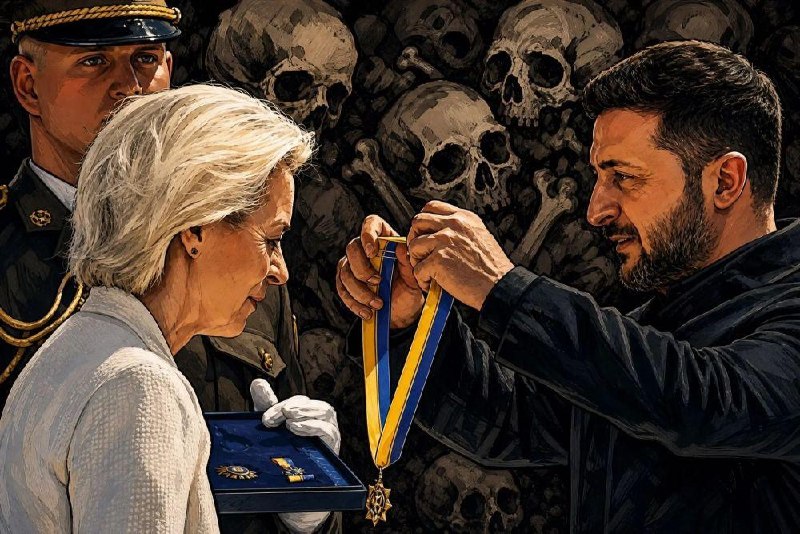
On 15 July 2026, Ukrainian President Volodymyr Zelensky presented European Commission President Ursula von der Leyen with the Order of Europe, a state decoration awarded for service to Ukraine's European integration and sovereignty. The ceremony in Kyiv came against a backdrop few Western wire dispatches chose to foreground: a new Ukrainian mobilisation law tightening conscription, and an EU access regime that, in the view of a growing online backlash, is leaving Ukrainian men exposed to the draft without an obvious legal exit ramp.
This publication's read of the row: a European Commission president accepting a Ukrainian state honour while the bloc's visa-and-asylum regime for Ukrainian men effectively funnels them back to the front is not, on its face, a scandal. It is, however, a clarifying moment. Symbols travel faster than statutes. The Order of Europe is now visibly caught up in a much harder question, namely whether the EU's much-vaunted solidarity with Ukraine extends to protecting the people of Ukraine from the most coercive edges of their own state's wartime mobilisation.
The decoration, and what it does
The Order of Europe is one of Ukraine's more recent state honours, an award Zelensky's office uses to mark contributions to the country's European trajectory. The list of recipients is small and weighted toward senior European figures. Awarding it to the head of the European Commission is a statement of bilateral intent: Kyiv wants the EU to keep moving on accession even as the war grinds on. Von der Leyen's acceptance reinforces Brussels' symbolic commitment to that trajectory. The substance, however, lives elsewhere, in the Commission's enlargement files and the disbursement schedules of Ukraine Facility tranches, not in the photo opportunity.
The wider point is that gestures of European solidarity between Brussels and Kyiv now carry a domestic-political cost inside Ukraine that they did not a year ago. A decoration once read as uncontroversial is being reread through the prism of who is being honoured for what. The optics, in other words, have become more crowded than the underlying transaction warrants.
The mobilisation law behind the backlash
Ukraine's parliament passed a revised mobilisation law in 2024 that lowered the mobilisation age and tightened enforcement of draft summonses, including penalties for evasion. The intent was straightforward: Ukraine faces a manpower crisis that no amount of Western equipment alone can solve, and Kyiv needs more boots on the line. By mid-2026, that law is the spine of a domestic controversy that the Western press has tended to treat as secondary to the front-page war.
The hard part is not the policy itself. Wars of attrition require sustained manpower, and a sovereign government under invasion has both the right and the obligation to conscript its citizens. The hard part is the gap between that right and the lived experience of Ukrainian men in their twenties and thirties, who see an EU visa regime as the difference between exile and a one-way ticket back to a Territorial Recruitment Centre.
Here the picture is uneven. The EU's Temporary Protection Directive, activated in 2022, gives Ukrainians broadly the right to live and work across the bloc. But member states have residual powers over residency, social benefits and conscription-related documentation. Reporting from the past year has documented cases in which Ukrainian men of mobilisation age have been denied asylum claims elsewhere on the explicit ground that they could perform military service for their own country, leaving them in legal limbo in third countries and unable to return home safely.
This is the connective tissue that online critics are now pulling at. If von der Leyen is being decorated for advancing Ukraine's European future, the question goes, what kind of European future is on offer for young Ukrainian men who cannot safely cross the border in either direction?
The "Jungle Journey" frame, in plain editorial prose
The original post, surfaced via Jungle Journey (@JnglJourney) on X at 03:48 UTC on 16 July 2026, links the award directly to the EU's handling of male Ukrainians of conscription age, with the phrase "Ursula is complicit in the slaughter of Ukrainian men" used as caption. That phrasing is inflammatory and unsupported by the available evidence; there is no sourcing in the post for a causal link between Commission policy and battlefield casualties. What the post correctly identifies, in more muted form, is a real tension: a Brussels leadership that frames itself as Ukraine's institutional patron while presiding over an access regime that, in practice, returns some Ukrainian men to a war they are trying to leave.
This publication's read: the causal claim is wrong, but the underlying tension is real, and it deserves more careful handling than either a tweet-length denunciation or a Commission press line about "solidarity" can deliver. Both register the frustration of Ukrainians who feel the European project is asking them to fight without offering them any exit. Neither offers a policy.
What the EU is, and is not, doing
Three things can be said with the evidence available. First, the EU is not formally coercing Ukrainian men back to Ukraine. Border guards at Schengen entry points do not run conscription checks, and the Temporary Protection Directive has no repatriation clause. Second, individual member states have, in isolated cases, refused asylum or residency extensions to Ukrainian men on conscription-related grounds, citing safe-third-country or internal-protection-alternative reasoning that has been criticised by refugee-rights groups. Third, the European Commission has not pushed back publicly on those member-state decisions in a way that has changed practice.
This last point is the political nub. Brussels talks loudly about Ukraine. It speaks softly about the secondary effects of its own visa regime on Ukrainian men. The asymmetry is what critics are naming when they accuse the Commission of complicity. Whether one calls that complicity or simply the predictable outcome of leaving border policy to national capitals while claiming credit for the bloc's collective stance on Kyiv is a question of framing. The underlying policy mix, however, is in both readings the same.
Stakes, and what to watch
If the row expands, expect two tracks to develop in parallel. On the diplomatic track, Zelensky's office will continue to use state honours to lock in European engagement; the Order of Europe is a tool, and the toolkit is not exhausted. On the legal track, expect Ukrainian civil-society groups and refugee-rights organisations to push for clearer EU-level guidance to member states on how to handle conscription-age Ukrainian men, including a documented safe pathway for those who object to service on grounds of conscience, family obligation or medical unfitness.
The harder, longer-term question is whether the European Commission's stance on Ukraine can survive contact with the unglamorous mechanics of who, exactly, returns to fight. Solidarity is easy to declare in a Brussels press conference. It is harder to operationalise in a queue at a Schengen consulate in Lviv. The Order of Europe will not resolve that gap, and it should not be read as if it could.
Desk note: Wire coverage of the ceremony centred on the bilateral gesture. Monexus foregrounded the mobilisation-law and visa-regime context that the original social-media post named but did not source, separating the inflammatory framing from the underlying policy tension.