Macron's replanting vow puts a 20,000-hectare test on French climate policy
A pledge to replant a forest scorched this week will test whether the Elysée can translate presidential theatre into the unglamorous work of soil, seed and zoning reform.
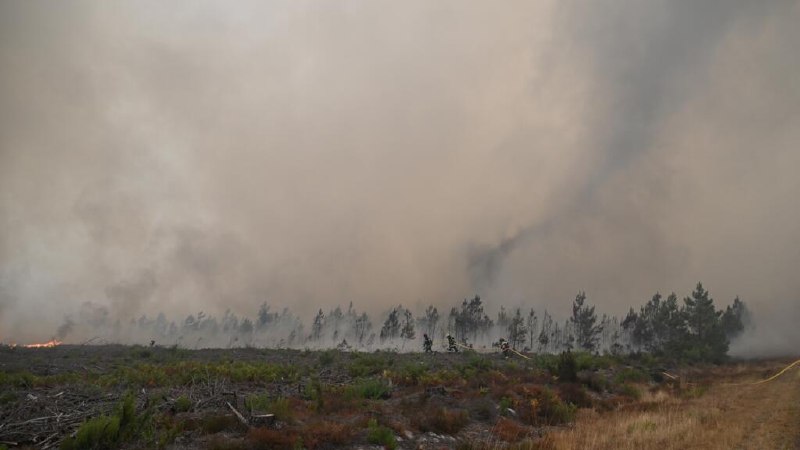
The figures Emmanuel Macron read out on Thursday were stark enough to print on a placard: wildfires have burned through at least ten percent of the 20,000-hectare Fontainebleau forest, France 24 reported on 16 July 2026 at 12:05 UTC, displacing hundreds of residents and pushing the Elysée into the kind of crisis-communication posture that has come to define French summers. The promise that followed, to replant what the flames consumed, was delivered with the choreography of a presidency that has learned to convert disaster into mandate.
The pledge is the easy part. The hard part begins in nurseries the French state does not yet own, on land it has not yet rezoned, under a climate regime that has not yet been re-priced. Macron's vow is best read less as a forestry programme than as a stress test of whether France can rehearse the response to a chronic climate emergency with the same seriousness it once reserved for acute security shocks.
What burned, and what was already brittle
Fontainebleau is not a wilderness. It is a working forest south of Paris, threaded with sandstone trails, dotted with training grounds for the French Foreign Legion, and pressed against commuter towns in Seine-et-Marne. Its soils are sandy, its undergrowth has been managed for centuries, and its pine stands, planted in earlier waves of afforestation, are the very thing that burns fastest in a dry July. The blaze described by France 24 tore through roughly 2,000 hectares in conditions the meteorological office had flagged weeks in advance: a sustained heat dome over the Île-de-France, with little overnight cooling and no rain in the forecast.
The displacement figure, "hundreds of residents," sits in the same paragraph as the 10 percent figure and matters for the same reason. Wildfire risk in temperate Europe is no longer a Mediterranean story. The 2022 Gironde fires, the 2023 blazes that reached within kilometres of Nantes, and a string of record-breaking Canadian seasons have rewritten the operational map. The brigade brigades, the water-bomber contracts, the cross-border mutual-aid protocols with Spain, Italy and Portugal that France has signed and periodically invoked, all of this was built for the south. Fontainebleau is the north.
The politics of the replanting vow
A presidential promise to replant is the safest kind of promise. It binds no budget in the current year, names no agency as lead, and can be measured against a horizon long enough to outlast the news cycle. It also gives the Elysée a stage to perform solidarity with rural France, an audience the presidency has been courting since the 2024 snap-election campaign and the subsequent rupture with the historic centre-right.
The political risk runs the other way. France's forestry office, the Office National des Forêts, has been warning for years that its planting budget has lagged its firefighting budget, and that the post-fire reforestation cycle in Mediterranean forests is stretching from a decade to a generation because seed stock of the right provenance has become harder to source. A 2,000-hectare replanting order, if executed faithfully, will collide with that bottleneck. If it is executed symbolically, with ceremonial saplings planted in front of cameras and the deeper work contracted out to the lowest bidder, the Elysée will own the disappointment when the canopy fails to return.
The structural frame, in plain terms
What the Macron pledge exposes is a recurring gap between climate ambition as announced and climate adaptation as built. The Elysée has been vocal on European emission-reduction targets, on the carbon border adjustment mechanism, on the industrial-policy arguments for French batteries and hydrogen. The domestic side, the unsexy work of land-use planning, building-code reform, civil-protection funding and forest-management contracts, has moved more slowly and with less presidential attention. A 20,000-hectare forest that loses a tenth of its canopy in a single week is, in that sense, less a natural disaster than a delayed receipt for underinvestment.
The same gap appears across the European Union. The bloc's adaptation strategy, the EU Adaptation Strategy, has been on the books since 2013 and was updated in 2021, but member states still report uneven progress on the metrics that matter most: forest fuel-load management, defensible space around the wildland-urban interface, and the integration of civil-protection planning into municipal zoning. France's pledge is worth watching precisely because the same political economy that produced the gap will be the one that decides whether it is closed.
What to watch by autumn
Three indicators will show whether the replanting vow is serious. First, the line item: whether the 2027 budget envelope for the Office National des Forêts moves materially above the trajectory set in the previous Loi de Finances. Second, the procurement language: whether replanting contracts are written for ten-year outcomes with provenance clauses for seed stock, or for one-season deliverables measured in saplings delivered. Third, the land-use fight: whether the Élysée is willing to take on the regional councils and private owners who control the buffer zones between forest and housing, and whose cooperation determines whether a replanted forest survives its first decade.
None of this is settled by a Thursday statement. The next round of useful information arrives when the post-fire damage assessment is published in full and when the first planting contracts go out to tender.
A note on what remains unclear
The France 24 dispatch describes the burned area as at least ten percent of the 20,000 hectares, a figure that implies 2,000 hectares or more, and flags that hundreds of residents were displaced. The reporting does not specify how many hectares are still actively burning, the cause of ignition, or the full extent of damage to built structures inside the forest perimeter. Those numbers, when they arrive, will set the scale of the replanting task in concrete rather than in presidential prose. Until then, the vow is a frame; the forest is the test.
Desk note: this publication treats Macron's statement as the opening move of a longer policy story, not as the story itself. The wire led on the vow; Monexus is reading it for the procurement and budget signals that follow.
Wire provenance
This editorial synthesis draws on the following public wire/social posts:
- https://t.me/france24_en
- https://en.wikipedia.org/wiki/Fontainebleau_forest
- https://en.wikipedia.org/wiki/Office_National_des_For%C3%AAts