Keltie Ferris, Painting as Building Blocks
A studio visit with Keltie Ferris reframes the conversation around process: the artist describes his work as an experiment in the elemental grammar of paint, played out across monumental body prints and gestural canvases.
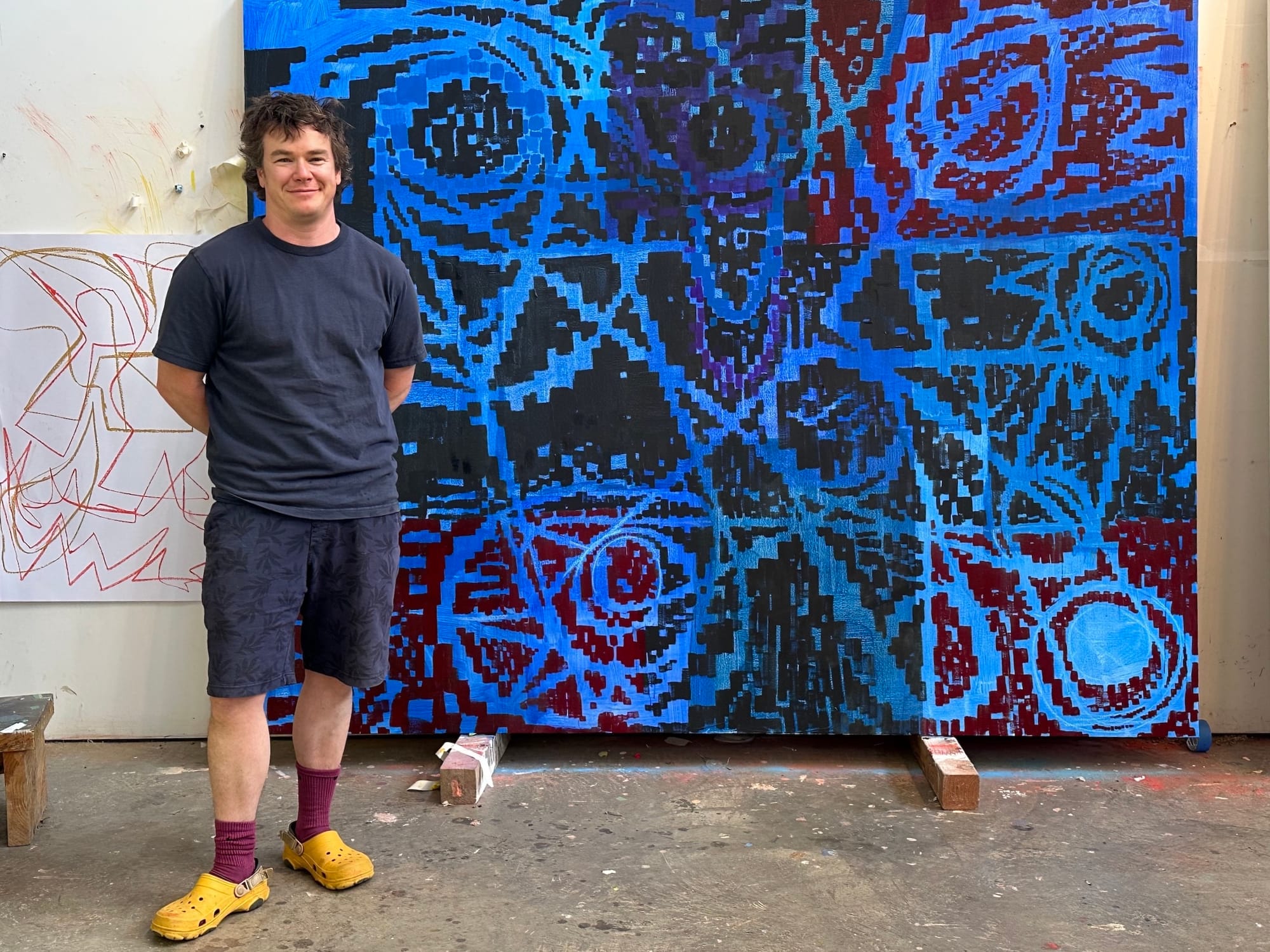
At a studio in Woodstock on 15 July 2026, Keltie Ferris greeted a visitor with the unhurried manner of someone accustomed to letting material do most of the talking. The walls held what the artist himself describes as the building blocks of painting: gestural canvases the size of standing doors, and a series of monumental body prints in which the human figure has been pressed directly into the wet surface. The framing, offered in an interview published by Hyperallergic the same day, treats the studio less as a workspace than as a chemistry set, with paint behaving somewhere between pigment and pet.
Ferris's stated ambition, in his own words, is "playing with the building blocks of painting," and the studio visit makes the phrase concrete. The body prints in particular push past the conventions of the self-portrait: the figure is not composed, it is transferred, and the resulting image carries the residue of pressure and angle rather than the polish of a planned composition. That procedural emphasis is the through-line of the interview and of the work on the walls.
A studio built around contact
Ferris's practice has long treated paint as a substance with its own gravity, and the Woodstock studio reads as an extension of that idea. Canvas leans against canvas in mid-process; surfaces that appear finished from across the room reveal, on closer inspection, the record of a hand, a hip, a forearm pressed against them. The body prints operate as an index rather than an image, marking presence without depicting it.
In the interview, Ferris frames the work as a deliberate return to fundamentals, the kind of reduction that strips a medium back to its first questions. The gestural canvases around the body prints extend the same logic: layering, smearing, reworking until the surface becomes a record of decisions made and unmade in real time.
Process over product
What stands out in the Hyperallergic exchange is the artist's insistence on the studio as a site of experimentation rather than display. There is little of the curatorial staging that often accompanies high-end contemporary painting; the work exists in a state of becoming, and the interview treats that state as the subject. Ferris's description of his method, in plain terms, is closer to a scientist's notebook than to a painter's statement of intent.
This emphasis on method has consequences for how the work is read. A body print is not a representation of a body; it is a trace of one, and the difference matters. The viewer is asked to look at process the way they might look at a geological stratum, reading the history of its making into its final surface.
The Woodstock context
Woodstock, New York, has a long history of attracting painters who want to work at a remove from the gallery districts of Manhattan, and Ferris's operation there fits a familiar pattern: a working studio, periodic exposure in the city, and a practice that benefits from the distance. The Hyperallergic visit captures that arrangement as it actually functions day to day, rather than as a marketing image of the rural artist.
The setting also shapes the scale of the work. Large canvases need room to lie flat, and the body prints in particular require space for the physical mechanics of their making. A studio visit, in that sense, is not a courtesy; it is part of the work's documentation.
What the interview does, and does not, settle
The piece is candid about what remains unfinished in the artist's thinking. Ferris offers a clear philosophy of process, but the interview stops short of any grand claim about the place of the work in the wider history of American painting. That restraint reads as honest rather than evasive; the studio is mid-experiment, and the artist is comfortable saying so.
What the visit does establish is a working vocabulary for the work: building blocks, gestural composition, body print as index. For a reader who has not seen the canvases in person, that vocabulary is the entry point. The rest, as Ferris would presumably argue, is a matter of standing in front of the painting and reading its surface.
This piece treats the studio visit as primary source rather than as promotional copy, letting the artist's stated emphasis on process drive the framing.