Iranian strikes on U.S. positions in Kuwait and Erbil reported as Geneva accord looms
Reports of Iranian drones and missiles hitting U.S. radar and launcher positions in Kuwait and Erbil surfaced on 16 July 2026, hours before Washington and Tehran were due to sign a peace accord in Geneva.
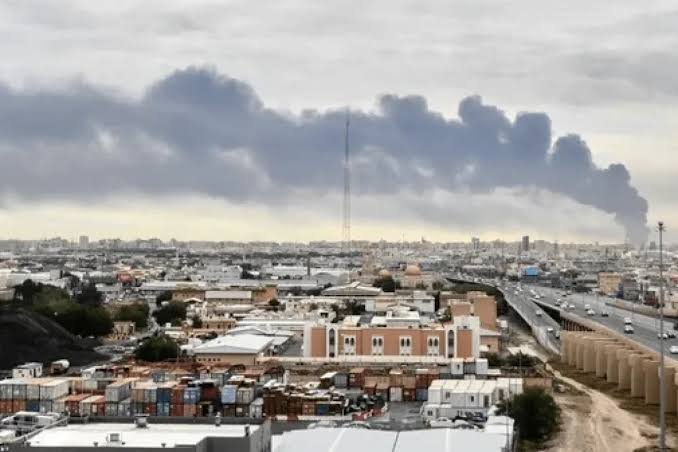
At 21:36 UTC on 16 July 2026, a Telegram channel affiliated with field correspondents in the Gulf published footage of what it said was the moment an Iranian drone struck the Kuwait-Iraq border, targeting a U.S. ground-based missile launcher. Within ninety minutes, at least eight other channels carried versions of the same claim, together with a second report that an Iranian drone had hit the American missile launch pad in Erbil, and a third that an Iranian projectile had struck a U.S. radar installation inside Kuwait. By 21:47 UTC, Iranian state television was reporting that a U.S. base in Kuwait near the Iraqi border was on fire. None of the strikes had been independently verified by Western wire services at the time of publication. All sat, uncomfortably, on the eve of a U.S.–Iran peace accord scheduled for signing in Geneva on Friday.
The reporting is fragmentary and the sourcing is uneven. What can be said with reasonable confidence is that, on the evening of 16 July 2026, multiple Iranian-aligned outlets circulated footage and eyewitness accounts describing direct Iranian action against U.S. military infrastructure in two theatres: the Kuwaiti border with Iraq, and the Kurdistan Region capital of Erbil. What cannot yet be said is how much damage was done, whether U.S. personnel were killed or injured, or whether the strikes represent a deliberate Iranian provocation aimed at collapsing the Geneva process, a calibrated retaliation for the second consecutive night of U.S. ground-based missile strikes on the Iranian city of Ahvaz, or something messier in between.
What the footage claims to show
The most widely circulated clip, posted by the channel @wfwitness at 21:36 UTC and republished by the open-source mapping account @AMK_Mapping three minutes later, purports to show a Shahed-131 or Shahed-135 loitering munition striking near the Kuwait-Iraq border in the vicinity of a U.S. ATACMS or HIMARS launcher. A separate video, attributed by @JahanTasnim and Tasnim News English at 21:29 UTC to "Arab sources," claims to show the moment an Iranian drone hit a U.S. radar system inside Kuwait. None of the videos has been independently geolocated by a Western wire service in the available reporting; all are sourced through Iranian or Iran-adjacent channels. The footage therefore establishes only that a strike was claimed, not that one occurred, and not that it achieved the effect described.
A third line of reporting, carried by Tasnim and Mehr News at roughly 21:21–21:24 UTC, cites "Iraqi sources" saying that an Iranian drone targeted the American missile launch pad in Erbil. Erbil hosts a U.S. military presence inside the Kurdistan Region of Iraq; the launch pad in question is not specified. Iraqi outlets have not, in the thread materials, corroborated the strike.
A counter-narrative: Kuwait and Erbil as the launching point, not the target
The Iranian claims sit on top of a reporting thread that points the other way. At 21:24 UTC, the @rnintel account, citing on-the-ground observers, asserted that for the second consecutive night U.S. ground-based missile systems in Kuwait had been used to strike the Iranian city of Ahvaz, the capital of Khuzestan province and a major Iranian urban and industrial centre. The Iranian strikes on Kuwaiti and Iraqi targets, in this reading, are a retaliation for a U.S. escalation that began before the accord was signed, not a spoiler of the accord itself. The framing matters: the official U.S. position, as of 16 July 2026, is that Washington and Tehran are due to sign a peace agreement in Geneva on Friday, and that the military action of the past 48 hours is a separate, contained track. The Iranian framing is that the military action is the substance, and the Geneva ceremony is the cover.
Middle East Eye reported at 19:43 UTC that "Iranian strikes on Kuwait resulted in material damage," without specifying a source. The headline is the most direct Western-adjacent assertion of impact in the available reporting, and it remains the only such assertion from an outlet on the approved list. The thread materials do not contain an independent confirmation of physical damage, casualty figures, or the specific U.S. assets affected.
The structural frame: a deal signed in the crossfire
What is unfolding is a diplomatic process conducted under live fire, in which both sides have an interest in claiming the strikes but neither, on the evidence so far, has an interest in admitting loss. Iran benefits from demonstrating that it can reach U.S. assets in two countries at once, hours before its negotiators sit down in Geneva. The United States benefits from keeping the Geneva process intact while continuing to degrade Iranian military infrastructure from forward positions in Kuwait. The information environment around the strikes is being shaped, on the Iranian side, by state media (Tasnim, Mehr, PressTV) and by Telegram channels operating in the grey zone between journalism and propaganda; on the U.S. side, by silence. The silence is itself a choice: in a context where the U.S. has not publicly confirmed any of the reported strikes, official denial or confirmation is being held in reserve for the negotiating table.
The pattern is a familiar one in the region: a conflict in which the public facts are filtered through aligned media, the military facts are filtered through operational security, and the political facts are filtered through the requirements of an ongoing negotiation. Readers in the Gulf, in Kurdistan, and in Iran itself are receiving three different versions of the same evening, and the Geneva signing on Friday will take place against that three-channel backdrop.
What remains contested, and what to watch
Three things are not yet established. First, the physical effects of the reported strikes. The footage shows impact, not consequence; a U.S. radar or launcher can be damaged, destroyed, or merely nicked, and the operational impact varies accordingly. Second, the chain of authorisation. Iranian state media attributes the action to the IRGC by implication, but no Iranian official, in the available reporting, has claimed the strikes on the record. Third, the U.S. response. If the Geneva accord is signed on Friday as scheduled, the strikes will be retroactively described as rogue or contained; if it is not, they will be described as a spoiler. The single most informative data point in the next 24 hours will be the language the U.S. side uses, or refuses to use, about 16 July 2026 in Kuwait and Erbil.
This article was written from Telegram-sourced reporting and one Middle East Eye live update. Independent confirmation of the strikes from a Western wire service was not available at the time of publication; the desk has marked unverified claims accordingly and will update as corroboration arrives.
Wire provenance
This editorial synthesis draws on the following public wire/social posts:
- https://t.me/tasnimplus
- https://t.me/rnintel
- https://t.me/mehrnews
- https://t.me/JahanTasnim
- https://t.me/FotrosResistancee
- https://t.me/tasnimnews_en
- https://t.me/wfwitness
- https://t.me/AMK_Mapping
- https://t.me/presstv