Guy Scott, the accidental head of state who never planned to run Zambia, dies at 82
Zambia's former vice president Guy Scott, who briefly became Africa's only white leader after the end of apartheid when his boss died in office, has died at 82. His tenure, and the reaction to it, says more about the country's political inheritance than about him.
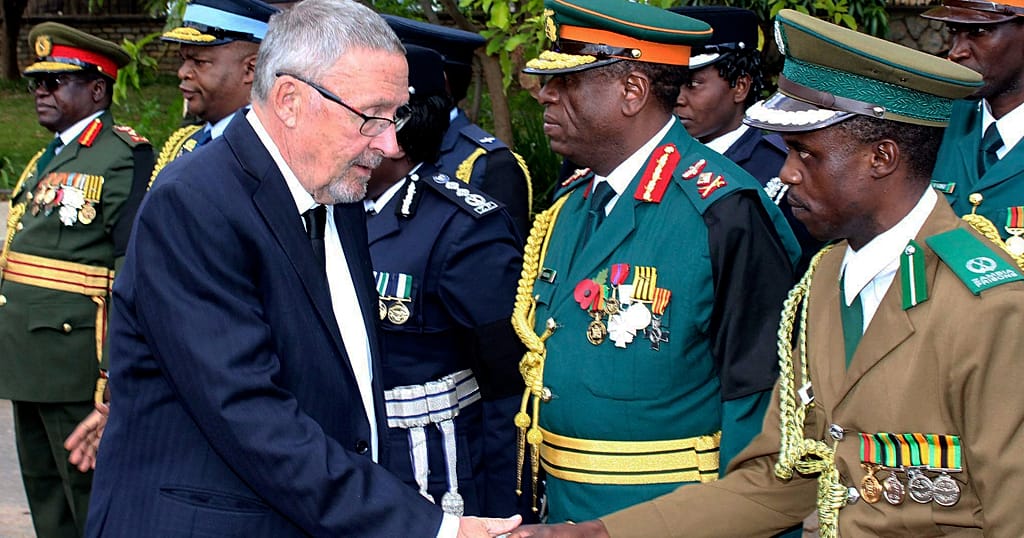
Guy Scott, the Zambian vice president who became Africa's only white head of state since the end of apartheid for a brief stretch in 2014, died on Wednesday 15 July 2026 at the age of 82, the Zambian government confirmed.
Scott's accidental presidency, lasting from October 2014 to January 2015, lasted barely ninety days but cut a path through Zambia's post-colonial politics that the country is still arguing about. He was vice president to Michael Sata, leader of the Patriotic Front, and ascended to the office automatically after Sata died in a London hospital on 28 October 2014, before a by-election could be held to replace him. The constitution at the time barred anyone with two Zambian-born parents from presidential eligibility, but Scott, born in Lusaka in 1944 to a Scottish father and a Zambian mother, met the lower bar in place at the time and was elevated by default.
His tenure matters less for what he did than for what his elevation revealed about the political mechanics of a country that styles itself as the quiet success story of southern Africa.
The accidental succession
Scott was a politically improbable figure. A former governor of the Bank of Zambia, an Oxford-educated agricultural economist and an avowed free-trader, he had returned to Lusaka as a child, been expelled from Zambia in the early 1960s during the Rhodesian Bush War era, and only came back permanently in the 1990s. He joined Michael Sata's opposition Patriotic Front in 2001, was elected to parliament in 2011, and was named Sata's running mate for the 2011 general election.
The reason this matters is that Scott was not supposed to be a face of the country. Sata had won a bruising 2011 election against incumbent Rupiah Banda, riding a populist anti-Chinese-mining platform and a wave of urban anger about inequality. When Sata died abroad three years later, the Patriotic Front's internal succession machinery produced Scott by constitutional default rather than political design.
During the ninety days he acted as president, Scott governed cautiously, leaving most heavy lifting to cabinet and to the party machinery, and declined to run in the by-election that followed. Edgar Lungu, who had briefly served as minister of defence and justice, was eventually selected as the PF's candidate and won the January 2015 presidential poll. Scott then served briefly as minister of agriculture under Lungu before resigning his vice presidency in 2016 citing ill health.
The colour line that wasn't supposed to matter
The domestic and continental reaction to Scott's elevation tells the more uncomfortable story. Zambian opposition figures and some commentators questioned whether a white leader, however technically eligible, was the face the country wanted in the era after Robert Mugabe's Zimbabwe had spent three decades lecturing the region about sovereignty and indigenous ownership of political space. South African and Botswanan opposition voices wondered openly whether Scott's appointment exposed a constitutional gap that needed tightening.
The dominant Zambian framing held that the constitution is the constitution: Scott was eligible, he had served as an elected vice president, and his brief stewardship did not displace the substantive decision-making of the Patriotic Front's wider leadership. That framing carried the day at the time, and Zambia's parliament later amended the constitution to require both parents to be Zambian-born for future presidential eligibility, effectively closing the door Scott had walked through.
The rebalancing reads as a quiet, evidence-led correction rather than a repudiation. Scott had been a PF loyalist for over a decade and was constitutionally eligible. The post-2014 amendment tightened the rule without retroactively invalidating his elevation. That is a meaningful distinction in a region where constitutional changes often get used to settle political scores retroactively.
What his career actually says about Zambian politics
Scott's longer record is more revealing than his ninety days in office. As governor of the Bank of Zambia between 1993 and 1995 he was one of the architects of the country's post-structural-adjustment monetary framework, a period in which the kwacha was floated and the central bank was given operational independence. That institutional inheritance is the spine on which Zambia's relatively disciplined macroeconomic management through the 2000s rested, even as the copper price roller-coaster repeatedly tested it.
His subsequent career as an opposition MP and then vice president was marked by an unfashionable consistency: he was a free-trader in a country that periodically demanded capital controls, a critic of subsidy-driven politics in a region where fuel and maize subsidies have broken budgets from Lusaka to Harare, and an early and unusually public critic of the Chinese mining presence at a time when Sata's base was still loudly anti-Beijing. The contemporary framing of his death as the loss of a figure with an awkward biography tends to obscure that substantive record.
The structural pattern here is a familiar one in southern African politics: technocratic reform coalitions carry the policy load during boom years, and then get pulled apart when commodity prices fall and populist constituencies start asking who actually benefited from the discipline. Zambia experienced that pattern in 2016, again in 2020, and most recently in the 2021 election that brought the United Party for National Development back to power under Hakainde Hichilema.
What Zambia is choosing to remember
The official Zambian response to Scott's death has been measured. The presidency issued a statement acknowledging his service as vice president and his longer record as central bank governor, without overstating the symbolism of his 2014 elevation. Opposition voices have been more pointed: some Patriotic Front figures have framed his legacy as proof that the PF's internal culture could absorb unexpected figures, while some UPND-aligned commentators have used the moment to argue that the post-2014 constitutional amendment was the right call and that Zambia's political class has now normalised a cleaner standard.
What remains uncertain is whether Scott's longer substantive record, particularly his central banking years and his consistent contrarian line on subsidy politics, will survive the news cycle. The colour of his skin, and the constitutional anomaly his brief presidency exposed, are easier stories to tell than the technical work of rebuilding a central bank in the mid-1990s.
Scott himself had been out of active politics for a decade at the time of his death. He spent his final years on a farm outside Lusaka and was a periodic, acerbic commentator on Zambian economic policy. His death closes out one of the more politically improbable careers in modern southern Africa, and leaves Zambia's political class to argue, once again, about which parts of his record actually mattered.
Desk note: Monexus has chosen to lead this obituary on Guy Scott's substantive policy record and the constitutional mechanics of his 2014 elevation, rather than on the colour of his skin. Wire coverage has tended to foreground the "only white leader in Africa" framing; that framing is accurate but does less analytical work than the central banking and constitutional-amendment story that Scott's career actually sits inside.
Wire provenance
This editorial synthesis draws on the following public wire/social posts:
- https://en.wikipedia.org/wiki/Guy_Scott
- https://en.wikipedia.org/wiki/2014_Zambian_presidential_succession
- https://en.wikipedia.org/wiki/2021_Zambian_general_election