A stadium, a banner, and a sovereignty fight the World Cup can't contain
Argentina's players unfurled a 'Malvinas are Argentine' banner after knocking England out of the World Cup. The match result is on the scoresheet; the sovereignty fight is on FIFA's desk.
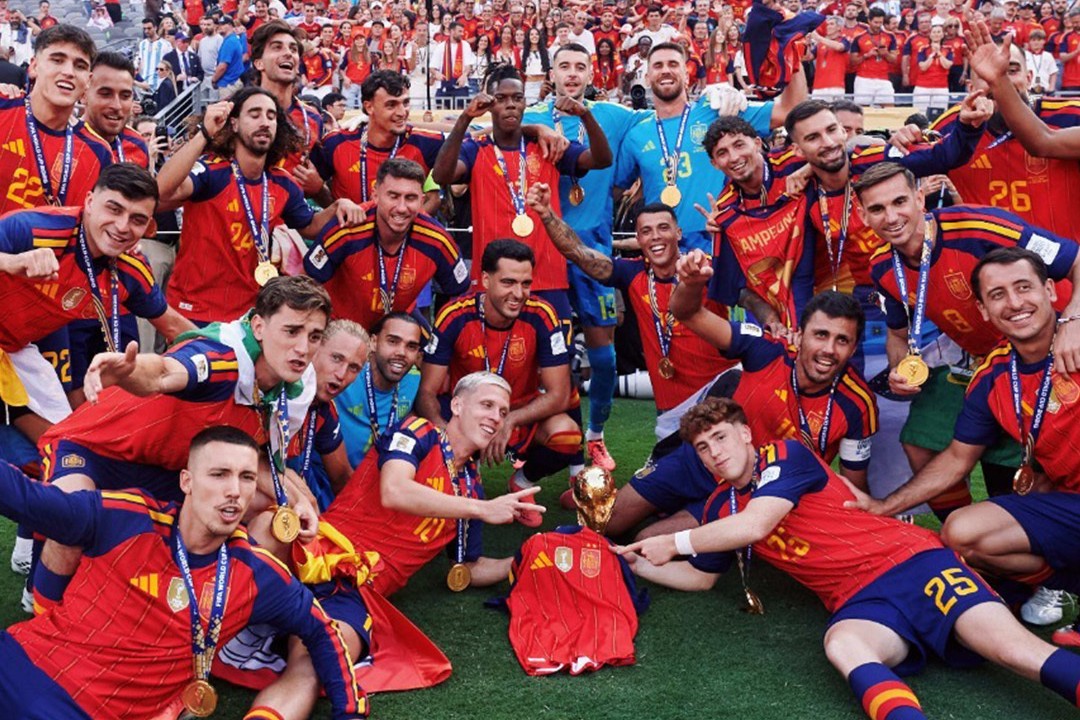
Argentina knocked England out of the 2026 World Cup semi-final on 15 July 2026, and within minutes the scoreline was no longer the lead. On the pitch at full time, Argentine players paraded a banner reading "The Malvinas (Falkland Islands) are Argentine," a 43-year-old sovereignty claim dragged into the centre of the planet's biggest sporting event. The BBC reported on 16 July 2026 that FIFA is weighing disciplinary action over the display. Polymarket, the prediction-market venue that had priced the match as a coin-flip, flagged the banner on the same night.
This was not a stray flag waved by one player. It was a coordinated, bilingual act of foreign policy, staged in the most-watched stadium slot of the year, in front of an English side that Buenos Aires has never stopped calling a colonial occupier. Argentina's footballing class has carried the Malvinas cause since the 1982 war, but the 2026 staging matters: the home crowds are American, the broadcast audience is global, and the room the players chose to make the point in belongs to a federation whose rules on "political" displays are stricter than those of the United Nations General Assembly.
What FIFA actually polices
Fifa's disciplinary regime, written into the Statutes and the Disciplinary Code, treats any "political, religious or personal" message displayed during a match as a potential breach. The bar is a low one: even armbands and on-pitch statements during warm-ups have triggered cases against European federations in recent tournaments. Argentina, should the case proceed, faces a range of sanctions, from a fine and a warning to a touchline ban for staff or, in the most aggressive reading, a match suspension for the team itself. The BBC's reporting on 16 July 2026 stopped short of naming a likely penalty. That is deliberate. FIFA is the global arbiter of football; it is also a body that depends on the political goodwill of its 211 member associations, and a fixture between two G20 economies carrying a sovereignty dispute is not a fine-and-forget file.
The procedural point matters. The banner is a display inside a football stadium. It is also, under Argentine domestic law, an affirmation of a constitutional claim: the country's 1994 constitution, reformed under Carlos Menem, explicitly names the Malvinas, South Georgia and the South Sandwich Islands, and the surrounding maritime space, as "integral parts of the national territory." Argentina's recovery of the islands is the standing position of every democratically elected government since 1983, including those that disagree on almost everything else. The English Football Association and the UK Foreign Office will not be drawn into the merits, but the political backdrop is what the disciplinary file will be litigated inside.
Why the timing is the message
Staging the claim in the semi-final, against England, on 15 July 2026, is the point. The islands have been in continuous British administration since 1833; the 1982 war cost 649 Argentine military dead, 255 British, and three Falkland Islanders; the UN's Decolonisation Committee has listed the territory as one of 17 remaining "Non-Self-Governing Territories" since 1965. Argentina's claim predates the war and outlasts the junta that waged it. Choosing the World Cup semi-final, against the national team of the country it last fought a war with, is a calculation about reach.
Polymarket's order book, which had priced the semi-final as roughly a 50/50 contest through the week, registered the result within minutes. The market's reaction was to the football. The diplomatic reaction, in London and at the UN, is to everything else. A banner that costs a federation a fine can deliver a sovereignty argument to several hundred million viewers without the cost of a state-issued communiqué. For Buenos Aires, that is a bargain.
What the counter-frame looks like
There is a reading under which this is a federation overreach that will end in a wrist-slap. England, whose own players have been disciplined for political messaging in recent tournaments, has a domestic audience reluctant to relitigate the war every four years; the UK government has, in successive Falklands-policy reviews, refused to negotiate sovereignty while the islanders themselves wish to remain British. A FIFA sanctions process that ends in a fine preserves the status quo and lets football return to being about football. That is the path the English-language wire will, by reflex, recommend.
The other reading is the one Argentina is betting on. The display is a reminder that the dispute is unresolved in international forums, that the General Assembly votes annually on a motion calling for bilateral negotiations, and that the world's soft-power venues are also diplomatic venues, whether FIFA likes it or not. A fine is the price of admission. A ban would be the story. And the story is what Buenos Aires wants.
Stakes beyond the pitch
The football answer is a disciplinary file. The political answer is bigger. Argentina hosts the G20 in 2026; the UK is renegotiating its post-Brexit trade architecture with Mercosur; the European Union's own 2025 regional strategy for Latin America made explicit reference to "shared interests in the South Atlantic." Every one of those conversations is more legible now that a banner has been on global television. A World Cup is, among other things, the loudest room in the world for four weeks, and a federation that has spent four decades learning to use it does not waste the chance. The disciplinary process will resolve the question of whether FIFA can keep politics off its lawns. It will not resolve the question of who owns the islands. The next round, as ever, will be in the General Assembly.
Wire provenance
This editorial synthesis draws on the following public wire/social posts:
- https://t.me/wfwitness