Eight minutes, four wires, one F-35: how an unconfirmed emergency over the UAE became a global story
Four Telegram channels carried near-identical reporting on an F-35A emergency over the UAE inside an eight-minute window. The story says less about the jet than about the wire environment that turned an unconfirmed squawk into a headline.
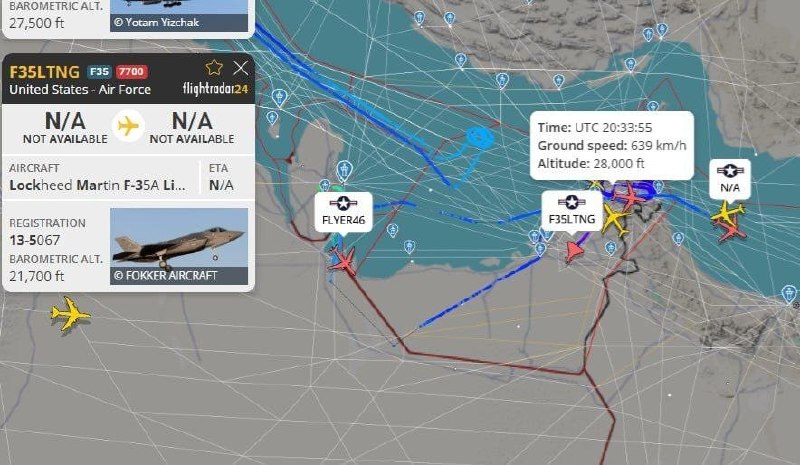
At 20:58 UTC on 16 July 2026, a U.S. Air Force F-35A multirole fighter squawked 7700, the international transponder code reserved for in-flight emergencies, while airborne over the United Arab Emirates. The first item posted on a Telegram channel dedicated to open-source flight tracking said the aircraft had declared an emergency and landed. Eight minutes later, an Iranian state-linked wire had recast the same incident: an "unconfirmed" crash. The four items reviewed here are the entire public record of the event as of publication, and they are nearly indistinguishable from one another in their core wording. That, more than the fate of the airframe, is the story.
The episode is small in evidentiary terms: a single emergency squawk, four near-simultaneous posts, no confirmed Pentagon or USAF read-out in the available material. It is large in structural terms. A story of this size now travels, mutates, and hardens inside a window narrow enough that editors downstream cannot tell the original bulletin from the echo. What looks like a global news cycle is, on inspection, a tightly coupled loop of channels amplifying one another, and the editorial question is no longer "what happened" but "which version of what happened survives the night."
The eight-minute window, in four posts
The first item, timestamped 20:58 UTC, came from a Telegram channel that maps open-source flight-tracking data. It described a U.S. Air Force F-35A declaring an in-flight emergency over the UAE on transponder code 7700, and stated that the aircraft had landed. The text was brief, declarative, and unattributed: no Pentagon spokesperson, no USAF release, no airline-equivalent operator quoted. It was, in effect, a translated reading of a 7700 squawk visible on a public feed, plus the channel's own inference about an outcome.
Three minutes later, at 21:01 UTC, a second channel, one focused on military and intelligence open-source reporting, carried the same item, with the same wording, the same framing, and the same outcome: emergency declared, aircraft landed. By 21:05 UTC, the third item had appeared, this time on a Telegram channel tied to Iranian state media. The framing shifted. The text now opened with "Unconfirmed reports of an F-35 fighter emergency situation over the UAE," and the body of the post stated that an F-35A had "crashed" while flying over the country. The fourth item, one minute later on a parallel Iranian state-linked channel, repeated the unconfirmed-crash framing verbatim.
The timeline is the finding. Inside eight minutes, a single open-source observation about a 7700 squawk had travelled from a flight-tracking channel through a military OSINT feed and into the framing infrastructure of a foreign state media apparatus, and the framing had hardened from "declared an emergency" to "unconfirmed reports of a crash." None of the four items named an on-the-record U.S. military spokesperson. None cited a UAE official. None carried a tail number, a base of origin, a mission identifier, or a recovery location. The story, as the public received it, was a closed circuit.
What a 7700 squawk actually tells you
A transponder code is not a story. When a pilot selects 7700, the aircraft is signalling a generic emergency to air-traffic control and to any receiver within range: a decompression, an engine issue, a hydraulics failure, a fuel problem, a flight-control anomaly, or a pilot incapacitation. It is the aviation equivalent of pulling over with the hazard lights on. The code does not encode the severity of the situation, the type of malfunction, or the eventual outcome. A 7700 can precede a wheels-up landing at a friendly airfield or a controlled crash into empty ground; the transponder does not distinguish.
In the Gulf, where U.S. and coalition aircraft operate at high tempo from a dense constellation of bases, 7700 events are not rare, and they are not, on their own, evidence of combat loss, hostile action, or systemic failure of a platform. The F-35A fleet has logged thousands of sorties from regional bases since the type was first deployed to the U.S. Central Command area of responsibility. A 7700 over the UAE is, in isolation, an operational data point, not a geopolitical one. The interpretive lift in the four reviewed items comes from the framing choices made around that data point, not from the data point itself.
The first two channels read the squawk as a routine emergency that ended in a landing. The second two read it as a crash. Both readings are consistent with a 7700. Neither is, on the available evidence, the only possible reading. The slippage between them is where the editorial work has to be done.
Who is in this conversation, and who is not
The four items reviewed here name no official source. They name no U.S. Air Force spokesperson, no Pentagon press officer, no UAE defence ministry official, no Lockheed Martin representative, no pilot, no eyewitness on the ground. The institutional voices that would normally convert a 7700 squawk into a confirmed public event are absent from the record. In their place is a chain of channels, each citing the previous one implicitly through identical wording, with the Iranian state-linked pair adding the editorial colouring of "unconfirmed reports" and "crashed."
The structural pattern is familiar. Open-source flight-tracking communities have, over the last several years, become a parallel newswire for military-aviation incidents, particularly in the Middle East and the Russia–Ukraine theatre. Their value is speed: a 7700 squawk appears on a public feed within seconds of selection, well before any government press office is briefed. Their liability is that they are not newsrooms. They have no comment line to the operating service, no obligation to correct in real time, and no institutional penalty for over-certain framing. A reader who treats the first Telegram post as a Reuters bulletin is reading past the medium.
The Iranian channels add a second layer. State-linked outlets operating in English-language Telegram have an established habit of seizing on unconfirmed military incidents involving U.S. or Israeli assets and amplifying them under hedged but directional framing. "Unconfirmed reports" is, in this register, a license to assert. The structure of the post does the work: a confident subject line ("F-35 fighter emergency situation"), a one-line claim ("unconfirmed reports indicate…crashed"), and the absence of any contrary evidence because there is no contrary evidence yet. By the time a denial or correction arrives, the first frame is already on the record.
The wire that did not run
The notable absence in the four reviewed items is a Western wire confirmation. Reuters, the Associated Press, Bloomberg, the BBC, and the major U.S. networks have not, on the basis of the material available to this publication, published a confirmed account of the incident as of the time of writing. There is no read-out from Al Dhafra, the UAE air base that hosts U.S. aircraft, no USAF public-affairs statement, no Pentagon briefing note, and no Lockheed Martin comment in the reviewed material. The story has therefore lived, so far, in the space between the squawk and the official silence.
That space is now where headlines get made. A reader scrolling a Telegram directory or a curated X feed at 21:10 UTC on 16 July 2026 would have seen three things simultaneously: the original OSINT framing of a declared emergency that ended in a landing; the Iranian state-linked framing of an unconfirmed crash; and, if they were lucky, the absence of any Western confirmation. The cognitive work of reconciling those three inputs is being done entirely by the reader, with no editorial intermediary supplying a sourcing hierarchy.
This is the new information environment for military-incident reporting in the Gulf. The Western wire confirmation, when it arrives, will be retrospectively compared to the framing already in circulation. If the wire says the aircraft landed safely, the Iranian channels' "unconfirmed crash" will be quietly archived. If the wire says the aircraft was lost, the OSINT channels' "landed" will be quietly archived. Either way, the version that moved first has already shaped the priors of the audience that matters, and the corrected version is a correction, not a story.
What the four items actually license us to say
What the four reviewed items support, on a strict reading, is narrow. They support the statement that a U.S. Air Force F-35A squawked 7700 over the UAE at or around 20:58 UTC on 16 July 2026. They support the further statement that, within eight minutes, four Telegram channels had carried items describing the event, with the first two describing an emergency that ended in a landing and the second two describing unconfirmed reports of a crash. They do not support a confirmed crash, a confirmed safe landing, an identification of the airframe, an identification of the pilot, a statement of mission type, or any attribution of cause. Any version of the story that goes beyond those four items is doing interpretive work the sources do not authorise.
That limitation is, in this case, the most important finding. The story is not the F-35. The F-35 is a five-hundred-million-dollar airframe operating in a region where U.S. airpower is densely concentrated and frequently exercised, and a 7700 squawk over the UAE is an operational data point, not, on this evidence, a strategic one. The story is the information ecosystem that can take a single open-source observation, refract it through two incompatible framings inside eight minutes, and deliver both framings to a global audience before any official source has spoken. The F-35 is what happened. The wires are what is changing.
The desk note: Monexus publishes this as a long-read because the evidentiary base is thin and the structural finding is the point. Where the Western wire has not yet spoken, we have not spoken for it; where Iranian state-linked channels have framed an unconfirmed report as a crash, we have named that framing for what it is. The reader is owed the difference between a squawk and a story.
Wire provenance
This editorial synthesis draws on the following public wire/social posts:
- https://t.me/AMK_Mapping
- https://t.me/intelslava
- https://t.me/FarsNewsInt
- https://t.me/farsna