Dubai blasts, then a denial: how a 30-minute wire loop exposed the fragility of real-time Gulf reporting
Reuters reported explosions in central Dubai. Within half an hour the Dubai Media Office denied it. The episode is a small, useful window onto how the Gulf's official communication apparatus handles live news that doesn't fit the script.
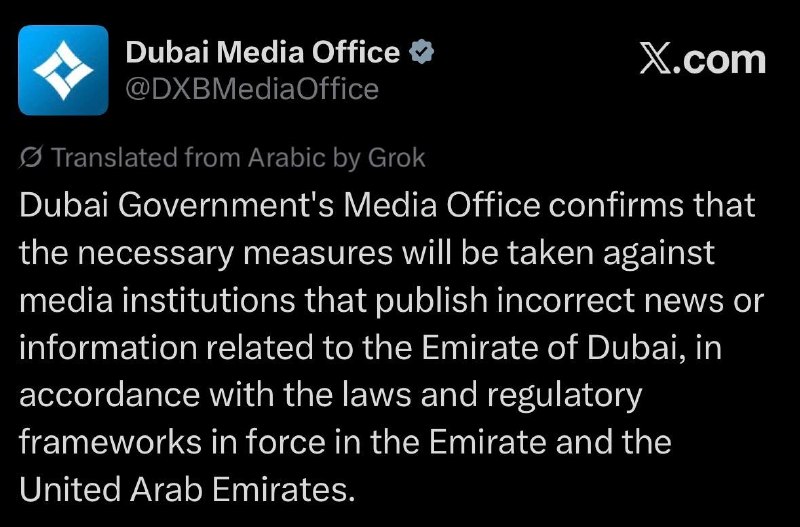
At 18:47 UTC on 16 July 2026, a wire bulletin moved across terminals from Beirut to London: explosions reported in Dubai, cause unknown. Thirty minutes later, the Dubai Media Office had publicly denied the account, saying the necessary measures were being taken and that no blasts had been heard in the city centre. By 19:17 UTC, the cycle had been compressed into a single Telegram post carrying both halves of the contradiction, attribution included. The story of what actually happened in Dubai on Thursday evening is, as of this writing, thinner than the story of what happened to the reporting of it.
The episode is small. It is also revealing. A major wire pushed an unverified explosion report into the global information system; a Gulf state media office moved quickly to overwrite that report; aggregator channels copied both halves without adjudicating between them; and the international audience was left holding a contradiction it could not resolve. Each step in that chain is now a familiar feature of how breaking news from the Gulf travels, and each step contains a structural problem worth naming.
A wire, a denial, and a half-hour
The initial bulletin, attributed to Reuters by the Telegram channel Megatron and timestamped 18:47 UTC, gave almost no detail beyond the headline claim that blasts had been heard in Dubai and that the cause was unknown. Reuters' institutional standard, like every major wire's, is to attribute unconfirmed reports to their source rather than to assert them as fact, and the original alert appears to have followed that discipline. The Dubai Media Office, the official communication channel of the emirate's government, then moved with a speed that suggested the report had landed on someone's desk almost in real time. By 19:17 UTC, both halves of the loop were circulating together in channels including The Cradle, which posted the denial alongside the original Reuters-flagship item and made clear that the rebuttal had come from the emirate itself, not from an independent authority.
The asymmetry here is the point. Wires publish what they can confirm, attribute what they cannot, and update as the picture clarifies. State media offices in the Gulf, by long institutional habit, prefer denial as the default register for any event that has not been pre-coordinated with them. The result, in fast-moving situations, is that an attribution of uncertainty collides with a flat assertion of non-event, and the audience is left to triangulate between them with no shared evidentiary ground.
Why the Gulf's denial reflex is so fast
Dubai's communication apparatus is built for exactly this kind of moment. The Dubai Media Office operates as a single clearing-house for the emirate's official narrative, with pre-drafted holding lines for categories of incident that range from weather events to security incidents. A denial does not require the office to have investigated the claim, only to have decided that the claim is not to be the day's story. When the claim originates with a Western wire, the political cost of leaving it unchallenged for even an hour is high: regional tourism markets, property sentiment, and the broader investment narrative around the UAE are all sensitive to the perception of security incidents in the city centre.
This is not a critique of denial as such. Officials have a legitimate interest in correcting inaccurate reporting, and the UAE's record on factual corrections in routine matters is reasonable. The pattern that matters is the reflex itself: the speed at which the office moves from report to rebuttal tends to outrun the evidentiary process, which means that by the time any third party could in principle adjudicate, the denial is already the dominant frame in regional channels. Reuters' original caution, with its explicit "cause unknown," is the part that gets dropped in transmission.
What the channel layer does to both halves
The Telegram layer is where the loop becomes permanent. Channels like The Cradle and Megatron are built for speed rather than adjudication. They reproduce wire copy and official statements in parallel, often within the same message thread, with the visual formatting of urgency. The reader who arrives at 19:30 UTC sees two contradictory propositions side by side, each attached to a credible institutional source, and no editorial signal telling them which to weight more heavily. The news, in other words, is no longer the explosion or the non-explosion; the news is the contradiction itself.
There is a structural problem underneath this. Information ecosystems that prize speed over adjudication tend to reward the loudest first claim, then the loudest counter-claim, and then the algorithmic repetition of both. Gulf state media offices understand this dynamic well, which is one reason their denials are pre-staged rather than reactive. They are not playing the verification game on the wires' terms; they are playing the distribution game on the aggregators' terms, and on those terms a fast flat denial travels further than a careful hedged bulletin ever will.
What remains unresolved
The sources on the record at 19:17 UTC do not specify what Reuters' original report was based on, whether the wire subsequently amended or retracted the bulletin, or whether any independent eyewitness or video corroboration has emerged from central Dubai. They do not specify which agency or official within the Dubai Media Office issued the denial, nor whether the UAE's federal authorities added a separate statement. The original Reuters copy is itself only present in the thread in the form of third-party attributions, not as a directly cited wire report. A reader who wants to know what actually happened at ground level in Dubai on the evening of 16 July 2026 will, for now, have to wait for the wire's own updated bulletin, or for a regional outlet with on-the-ground staff to publish its own account.
That is the load-bearing point. The episode is not, on the evidence available, a story about an attack, a false alarm, or a cover-up. It is a story about the speed and asymmetry of the modern Gulf information environment, in which a wire's careful attribution of uncertainty is structurally outgunned by an official denial that needs no evidence to be issued. Until either Reuters updates the original report with confirmed detail or an independent on-the-ground account emerges, both halves of the loop will continue to circulate, and the most useful thing this publication can do is name the structure rather than pick a side.
Desk note: Monexus treated this as a media-and-information story first, a Gulf security story second. The available sources support the loop but not the underlying event, and the piece is built to make that distinction visible to the reader rather than paper over it.
Wire provenance
This editorial synthesis draws on the following public wire/social posts:
- https://t.me/megatron_ron
- https://t.me/thecradlemedia
- https://t.me/TheCradleMedia
- https://en.wikipedia.org/wiki/Dubai_Media_Office
- https://en.wikipedia.org/wiki/Reuters