Arundhati Roy on AI, the Beatles and the limits of the indie auteur
At the London Indian Film Festival, the Booker-winning author warned that generative AI is hollowing out the labour of filmmaking and named the Beatles as the unlikely emblem of that squeeze.
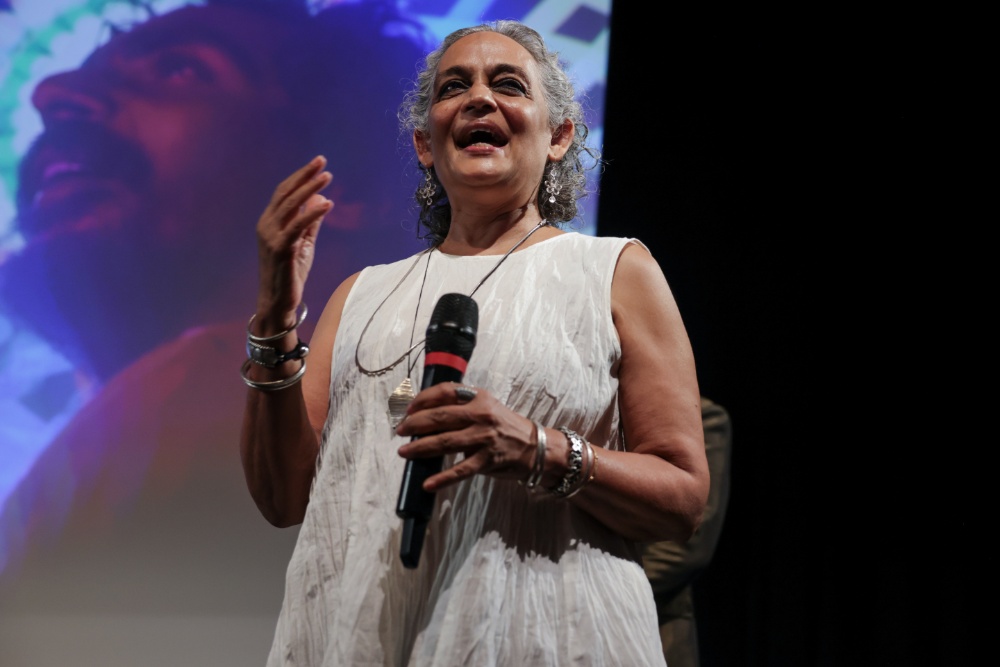
The Beatles got there first. Arundhati Roy told a London audience on 16 July 2026 that the unauthorised use of the band's songs in her 1989 television film "In Which Annie Gives It Those Ones" taught her, three decades before the current artificial-intelligence panic, that large rights-holders can appropriate, monetise or simply absorb a small filmmaker's work without consent and without consequence. The pattern, she suggested at the London Indian Film Festival, is now the operating logic of generative AI in cinema: a powerful platform extracts value from a vast pool of uncredited, under-compensated human labour and the original maker has no practical recourse. The comment lands at a moment when Indian and global filmmakers are openly debating what machine-generated imagery, voice cloning and synthetic performance mean for a craft built on long, unglamorous apprenticeship.
Roy's framing matters because it inverts the usual AI-in-cinema narrative. Western industry discourse has tended to fixate on copyright litigation, authors suing model trainers, performers suing voice-clone shops, Hollywood guilds bargaining over synthetic likenesses. The Indian writer and activist is pointing at something older and more structural: the asymmetric relationship between a platform that ingests everything and an individual creator who produces one thing. Whether the ingesting party is a record label in 1989 or a frontier-model lab in 2026, the geometry of the transaction is the same.
From "Annie" to the algorithm
The film's history is a tidy parable. "In Which Annie Gives It Those Ones" aired on Indian state television in 1989, with Shah Rukh Khan in an early screen role. Roy wrote the screenplay; the production was small; the budget for music was smaller still. According to Roy's remarks at the festival, as reported by Variety, the makers used Beatles recordings because the rights holders never asked and the producers could not have afforded clearance if they had. The show became a cult artefact of Indian television. The rights question, who owned the resulting work, and on what terms, was settled in the same way such questions usually are when one party has the lawyers and the other does not: by default, in favour of the larger party.
Three and a half decades later, the same imbalance is being built into the training pipelines of generative models. Indian cinema has particular reason to feel it: the country is one of the world's largest producers of film and television, with a deep archive of regional-language work, much of it under-documented in the metadata pipelines that Western model labs treat as free raw material. Roy's point is not that the law is unworkable; it is that the law, as currently configured, treats the output of a major studio and the output of a regional independent as equivalents to be ingested at the same rate, on the same terms, for the same downstream price.
What the indie auteur actually defends
Festival conversation about AI in cinema has a tendency to drift toward the spectacular, the de-aged actor, the resurrected voice, the synthetic extra. Roy's intervention is less photogenic and more useful. She is defending a particular kind of filmmaking labour: the long, collaborative, often under-paid apprenticeship through which an editor learns pace, a sound designer learns silence, a screenwriter learns the difference between a draft and a draft that survives a room. Generative tools can compress parts of that apprenticeship. They can also, if the economics go the usual way, simply delete the apprentice.
The Indian independent sector, where budgets are measured in lakhs rather than crores, is the most exposed. A studio system can absorb a synthetic-effects line item; a regional documentary unit cannot. If the price of moving imagery falls to the marginal cost of a prompt, the ceiling on what an independent production can earn falls with it. Roy is not arguing against the tools. She is arguing for a settlement in which the human labour absorbed by those tools is named, compensated and traceable.
The festival, briefly
The London Indian Film Festival, which hosted the conversation, has spent recent editions positioning itself as a venue for exactly this kind of crossover talk, literary figures, activists and screenwriters alongside the working directors. The audience at a festival screening is unusually well-placed to test the argument, because it is composed of people who have made films on small budgets and know what a clearance fight costs in time and morale. Roy's choice of the Beatles anecdote, rather than a more contemporary AI case, is itself a piece of framing: it tells the room that what is happening now has a precedent, and the precedent did not end well for the smaller party.
What remains contested
The unresolved question is whether the legal infrastructure around generative AI will look more like the 1989 Beatles arrangement or like something genuinely new. Indian courts have so far been cautious about extending copyright doctrine to model outputs; the Indian government's approach to AI regulation has emphasised innovation over restriction, and major industry bodies have largely accepted training-on-archive as a fait accompli. Roy's argument is that acceptance is itself the outcome of the asymmetry she is describing, not a neutral position above it. Whether Indian filmmakers, organised or otherwise, can extract a different settlement than Indian television writers did in 1989 is the open question the festival left on the table.
How Monexus framed this vs the wire: Variety carried the festival appearance as a celebrity profile; Monexus read the same remarks as a structural argument about platform labour and treated the Beatles anecdote as a precedent rather than a colour piece.