Argentina's Malvinas banner turns a World Cup semi-final into a sovereignty test for FIFA
Argentina's players unfurled a 'Las Malvinas son Argentinas' banner after edging England, and London wants FIFA to act. The football now meets a forty-year dispute the sport was never built to settle.
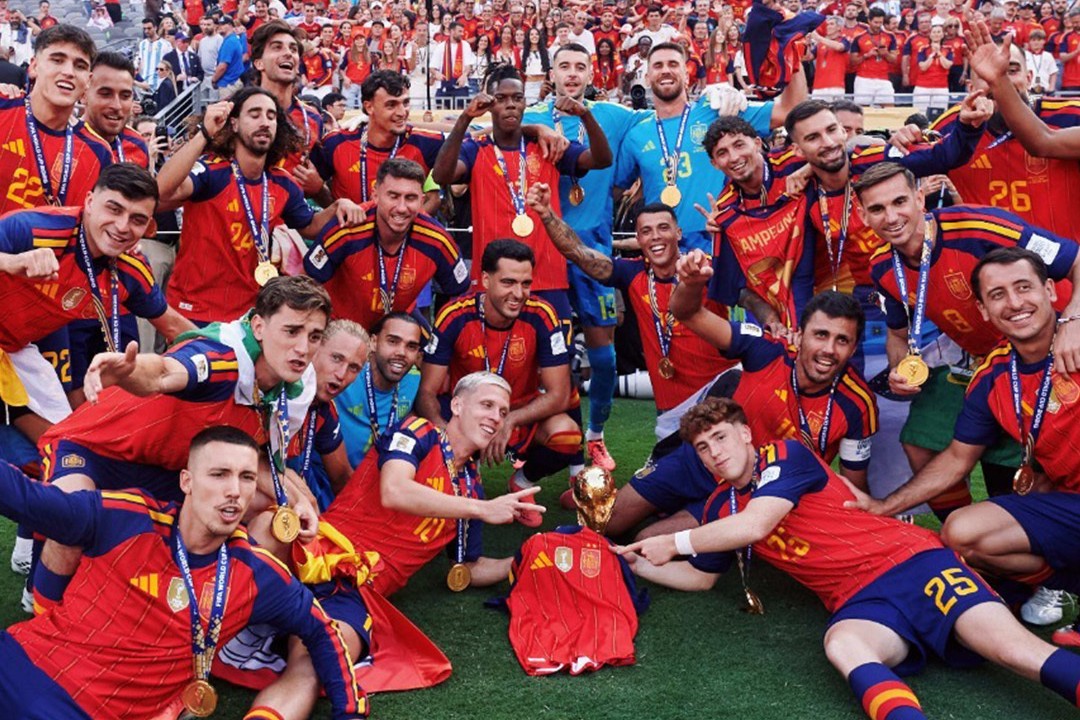
At full-time in the World Cup semi-final on 15 July 2026, Argentina's players did not celebrate only a 2-1 win over England. They lifted a banner that read "The Malvinas (Falkland Islands) are Argentine," and in doing so pulled one of the world's loudest sporting moments into a sovereignty argument that has outlasted governments on both sides of the Atlantic. Within hours, the United Kingdom had called for FIFA to open an investigation into the display, and the world's football federation was weighing whether a football pitch could, once again, be treated as a stage for a territorial claim.
The Argentine squad's gesture, made immediately after the final whistle in front of the cameras, was the trigger; the political freight came with it. The Malvinas banner does not read as improvisation. It sits inside a continuous Argentine state position on the South Atlantic archipelago that Buenos Aires has maintained since 1833, the year British forces reasserted control over the islands. Every Argentine government since the return of democracy in 1983 has reaffirmed that position in international forums, from the UN Decolonisation Committee to the yearly UN C24 text on the question. On a football pitch, the claim travels with the team.
What FIFA actually decides, and how fast, will determine whether this banner ends as a fine, a warning, or a precedent. FIFA's disciplinary rules prohibit political messaging on the field of play, and the federation has shown it is willing to act on that line. The UK's intervention is notable because it does not contest Argentina's right to express the claim as a country; it contests the venue. London wants the regulator, not the players, to draw the line. That is a narrower ask than it sounds, and it puts FIFA in the middle of a sovereignty fight it cannot resolve but can choose to host or to discipline.
A banner the players did not improvise
The display was visible, televised and unmistakable. According to wire reporting on 15-16 July, Argentina's squad paraded the banner at the end of the semi-final, with English-language coverage framing the message as a political act at a sporting event and Spanish-language coverage framing it as a routine reaffirmation of a national position. The split in framing is itself part of the story. The phrase "Las Malvinas son Argentinas" is a slogan only if you read it as protest; it is a constitutional instruction if you read it as Argentine state policy. Argentina's 1994 reformed constitution includes a transitional provision that obliges the country to recover the islands "by diplomatic means" and to honour those who fought there. The banner, in other words, is the constitutional position held up to a camera.
For the United Kingdom, the same sentence is non-negotiable in the opposite direction. British sovereignty over the Falkland Islands is administered through a locally elected government in Stanley, with a UK-appointed governor and a British military garrison. There is no diplomatic ambiguity in Whitehall's position. The UK's request to FIFA is a procedural way of expressing that there are venues where the dispute should not be expressed; football, in the British view, is one of them. Argentina's view is that no venue is off limits for a position the constitution requires the state to maintain.
A federation caught between rule and ritual
FIFA's statutes and disciplinary code are written for the narrow purpose of keeping politics out of the match itself: no shirts, no banners, no armbands, no on-pitch speech at moments the cameras are guaranteed to capture. The federation has used that authority in recent memory against players and federations that wore or displayed messages during matches. It is the same authority being invoked now, and the same authority that will be tested by whether this case is treated as routine enforcement or as exceptional politics.
The risk for FIFA is asymmetry. If it opens a formal case and sanctions Argentina, it will be cast, fairly or not, as a federation doing London's bidding in a sovereignty fight. If it closes the file or treats the incident as a warning only, it will be cast as a federation willing to relax its own rules when the message travels in a direction that one of its most powerful member associations refuses to police. The federation's institutional instinct is to treat these moments as quickly and quietly as possible. The political weight of this one will make that hard.
Sovereignty as a recurring cameo
The Malvinas question has surfaced at sporting events in Argentina for decades, and not only at football. Argentine athletes in rugby, hockey and Olympic disciplines have used international competition as a stage for the same message. The pattern is consistent enough that it is fair to describe it as a feature of Argentine sporting diplomacy rather than an incident. For Buenos Aires, the logic is straightforward: every international appearance is an opportunity to put the claim in front of an audience that no bilateral note will reach.
For the United Kingdom, the pattern is exactly why it reaches for a regulator. London cannot control the message, but it can try to control the venue, and it can use the existence of a regulator to shift the cost of the message from a bilateral conversation into a procedural one. Whether that produces a sanction or a shrug will tell the world a great deal about how FIFA's political-message rule is enforced in cases where one of the disputants is a permanent member of the UN Security Council and the other is a regional power with a constitutional duty to repeat the claim.
What is still being decided
Two questions are open at the time of writing. The first is procedural: whether FIFA's disciplinary arm opens a case, what it charges, and on what timetable. The second is political: whether the UK escalates beyond a request for an investigation, for instance by joining the diplomatic correspondence Argentina routinely files at the UN, or whether the matter is left to the federation to manage. The sources available in the public record do not specify the disciplinary timetable or the contents of any UK note beyond the call for an investigation, so any reading of how FIFA will resolve the file is, at this stage, an inference from precedent rather than a statement of fact.
What can be said with confidence is that this incident will not be the last of its kind. As long as the dispute is unresolved, Argentine teams will treat major international competitions as occasions to repeat the claim, and the UK will treat each repetition as an occasion to seek redress. The only durable change will come from the diplomatic process the Argentine constitution invokes, not from a FIFA ruling. A disciplinary verdict, when it comes, will tell us who FIFA is willing to annoy. The banner, regardless, stays in the room.
Desk note: Monexus treats the banner as a constitutional expression of Argentine state policy, not as a protest slogan, and reports the UK call for an investigation as a procedural request to a regulator rather than a substantive re-litigation of the sovereignty claim.
Wire provenance
This editorial synthesis draws on the following public wire/social posts:
- https://t.me/s/euronews
- https://x.com/Polymarket/status/1947700000000000000
- https://x.com/unusual_whales/status/1947600000000000000