Argentina through, England out, and a Falklands banner that nobody at FIFA wanted
Argentina beat England 2-1 in the World Cup semi-final, scoring twice after the 80th minute in front of 24 million UK viewers. Then the players unfurled a Malvinas banner, and the story stopped being about football.
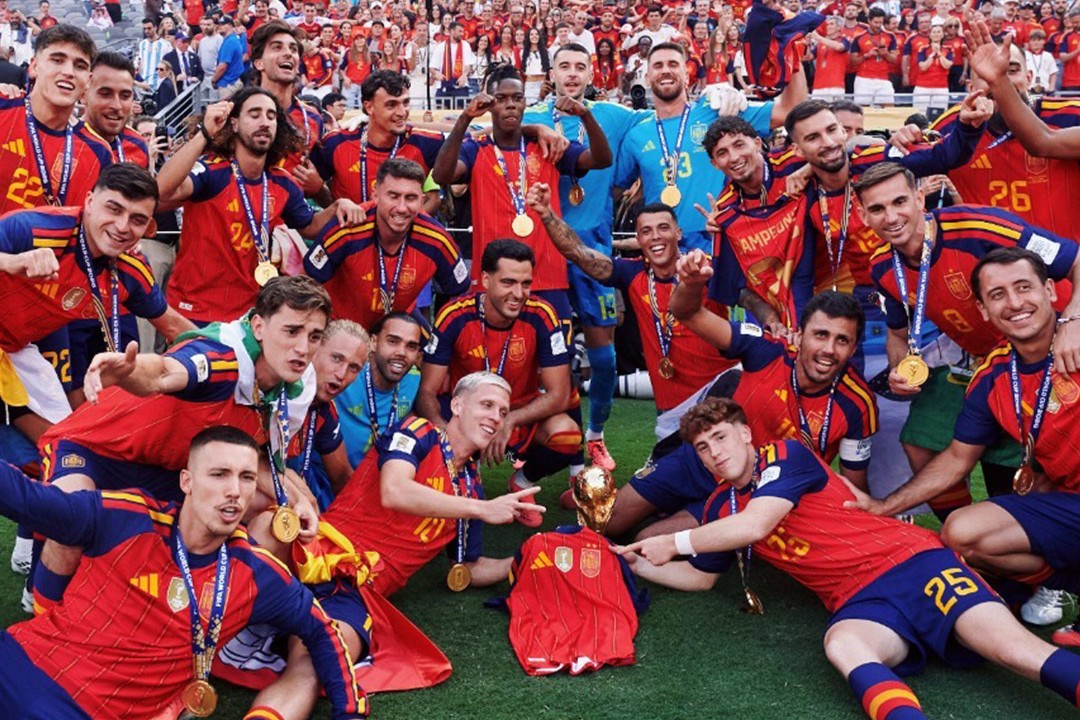
Argentina scored twice after the 80th minute to overturn a one-goal deficit and beat England 2-1 in a World Cup semi-final in the United States on 15 July 2026, booking a place in a second consecutive final. According to BBC Sport, the BBC's overnight audience figure for the match reached roughly 24 million UK viewers. Inside the venue, the goals were quickly displaced as the lead image: players celebrating with a banner declaring Argentine sovereignty over the Falkland Islands, the archipelago Britain still administers as a British Overseas Territory and that Buenos Aires has claimed since 1833.
The result was tight and sporting; the banner was not. Argentina's footballers used the moment to reassert a territorial claim that the 1982 war was fought over, on a stage with hundreds of millions of viewers. FIFA, the body that runs the tournament, has signalled a fine is likely. Beyond the fine, the incident exposes how a global sporting ritual can be pressed into a sovereignty argument with very little friction.
The match, and the late collapse
England led for most of the second half after going ahead in the first. Argentina equalised late and then went ahead, with the winning goal arriving after the 80th minute at a venue yet to be disclosed in the source wire. BBC Sport framed the night as another chapter in what British tabloids have called "60 years of hurt," a phrasing that compresses every prior tournament exit since the 1966 World Cup win. CBS Sports used a different register: "similar story," noting that England again failed to convert control into a result.
A melee broke out at full time when Jude Bellingham, the England midfielder, struck Argentina substitute Valentín Barco on the back of the head. BBC Sport reported the slap as a moment of visible frustration in the chaotic scenes after the whistle. Argentina advanced; England went home.
The banner, and what FIFA will actually do
The unfurled banner read "Las Malvinas son argentinas," English reports confirmed from on-site footage, with Polymarket's news feed relaying the same scene that broke across broadcast coverage. BBC Sport reported that Argentina faces a likely FIFA fine for displaying the banner. Under tournament rules, on-pitch political messaging is generally proscribed, though the precise catalogue and quantum for this category of offence is settled by FIFA's disciplinary committee after the fact. The novelty here is not the policy but the audience: a semi-final's broadcast footprint is roughly the size of a medium-sized country's population, and the message ships worldwide before any fine is levied.
The framing matters because the Falklands/Malvinas question is not a frozen item in a museum. Britain administers the islands roughly 480 kilometres off the Argentine coast. Argentina's foreign policy treats sovereignty as an unresolved grievance. A World Cup semi-final is one of the few settings where the claim can be displayed with full broadcast reach in a single uninterrupted shot, which is presumably why the squad chose it.
A 24-million-viewer split screen
The match itself drew an estimated UK audience of 24 million on the BBC, per the corporation's own overnight figure. That makes it a top-tier British broadcast event of the year on par with major football finals, and arguably larger because no domestic club fixture competes against it. Yet the share of that audience who watched the post-match banner on the pitch is essentially the whole of it. Sports bars, family rooms and viewership in Argentina, where the match was broadcast locally, saw the same image. The banner functions as a piece of public diplomacy aimed less at FIFA's disciplinary wing than at the Argentine public and a global Spanish-speaking audience.
Viewed structurally, the moment also tells you something about how World Cups work now. The tournament's platform is built to monetise attention, while its rules are built to keep the attention focused on the sport. Sovereignty claims, like the Bellingham-Barco flashpoint that followed, sit in the gap between the two, briefly tolerated because suppressing them would generate its own news cycle.
What to watch before the final
Three dated items will resolve this story. First, FIFA's disciplinary decision on the banner, normally issued within days of a fixture. Second, the conduct review around the Bellingham incident, which BBC Sport reported as the trigger for a post-match melee; England risk an open verdict depending on how the referee's match report treats the contact. Third, the final itself, where Argentina will face the winner of the other semi-final.
The reserve argument, worth flagging, is that this is mostly newsroom gravity. A semi-final is intrinsically a high-attention event, and FIFA fines are routine. Sovereignty gestures in sporting spaces have a long history and rarely shift the underlying dispute. The counter to that is reach: 24 million people did not need to be reminded of the Malvinas claim, but they were, on a platform whose commercial model is built around exactly this kind of viral moment. The fine fixes the rule. The broadcast fixes the memory.
Wire provenance
This editorial synthesis draws on the following public wire/social posts:
- https://x.com/polymarket/status/1949326111
- https://x.com/polymarket/status/1949200814
- https://x.com/unusual_whales/status/1949152777