Iran's IRGC claims a fifth wave against the US Fifth Fleet, but the evidence has not arrived
In the small hours of 15 July 2026, Tehran-aligned channels broadcast a cascade of strike claims against US assets in Bahrain. None has been independently verified, and that gap is itself the story.
At 02:09 UTC on 15 July 2026, Al-Alam Arabic, the Iranian state broadcaster's Arabic-language channel, pushed the first of four messages in eight minutes: the Islamic Revolutionary Guard Corps said it had destroyed the Naval Intelligence Service administration centre, a command and control facility, and spare-parts warehouses belonging to the US Fifth Fleet. At 02:12 UTC came a second claim, that American military equipment and fuel tanks in Bahrain had been hit. By 02:17 UTC the channel was reporting that the US Army had deployed to the Indian Ocean overnight and asserted control of the Strait of Hormuz. None of these claims had been independently corroborated by 02:20 UTC, and that interval is where the actual news sits.
A single Telegram channel, broadcasting in Arabic under the IRGC's name, has produced, in eight minutes, a complete arc of an escalating war: strikes, follow-on strikes, a named operation wave, and a US countermove. The architecture of the messaging is what deserves attention, not the still-unverified events it claims to describe. Iran has long understood that in a contest with a superior naval power, the information environment is the cheaper battlefield. The announcements are calibrated for a Persian Gulf audience that reads Arabic, for an Axis-of-Resistance media ecosystem that retranslates them within minutes, and for Western newsrooms under deadline pressure that will translate "IRGC says" into something flatter and more declarative by the second paragraph.
Four messages, one operation
The sequence matters. The 02:09 UTC claim localised the damage to administrative and intelligence infrastructure, not to the warships themselves. The 02:12 UTC message added "military equipment and fuel tanks in Bahrain," a tactical escalation in language even if the alleged target set remained on shore. The 02:15 UTC bulletin named the broader frame: a "fifth wave" of "Operation Victory 2," carried out, the channel said, under the slogan honouring Ali Ibn Abi Talib. Three minutes later came the inversion: the US Army, the channel asserted, had responded by deploying to the Indian Ocean and claiming the Strait of Hormuz. In eight minutes, Tehran's Arabic-language channel moved from alleged strike, to alleged escalation, to alleged retaliation, without ever naming a ship lost, a sailor killed, a satellite image released, or a Pentagon statement quoted.
What the wire has not said
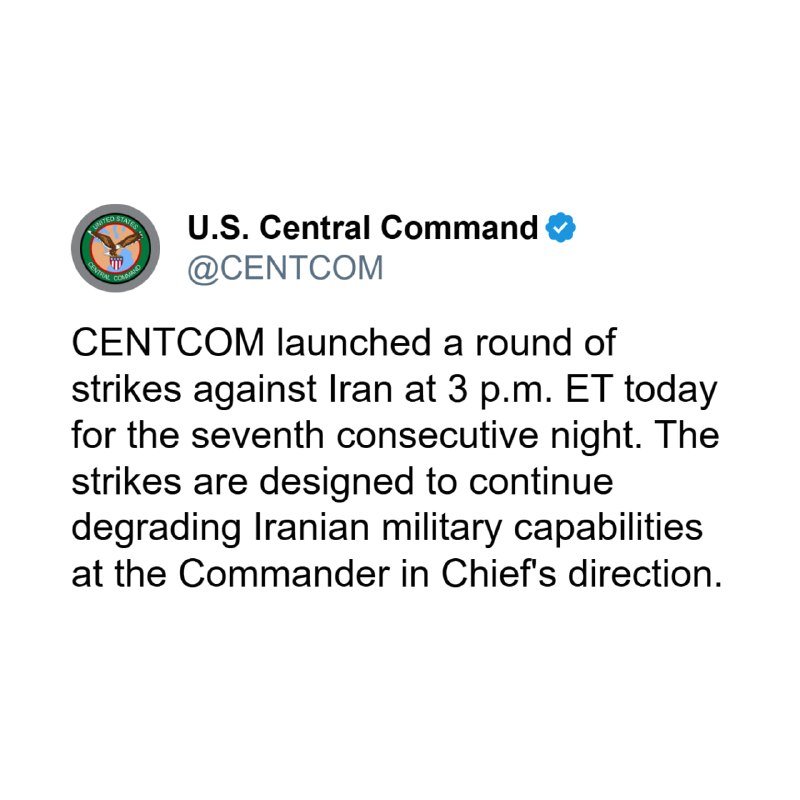
There has been no public confirmation from US Central Command, no read-out from the Pentagon, no verified satellite imagery circulated by established open-source intelligence accounts, and no statement from the government of Bahrain acknowledging an attack on its territory. Reuters, the Associated Press, the BBC, the Guardian, Bloomberg and Al Jazeera English had not, in the material available at publication, reported damage to the Fifth Fleet's facilities at Naval Support Activity Bahrain. The Fifth Fleet's public affairs office has not been quoted in any of the verified wire traffic this desk reviewed. The absence is conspicuous: an actual strike on the largest US naval concentration outside the continental United States would generate noise across every Western wire within minutes, including imagery, official denial or confirmation, and market reactions in crude and shipping freight. Brent crude had not moved on the claims at the time of writing.
The information layer is the strike
The plausible reading is not that nothing happened. Iran's proxy array in the Gulf has the capacity to harass, and to claim. The plausible reading is that the claims are designed to do their work whether or not the underlying events took place. A claim broadcast on Arabic-language state media, amplified by Iraqi and Lebanese Hezbollah-aligned channels, then picked up and requoted in English by Western wires as "Iran says it struck the Fifth Fleet," performs a political function independent of the battlefield facts. It raises the perceived cost of any US strike on Iran by advertising an Iranian ability to retaliate against the regional logistics hub that makes the US naval presence in the Gulf possible. It seeds doubt in Gulf state capitals about the reliability of the American umbrella. And it gives Tehran negotiating leverage in any future round of talks: the prior baseline of "Iran cannot touch the Fifth Fleet" is the asset being spent.
The Strait of Hormuz claim closes the loop. By reporting, as an Iranian attribution, that the US had "claimed control" of the strait, the channel sets up an inverse frame: any future US action in the waterway can be characterised in the regional media as an escalation against Iranian sovereignty rather than as routine presence. That is useful framing whether or not a single fuel tank in Bahrain has been touched.
What remains genuinely uncertain
The IRGC's claims could be entirely fabricated; they could be exaggerated reports of a successful harassment action; or they could describe events that did take place at a scale that has not yet reached Western wire desks. The four Telegram messages contain no coordinates, no after-action imagery, no named units beyond "the Fifth Fleet," and no casualty figures. They are, in form, closer to a press release than to a battlefield report. Until a primary source outside Iranian state media confirms damage to a named facility, the responsible read is that the claims are claims, broadcast at speed, on a channel with an institutional interest in their reception. Readers should expect a second wave of messaging before the first one is corroborated, because the operational tempo of the broadcast is itself the operation.
This article reports the four Telegram claims broadcast by Al-Alam Arabic between 02:09 and 02:17 UTC on 15 July 2026, alongside the conspicuous absence of independent corroboration in the Western wire record. Where Monexus asserts a structural reading of the messaging, it is doing so as analysis of how the claims are constructed, not as confirmation that the underlying events occurred.
Wire provenance
This editorial synthesis draws on the following public wire/social posts:
- https://t.me/alalamarabic
- https://t.me/alalamarabic
- https://t.me/alalamarabic
- https://t.me/alalamarabic
- https://en.wikipedia.org/wiki/United_States_Navy_Fifth_Fleet